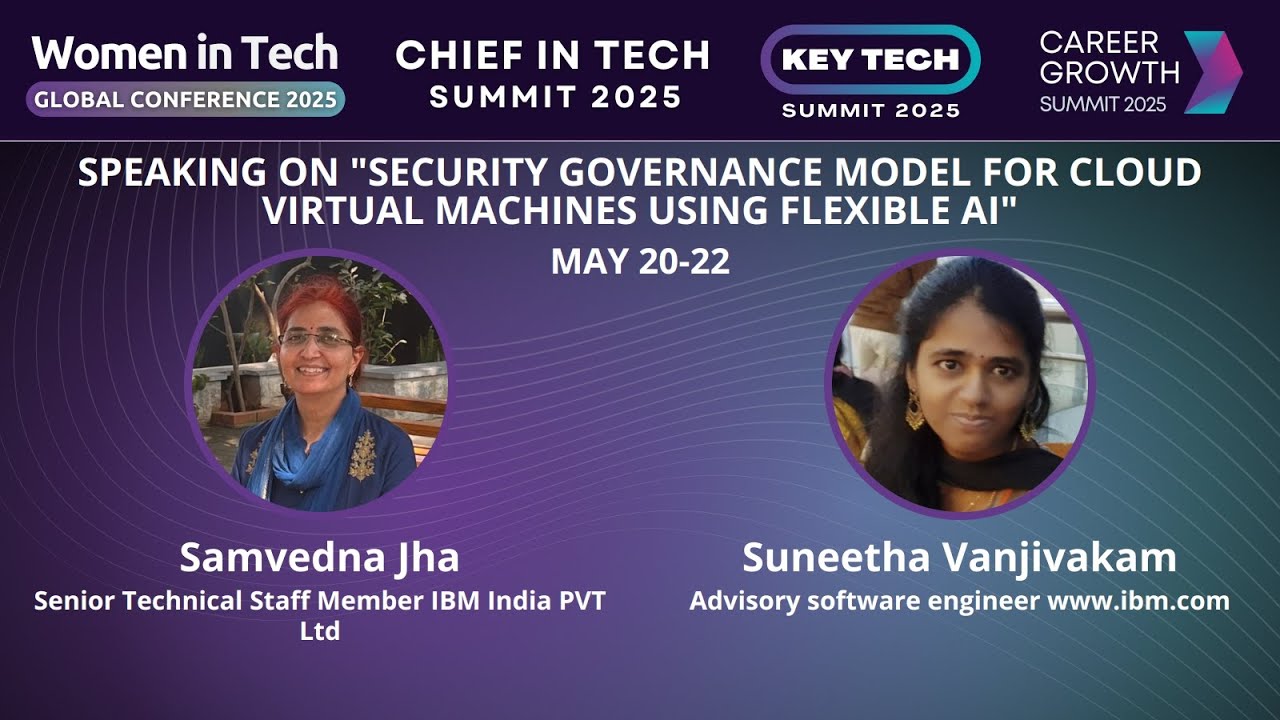
Security Governance model for Cloud virtual machines using flexible AI
Samvedna Jha19:212025
Securitatea bazată pe AI nu e gratuită, deci nu o mai rulați pe fiecare VM din cloud
Funcțiile de securitate bazate pe AI nu sunt gratuite, iar activarea lor pe o mașină virtuală care servește tutoriale publice nu justifică resursele consumate. Samvedna Jha, Security Architect pentru IBM Power, cu peste douăzeci de ani de experiență, susține că echipele de cloud pot reduce consumul de energie și costurile fără a slăbi izolarea sau conformitatea. Rămâne întrebarea: ce VM-uri merită protecție AI completă și cine decide când aceasta se dezactivează?
Descoperiți modelul pe trei niveluri care stabilește câtă securitate AI primește fiecare VM
Samvedna Jha și co-prezentatoarea Suneetha Vanjivakam de la IBM propun un model de guvernanță a securității pentru mașinile virtuale din cloud, în care protecția bazată pe AI este configurată pentru fiecare VM și activată doar când este nevoie. Ele susțin că împărțirea VM-urilor pe niveluri, după criticitatea sarcinilor de lucru, păstrează izolarea, asigură conformitatea și reduce consumul de energie și costurile unui AI mereu activ.
“Amintiți-vă mereu că niciuna dintre aceste funcții AI, toate așa-numitele funcții cool, nu vine gratuit.”
“Ar trebui să aveți un mecanism prin care, atunci când este necesar, îl activați. Iar când nu este necesar, îl dezactivați.”
What you will learn
Aplicați cei patru piloni (securitate, conformitate, managementul riscului și AI flexibil) în guvernanța VM-urilor din cloud.
Clasificați VM-urile în sarcini de lucru critice, medii și simple pentru a decide câtă securitate AI necesită fiecare.
Planificați activarea și dezactivarea la cerere a instrumentelor de securitate AI pentru a reduce costurile de energie și resurse.
Corelați cadre consacrate precum ISO 27001 și cadrul NIST cu guvernanța bazată pe AI.
Explicați cum configurarea per VM protejează izolarea datelor și menține securizată partajarea resurselor.
Details
Level
Intermediate
Format
Talk
Technical depth
Introductory technical
For
Mid-career, Senior individual contributor
Length
19:21
Published
July 2025
Questions this talk answers
Ce înseamnă AI flexibil pentru guvernanța securității VM-urilor din cloud?
Este un AI care preia informații despre tipul sarcinii de lucru și datele pe care le deține un VM, astfel încât este aplicat conform cerințelor proprii ale acelui VM, nu orbește. Ar trebui să detecteze amenințări fără intervenție umană, să se adapteze sarcinii de lucru și să susțină auto-vindecarea și politici per VM.
De ce instrumentele de securitate AI nu ar trebui să ruleze permanent pe fiecare VM?
Funcțiile AI nu sunt gratuite și consumă multe resurse, așa că rularea lor doar când este nevoie economisește energie și resurse în cloud. De exemplu, VM-urile care servesc informații publice nu justifică acest cost.
Cum ar trebui împărțite VM-urile pe niveluri pentru a decide câtă securitate AI le trebuie?
Sarcinile de lucru critice primesc securitate AI completă, cu atenuare imediată, cele medii (cele mai comune) primesc AI de bază, iar cele simple, precum tutorialele publice, necesită protecția hardware-ului de bază plus conformitate.
Cum protejează guvernanța per VM izolarea datelor și partajarea resurselor?
Configurarea modelului per VM protejează datele fiecărui VM, deoarece fiecare are propriile sarcini de lucru, și garantează că resursele partajate nu sunt folosite în detrimentul securității. Proprietarii VM-urilor pot decide dacă AI-ul este necesar, ocolit sau dezactivat pentru o perioadă.
Ce beneficii de business aduce guvernanța AI flexibilă?
Vorbitoarele menționează inovare mai rapidă și eficiență a costurilor, reziliență prin utilizarea optimă a resurselor și performanță, precum și supraveghere etică ce simplifică auditurile, reglementarea și raportarea amprentei de carbon.
Activați securitatea AI doar când este nevoie (74 s)
Trei niveluri de sarcini de lucru pentru VM-uri în cloud (83 s)
Audituri, etică și economii de carbon (71 s)
Good morning, good afternoon, everyone. Thank you for joining us today. So, you know, in the era where digital transformation is driving everything, every aspect of organization, our products. So, security is no longer, it's like an IT concern, right? It is, it's not something which is a tick mark anymore. It is a business imperative. And in that, whether you like, whether we like it, whether we like it, whether we like it.
or not, security governance is the framework that ensures that all the requirements we are meeting, we are, we have all these strategies in place. We have a way to handle the risk and things like that. So today we are going to explore the security governance model for the cloud virtual machines and why it is so important to empower it at this stage itself when AI is picking up in every, every area, how we can bring the innovation, how we can build trust.
across these digital subsystems and using which, which are going to use AI. So, with this, let us move to the next slide. So, you know, every presentation of security, we need to start with a kind of motivation, right? Because not only for, to handle the security aspect, but also to ensure that how are we handling the customer's requirement and making sure that everything is in place. So, the importance of security and governance for the VMs has, we have divided into four pillars, basically. The first one is the security, just to ensure that the data is protected, the sensitive data, irrespective of the nature of its nature, client customer data, they are all protected.
We are also meeting the compliance requirement, which is the second pillar. We are reducing the cyber security risk, which is the third pillar as part of risk management. And finally, we are bringing in flexible AI here. And the idea about this flexible AI to bring from cloud security is to have threat detection to ensure without human intervention, to have it like a very clear, fair detection.
So, it also should have to adapt to security based on the VM load it is having, based on the final workload which is running on that VM. And then the third point that we want to bring is that these VMs, when they get into a trouble and shoot mode, how to have them as a self-healing system, so that they not only, you know, go down, they also have ability to come up, come back up.
And then finally, we should have security policies per VM, where based on the type of the workload it is running, how to ensure that the policy actually is flexible enough for them to get into those, you know, to utilize those flexible AI. So, just to give a little overview for what flexible AI we are using here is, it actually is trying to bring the kind of input from the workload type it is running, the type of data it has, and based on that, the various decisions are made to ensure that this AI is not applied blindly, but based on the personalized requirements of that VM.
So, that is the main flexibility which is coming up here. With this, I will move to the next slide. Now, here, you know, we will be talking about the governance model that itself that we are talking about here, right. So, you must be aware of some of the well-known, widely adopted governance models we already have in industry.
For example, ISO 27001. And what is its purpose? Its purpose is to provide a systematic approach to manage sensitive information, to ensure it remains secure at all environments. There are physical controls which it handles. There are, you know, it is logical controls when it is about data center, but it has to enhance to ensure that it handles all the AI requirements also.
And that's, and when we are talking about the flexible AI for that matter. The next one, I would like to cite example is NIST framework itself. So, NIST actually will provide is a very well-known, widely accepted framework, every product, mostly all products meet all the NIST requirements. And their also approach is to manage the cybersecurity risk. And, you know, it has provided various guidelines to handle various type of, you know, the main pillars, for example, integrity.
You have identify, protect, detect, respond, and recover the system. So, based on this example, what we are proposing here in our session today is about this model powered by the flexible AI, specifically targeting the virtualization platform, where in each server itself, each resource itself, you are trying to virtualize it to achieve, to run multiple virtual machines on the same hardware resource, right?
So, what we actually propose here is to have enabled disablement of AI. You need not have AI for all this. You should have a mechanism by which, when it is required, you enable it. And when it is not required, you disable it. So, you know, that type of governance model should be in place. Then, next point is about decide that each VM, basically, you know, when it requires, AI needs a security governance model or not.
For example, in any public data, which is like a very publicly available information, you don't want to spend your resources and tools to basically apply AI there, or basically to apply any governance model. You can actually utilize that resource to do something which is like more critical with respect to the mission or the workload that VM is running.
And then, final point is about, you don't have to use this AI all the time. When it is needed, use it. It also helps you to save energy and resources in the cloud itself. Always remember that none of these AI features, all the so-called cool features, they do not come for free. They actually are very much resource-eating, you know, applications and tools.
And my friend Sunita will actually talk about it more detail in next slides. But these all are very much important and why we need to have it a mechanism to not use it all the time when not needed specifically. So, we have divided, you know, our VMs at a very high level in three categories basically. The VMs which are running the mission critical workload, where we would like to have AI to handle the end-to-end security completely.
Where in case of attack, any security incident, you not only are informed about it, but also there is a mitigation which is applied immediately. And I can cite one example, where in an insider attack, if they are trying to do some malicious activity for your VM to get destroyed or misbehaved, there should be an AI mechanism that triggers and it gives you the complete security so that it stops the harm or the damage at a level which you can recover back.
The next one we would want to highlight is about the medium workload. This is the most commonly, you know, workload which is deployed in our organizations. And then we don't, we have, we need to have basic AI, right? We need not have like a very advanced or complicated, which is like resource exhaustive AI mechanism or things that we need to deploy here.
And then the finally, which is a very simple workflow. Where in you don't, they can be as simple as a tutorials, which do not need any kind of fees or any kind of, you know, membership to access it. If these are like the publicly available information, which any user can get it. Just that you need to protect your underlying hardware and resource.
You need to have a security compliance in place. And for that, we need to have a governance model. So with this, let me move to the next slide. And I will request Sunita to, you know, share some of the insights about it. Yeah. Thank you, Samwedna. So hi, hi all. This is Sunita Advisory Software Engineer working with IBM India Systems Development Labs.
So continuing with what my SDSM Samwedna has conveyed in this session. Let me start with the significance why AI should be flexible for every cloud VM runtime. So when it comes to AI models, I think data is the core heart of the AI models. Only with the data, we can bring out more insights and more, you know, more purposeful decisions we can make with the data.
But when we collect the data, I mean, it should be very conscious and it should be flexible enough for VM rather than it should be configured. I mean, it is configured on a global scope level. So this session is more about what is that, you know, significance we can bring out when the AI is per VM. So the one such principles which can be protected properly or, you know, the core heart of security is the data isolation.
When it comes to VMs, VM data should be protected properly because each VM carries its respective workloads. So the data isolation principle can be properly governed when we keep this security governance model per VM. And another principle is the resource sharing principle. When it comes to cloud VMs, VMs share a lot of resources, but it should not be at the cost of security.
The security governance model, when it is configured per VM, resource sharing will be on purpose and it will be on purpose. And when we bring the VM owner into the picture here, VM owner is given a liberty to decide whether AI is really needed or AI should be on pass or AI can be disabled for a timeframe, depending on the workload that is running on the cloud.
So the, the, the, the overall purpose of this here is we should be made, we should use AI, we should bring out interesting insights from AI. We should you, we should, we should, we should, we should bring out every value. We can give it to our end customers from our applications, but AI should be flexible enough to save our power consumption and energy costs.
So that is a more, uh, uh, significance, uh, that can be brought out when the AI is flexible, when it is configured per VM. So we will see what, what can be the expected outcomes, particularly when it is really flexible. So here, here is a small glimpse of the data. We can see what we can see from international data corporation.
So the report, uh, the report, the report statistics, we can see here with every year by year, how the over consumption and energy costs are rising and the surging demands for electricity. When, when we are, uh, when we are consuming AI, uh, without, without making it flexible or consciously being used for applications. So when it is really, uh, flexible, we can bring down this and make this more sustainable and, you know, uh, for, uh, future generations.
I think already large language models or small, large, small language models, which are already, uh, in the market by all the market leaders in the, uh, you know, AI, they are making their way to save our energy and power consumption. Making it, making them agent AI, uh, which is, uh, making them, you know, small, small agents, which is going to bring down the data center costs.
Because when, when the agents are really working on, uh, working on small, small purposes, there is no, there is no need for more power or more energy you can use at a global level, uh, you know, for the whole product. So when it comes to agents, it is, it, it can be even at a granular level of VM and it, it can be more granular level of, even for that VM also for a particular purpose, the AI can be used.
So, um, uh, that is the more, uh, expected outcome of this, uh, um, of this more flexible AI that can be brought out here. And, um, uh, this is the evidence we can, uh, we can see here from the, uh, power consumption and energy data. Um, somewhere now, can we go to conclusion? Yeah. So, um, here we conclude, um, we know AI is gaining a lot of momentum, but AI should be more flexible enough and more conscious enough, you know, uh, not to, uh, to bring a lot, uh, not to just solve the problems, uh, but it should not break any virtualization boundaries.
We build in our cloud VM products and the security governance model we bring on, uh, our, uh, AI, the, the security governance models, which is powered by AI, which is, uh, you know, uh, which is per VM. It should be more flexible enough to, uh, configure or de-configure at any moment or not to enforce on, uh, overall VMs and the outcome.
We, we will evaluate periodically, uh, so that, you know, it should, it should not be always running, uh, you know, saving our data center costs and energy costs. So the, the, that's, uh, uh, that's the conclusion of this, uh, session. So Samvedna, go to your back. Okay. So thanks. Thanks, Sunita. I think, uh, you know, the, the, the main important thing that, you know, as Sunita highlighted and as a, as a whole, we would like to highlight here is why to bring this flexible, you know, AI solution, uh, in case of this, you know, cloud VM security governance.
And, uh, because the, the well-known facts are, you know, for example, I can consider a few of the items, uh, as a, you know, talking point, it gives you faster innovation. Very, when Sunita highlighted, right. Why you need to have this AI tools run all the time when it is consuming so much of energy and power of your, uh, you know, VMs, you are paying for it, right.
At the end of the day. So, uh, it, it's not so important. You, whenever it is required, whenever deployment requires, enable it. And also there are some work, some VMs are only doing the experimentation or, you know, deployment before moving to market. So for such things also, it, it is so important that, you know, these, these will actually give us a very cost efficient solution.
The next one we can talk about with respect to the resilience. It is like, you know, when you have this type of model, where on need basis, we are having some governance model for these AI to be used. It gives you, it maintains the performance of these environments very, very, uh, you know, at the optimal level, because here you are utilizing the resources at the, at the hundred percent.
It is not that you are, there is a waste or anything which, you know, which, which can be found on. And last, last important thing is about the ethical oversight. So what happens is, uh, many times you must have been involved as a security analyst or security investigator in the forensic of any malicious activity done on the VMs.
Now, when you have such a requirement, these flexible, flexible implementation actually gives you very easy for audit, you know, meet the regulation requirement and also adjust the, you know, the requirements as per your organization's values. So lot of our, you know, not only for the security, but in general, carbon footprint requirement has become one of the important aspect, right?
Lot of, lot of companies are trying to achieve that. Now, this will be one of the small step to take forward, to have it run when needed. And you, you can always calculate it back and show this much carbon footprint has been saved. So, you know, such, for such thing, it can be helpful. Now, let me cite you with couple of examples where actually this flexible AI is showing really good output.
So first one, I would like to cite IBM Watson help. So, these AI is, as it may suggest, right, it is related to some healthcare industry. So, these AI subsystem actually, it adopts to the new medical research and the patient data. So, it's not that, you know, it is, this AI is not just like based on this, any hypothetical theory.
It actually goes with the history data. It adapts to it for the next time. So, it is also learning, like a human doctor. They are also learning, right? They, when we go to any doctor, they ask us for a lot of history and then only they come out, you know, about the present situation, right? So, in the same way, it has to learn.
So, this, this, it is adopting flexible AI in a different way. So, if I go to another cloud platform, for example, you know, Azure ML, which is one of the cloud platform available. So, they are using these deployment of custom models, which is learned from the previous, you know, trained data that you have supplied. So, it's not like a blank foundational model is available to you on which you can run your ML or any algorithm or any tool or, you know, derive anything out of it.
So, people are seeing a lot of advantages for this flexible AI. And just, it is such a high time that instead of reacting, it is so important to have things and all of us here will appreciate because of our, you know, work background that insecurity, why it is so important to bring such principle now itself, so that these governance models are helping us in many, many different, you know, forums.
So, you know, not only to meet security requirements, but also to ensure that we do not bring additional burden because more and more, we are moving to cloud and you know that in cloud, you have a VM, which is like a shared resource. So, how it, it can meet all the underlying principle of virtualization. And at the same time, you, you get, you know, platform which is scalable, which is reusable.
And most importantly, it is secure for, you know, peace of, peace for us and for the, you know, organization. So, I hope you found the, you know, details useful. We will be very happy to, you know, help or, you know, guide or, you know, talk, have continued discussion offline as well. We both are available on LinkedIn platform.
And, you know, thanks to Women in Technology Forum, which gave us this opportunity to come and share our, you know, session today. Thanks a lot. And thank you very much for all of your time and, you know, coming here for this session. Thank you.
Transcribed automatically; names checked against the speaker record. Select a time to jump there.
Article based on this talk
De ce securitatea AI pentru VM-urile din cloud ar trebui activată doar când este nevoie
Samvedna Jha și Suneetha Vanjivakam de la IBM propun un model de guvernanță per VM care împarte sarcinile de lucru pe niveluri, protejează izolarea și reduce costul energetic al unui AI mereu activ.
Pe scurt
Samvedna Jha, Senior Technical Staff Member la IBM, susține că securitatea bazată pe AI pentru mașinile virtuale din cloud nu ar trebui să ruleze implicit peste tot. Împreună cu co-prezentatoarea Suneetha Vanjivakam, ea propune un model de guvernanță în care AI este configurat per VM, adaptat criticității fiecărei sarcini de lucru și activat doar când este nevoie, astfel încât organizațiile își păstrează izolarea și conformitatea, reducând totodată consumul de energie și costurile unui AI mereu activ.
Idei principale
Un model de guvernanță a securității pentru produsele care plănuiesc să folosească AI
Avantajele utilizării unui AI flexibil
Utilizarea AI doar atunci când este nevoie
De ce guvernanța securității are nevoie de AI acum
Jha începe prin a plasa guvernanța în centrul transformării digitale. Securitatea nu mai este o simplă bifă sau o preocupare restrânsă a departamentului IT, spune ea: „Este un imperativ de business.” (0:00) Guvernanța este cadrul care asigură îndeplinirea cerințelor, existența strategiilor și gestionarea riscurilor, iar ea susține că trebuie consolidată acum, când AI se extinde în toate domeniile.
Modelul ei se sprijină pe patru piloni: protejarea datelor sensibile, indiferent de natura lor, îndeplinirea cerințelor de conformitate, reducerea riscului de securitate cibernetică și introducerea unui AI flexibil. AI-ul flexibil, așa cum îl descrie ea, detectează amenințări fără intervenție umană, adaptează securitatea la sarcina de lucru care rulează pe fiecare VM, ajută VM-urile să se recupereze ca sisteme cu auto-vindecare și susține politici de securitate stabilite per VM. Deoarece preia informații despre tipul sarcinii de lucru și datele pe care le deține un VM, urmează cerințele proprii ale acelui VM în loc să fie aplicat orbește.
Ea își fundamentează propunerea pe cadre deja cunoscute de practicieni. ISO 27001 oferă o abordare sistematică a gestionării informațiilor sensibile prin controale fizice și logice, iar cadrul NIST organizează riscul de securitate cibernetică în jurul funcțiilor de identificare, protecție, detectare, răspuns și recuperare. Ambele, sugerează ea, trebuie acum extinse pentru a acoperi cerințele AI.
Activarea AI doar când este nevoie
Esența propunerii este un mecanism de guvernanță pentru activarea și dezactivarea AI: „Ar trebui să aveți un mecanism prin care, atunci când este necesar, îl activați. Iar când nu este necesar, îl dezactivați.” (5:07) Fiecare VM ar trebui evaluat pentru a vedea dacă are cu adevărat nevoie de un model de guvernanță bazat pe AI. De exemplu, un VM care servește informații disponibile public nu justifică acest cost, iar resursele respective pot fi direcționate către sarcini de lucru mai critice, legate de misiune.
Jha este directă în privința importanței acestui aspect: „Amintiți-vă mereu că niciuna dintre aceste funcții AI, toate așa-numitele funcții cool, nu vine gratuit.” (5:57) Instrumentele AI consumă resurse semnificative, așa că utilizarea lor doar când este nevoie economisește energie și resurse în cloud.
Trei niveluri de sarcini de lucru pentru VM-uri
Pentru ca alegerea să fie practică, vorbitoarele împart VM-urile în trei categorii generale. Sarcinile de lucru critice primesc securitate AI completă, inclusiv răspuns automat: „În cazul unui atac, al oricărui incident de securitate, nu doar sunteți informat despre el, ci se aplică și o măsură de atenuare imediat.” (6:49) Exemplul dat de Jha este cel al unei persoane din interior care încearcă să distrugă sau să perturbe un VM, caz în care AI ar trebui să intervină și să limiteze daunele la un nivel din care organizația își poate reveni.
Sarcinile de lucru medii, pe care ea le descrie ca fiind cele mai comune în organizații, au nevoie de AI de bază, nu de mecanisme avansate, consumatoare de resurse. Sarcinile de lucru simple, precum tutorialele disponibile gratuit, au nevoie de puțin mai mult decât protecția hardware-ului și a resurselor de bază, cu conformitate de securitate și un model de guvernanță în continuare aplicate.
Izolare, resurse partajate și energie
Suneetha Vanjivakam conduce a doua parte a prezentării, explicând de ce AI ar trebui să fie flexibil pentru fiecare VM din cloud, în loc să fie configurat global. Guvernanța per VM, spune ea, protejează două principii fundamentale ale virtualizării. Primul este izolarea datelor, deoarece fiecare VM are propriile sarcini de lucru. Al doilea este partajarea resurselor: „Când vine vorba de VM-urile din cloud, acestea partajează multe resurse, dar nu ar trebui să fie în detrimentul securității.” (9:20) Proprietarul VM-ului are libertatea de a decide dacă AI este necesar, dacă trebuie ocolit sau dacă poate fi dezactivat pentru o perioadă.
Apoi abordează tema energiei, citând date International Data Corporation prezentate pe slide. Potrivit vorbitoarei, cifrele arată o creștere de la an la an a consumului de energie, a costurilor energetice și a cererii de electricitate atunci când AI este folosit fără a fi făcut flexibil. Modelele lingvistice mai mici și AI-ul agentic construit pentru scopuri restrânse, observă ea, reprezintă o modalitate prin care liderii pieței reduc consumul de energie al centrelor de date, iar astfel de agenți ar putea funcționa la nivelul unui singur VM sau chiar al unui singur scop din cadrul acestuia. Concluzia ei: guvernanța bazată pe AI ar trebui să fie ușor de configurat sau de eliminat, nu trebuie niciodată să încalce limitele virtualizării și ar trebui evaluată periodic, în loc să ruleze permanent.
Argumentele de business: cost, reziliență și supraveghere
Jha încheie cu beneficiile. AI-ul flexibil susține inovarea mai rapidă și eficiența costurilor, deoarece organizațiile plătesc pentru energia consumată de instrumentele mereu active, iar VM-urile folosite doar pentru experimentare sau implementare înainte de lansare au rareori nevoie de ele. Susține reziliența, menținând utilizarea eficientă a resurselor și performanța la un nivel optim. Susține și supravegherea etică: pentru analiștii care investighează activități malițioase pe VM-uri, o implementare flexibilă face auditurile și cerințele de reglementare mai ușor de îndeplinit și permite ca mecanismele de control să reflecte valorile organizației.
Sustenabilitatea completează argumentația. „Acum, acesta va fi unul dintre pașii mici de făcut înainte, să-l avem în funcțiune când este nevoie. Și puteți oricând să calculați retroactiv și să arătați câtă amprentă de carbon a fost economisită.” (16:02) Ea menționează IBM Watson Health, care se adaptează la noile cercetări medicale și date ale pacienților, și implementarea în Azure ML a modelelor personalizate antrenate pe datele furnizate, ca exemple de AI flexibil în practică, și îndeamnă echipele de securitate să adopte aceste principii acum, în loc să reacționeze mai târziu.
Urmăriți prezentarea
„Security Governance model for Cloud virtual machines using flexible AI”, de Samvedna Jha (19 minute): https://www.womentech.net/video/security-governance-model-cloud-virtual-machines-using-flexible-ai
Despre vorbitoare
Samvedna Jha este Senior Technical Staff Member la IBM India PVT Ltd, unde activează ca Security Architect pentru IBM Power în Bengaluru, cu responsabilitate tehnică la nivel mondial pentru cerințele de securitate și conformitate ale produselor Power. Are peste douăzeci de ani de experiență, deține un master în Computer Application și este autoare de bloguri, IBM Redbooks și dezvăluiri publicate.
Întrebări la care răspunde prezentarea
Ce înseamnă AI flexibil pentru guvernanța securității VM-urilor din cloud?
De ce instrumentele de securitate AI nu ar trebui să ruleze permanent pe fiecare VM?
Cum ar trebui împărțite VM-urile pe niveluri pentru a decide câtă securitate AI le trebuie?
Cum protejează guvernanța per VM izolarea datelor și partajarea resurselor?
Ce beneficii de business aduce guvernanța AI flexibilă?
Redactat cu AI pe baza transcrierii prezentării. Revizuirea editorială este în așteptare.