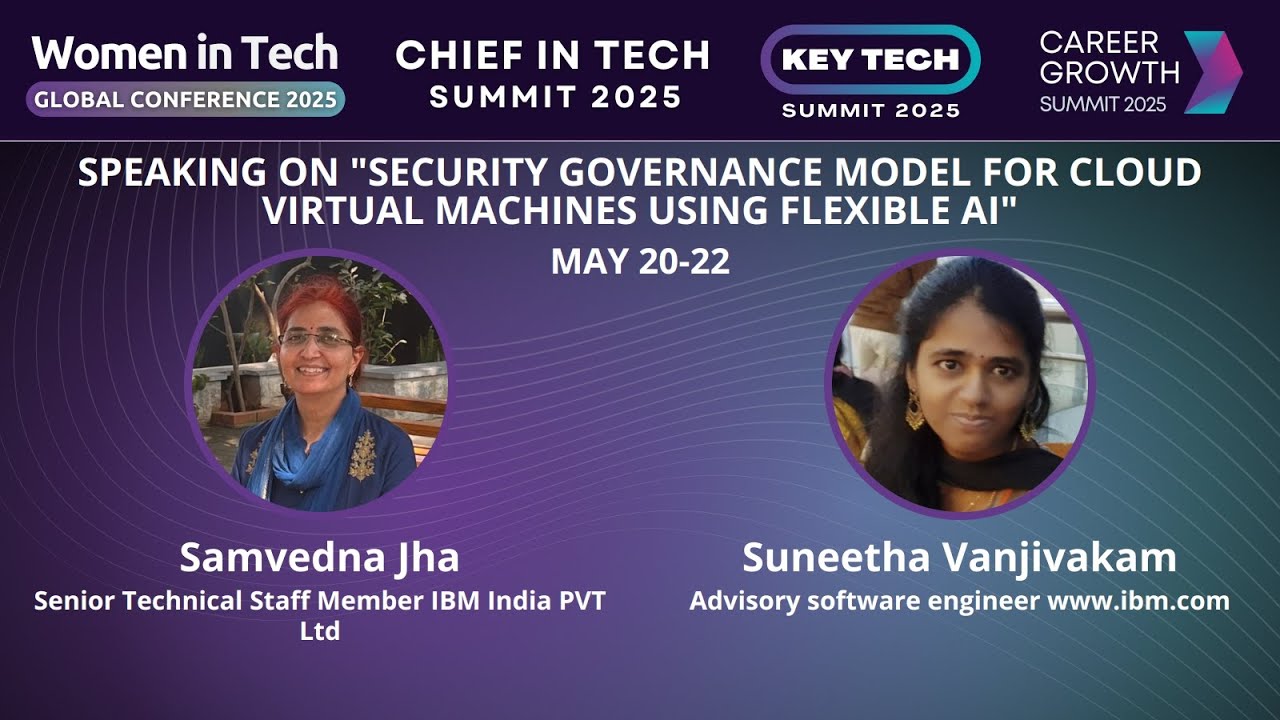
Security Governance model for Cloud virtual machines using flexible AI
Samvedna Jha19:212025
Segurança com IA não sai de graça, então pare de rodá-la em toda VM na nuvem
Os recursos de segurança com IA não saem de graça, e ativá-los em uma máquina virtual que serve tutoriais públicos não justifica o que consomem. Samvedna Jha, arquiteta de segurança do IBM Power com mais de vinte anos de experiência, defende que as equipes de nuvem podem reduzir energia e custos sem enfraquecer o isolamento ou a conformidade. A questão em aberto é quais VMs merecem proteção total com IA e quem decide quando ela é desligada.
Conheça o modelo de três níveis que define quanta segurança com IA cada VM recebe
Samvedna Jha e a copalestrante Suneetha Vanjivakam, da IBM, propõem um modelo de governança de segurança para máquinas virtuais na nuvem em que a proteção baseada em IA é configurada por VM e ativada apenas quando necessário. Elas defendem que classificar as VMs pela criticidade da carga de trabalho preserva o isolamento, atende à conformidade e reduz a energia e o custo de uma IA sempre ligada.
“Lembre-se sempre de que nenhum desses recursos de IA, todos esses recursos ditos legais, nenhum deles sai de graça.”
“Você deve ter um mecanismo pelo qual, quando for necessário, você o ativa. E quando não for necessário, você o desativa.”
What you will learn
Aplicar os quatro pilares de segurança, conformidade, gestão de riscos e IA flexível à governança de VMs na nuvem.
Classificar VMs em cargas de trabalho de missão crítica, médias e simples para decidir quanta segurança com IA cada uma precisa.
Planejar a ativação e desativação sob demanda de ferramentas de segurança com IA para reduzir custos de energia e recursos.
Relacionar frameworks consolidados, como a ISO 27001 e o framework do NIST, à governança com IA.
Explicar como a configuração por VM protege o isolamento de dados e mantém o compartilhamento de recursos seguro.
Details
Level
Intermediate
Format
Talk
Technical depth
Introductory technical
For
Mid-career, Senior individual contributor
Length
19:21
Published
July 2025
Questions this talk answers
O que significa IA flexível para a governança de segurança de VMs na nuvem?
É uma IA que recebe como entrada o tipo de carga de trabalho e os dados que uma VM contém, de modo que é aplicada conforme os requisitos próprios daquela VM, e não às cegas. Ela deve detectar ameaças sem intervenção humana, adaptar-se à carga de trabalho e oferecer suporte à autorrecuperação e a políticas por VM.
Por que as ferramentas de segurança com IA não devem rodar em todas as VMs o tempo todo?
Os recursos de IA não saem de graça e consomem muitos recursos, então executá-los apenas quando necessário economiza energia e recursos na nuvem. VMs que servem informações públicas, por exemplo, não justificam o custo.
Como classificar as VMs em níveis para decidir quanta segurança com IA elas precisam?
Cargas de missão crítica recebem segurança com IA de ponta a ponta e mitigação imediata, cargas médias (as mais comuns) recebem IA básica, e cargas simples, como tutoriais públicos, precisam de proteção do hardware subjacente e de conformidade.
Como a governança por VM protege o isolamento de dados e o compartilhamento de recursos?
Configurar o modelo por VM protege os dados de cada VM, pois cada uma executa suas próprias cargas de trabalho, e garante que os recursos compartilhados não sejam usados à custa da segurança. Os responsáveis pelas VMs podem decidir se a IA é necessária, ignorada ou desativada por um período.
Quais benefícios de negócio a governança com IA flexível traz?
As palestrantes citam inovação mais rápida e eficiência de custos, resiliência por meio do uso ideal de recursos e desempenho, e supervisão ética que facilita auditorias, regulamentação e relatórios de pegada de carbono.
Ative a segurança com IA só quando necessário (74 s)
Três níveis de cargas de trabalho de VMs na nuvem (83 s)
Auditorias, ética e redução de carbono (71 s)
Good morning, good afternoon, everyone. Thank you for joining us today. So, you know, in the era where digital transformation is driving everything, every aspect of organization, our products. So, security is no longer, it's like an IT concern, right? It is, it's not something which is a tick mark anymore. It is a business imperative. And in that, whether you like, whether we like it, whether we like it, whether we like it.
or not, security governance is the framework that ensures that all the requirements we are meeting, we are, we have all these strategies in place. We have a way to handle the risk and things like that. So today we are going to explore the security governance model for the cloud virtual machines and why it is so important to empower it at this stage itself when AI is picking up in every, every area, how we can bring the innovation, how we can build trust.
across these digital subsystems and using which, which are going to use AI. So, with this, let us move to the next slide. So, you know, every presentation of security, we need to start with a kind of motivation, right? Because not only for, to handle the security aspect, but also to ensure that how are we handling the customer's requirement and making sure that everything is in place. So, the importance of security and governance for the VMs has, we have divided into four pillars, basically. The first one is the security, just to ensure that the data is protected, the sensitive data, irrespective of the nature of its nature, client customer data, they are all protected.
We are also meeting the compliance requirement, which is the second pillar. We are reducing the cyber security risk, which is the third pillar as part of risk management. And finally, we are bringing in flexible AI here. And the idea about this flexible AI to bring from cloud security is to have threat detection to ensure without human intervention, to have it like a very clear, fair detection.
So, it also should have to adapt to security based on the VM load it is having, based on the final workload which is running on that VM. And then the third point that we want to bring is that these VMs, when they get into a trouble and shoot mode, how to have them as a self-healing system, so that they not only, you know, go down, they also have ability to come up, come back up.
And then finally, we should have security policies per VM, where based on the type of the workload it is running, how to ensure that the policy actually is flexible enough for them to get into those, you know, to utilize those flexible AI. So, just to give a little overview for what flexible AI we are using here is, it actually is trying to bring the kind of input from the workload type it is running, the type of data it has, and based on that, the various decisions are made to ensure that this AI is not applied blindly, but based on the personalized requirements of that VM.
So, that is the main flexibility which is coming up here. With this, I will move to the next slide. Now, here, you know, we will be talking about the governance model that itself that we are talking about here, right. So, you must be aware of some of the well-known, widely adopted governance models we already have in industry.
For example, ISO 27001. And what is its purpose? Its purpose is to provide a systematic approach to manage sensitive information, to ensure it remains secure at all environments. There are physical controls which it handles. There are, you know, it is logical controls when it is about data center, but it has to enhance to ensure that it handles all the AI requirements also.
And that's, and when we are talking about the flexible AI for that matter. The next one, I would like to cite example is NIST framework itself. So, NIST actually will provide is a very well-known, widely accepted framework, every product, mostly all products meet all the NIST requirements. And their also approach is to manage the cybersecurity risk. And, you know, it has provided various guidelines to handle various type of, you know, the main pillars, for example, integrity.
You have identify, protect, detect, respond, and recover the system. So, based on this example, what we are proposing here in our session today is about this model powered by the flexible AI, specifically targeting the virtualization platform, where in each server itself, each resource itself, you are trying to virtualize it to achieve, to run multiple virtual machines on the same hardware resource, right?
So, what we actually propose here is to have enabled disablement of AI. You need not have AI for all this. You should have a mechanism by which, when it is required, you enable it. And when it is not required, you disable it. So, you know, that type of governance model should be in place. Then, next point is about decide that each VM, basically, you know, when it requires, AI needs a security governance model or not.
For example, in any public data, which is like a very publicly available information, you don't want to spend your resources and tools to basically apply AI there, or basically to apply any governance model. You can actually utilize that resource to do something which is like more critical with respect to the mission or the workload that VM is running.
And then, final point is about, you don't have to use this AI all the time. When it is needed, use it. It also helps you to save energy and resources in the cloud itself. Always remember that none of these AI features, all the so-called cool features, they do not come for free. They actually are very much resource-eating, you know, applications and tools.
And my friend Sunita will actually talk about it more detail in next slides. But these all are very much important and why we need to have it a mechanism to not use it all the time when not needed specifically. So, we have divided, you know, our VMs at a very high level in three categories basically. The VMs which are running the mission critical workload, where we would like to have AI to handle the end-to-end security completely.
Where in case of attack, any security incident, you not only are informed about it, but also there is a mitigation which is applied immediately. And I can cite one example, where in an insider attack, if they are trying to do some malicious activity for your VM to get destroyed or misbehaved, there should be an AI mechanism that triggers and it gives you the complete security so that it stops the harm or the damage at a level which you can recover back.
The next one we would want to highlight is about the medium workload. This is the most commonly, you know, workload which is deployed in our organizations. And then we don't, we have, we need to have basic AI, right? We need not have like a very advanced or complicated, which is like resource exhaustive AI mechanism or things that we need to deploy here.
And then the finally, which is a very simple workflow. Where in you don't, they can be as simple as a tutorials, which do not need any kind of fees or any kind of, you know, membership to access it. If these are like the publicly available information, which any user can get it. Just that you need to protect your underlying hardware and resource.
You need to have a security compliance in place. And for that, we need to have a governance model. So with this, let me move to the next slide. And I will request Sunita to, you know, share some of the insights about it. Yeah. Thank you, Samwedna. So hi, hi all. This is Sunita Advisory Software Engineer working with IBM India Systems Development Labs.
So continuing with what my SDSM Samwedna has conveyed in this session. Let me start with the significance why AI should be flexible for every cloud VM runtime. So when it comes to AI models, I think data is the core heart of the AI models. Only with the data, we can bring out more insights and more, you know, more purposeful decisions we can make with the data.
But when we collect the data, I mean, it should be very conscious and it should be flexible enough for VM rather than it should be configured. I mean, it is configured on a global scope level. So this session is more about what is that, you know, significance we can bring out when the AI is per VM. So the one such principles which can be protected properly or, you know, the core heart of security is the data isolation.
When it comes to VMs, VM data should be protected properly because each VM carries its respective workloads. So the data isolation principle can be properly governed when we keep this security governance model per VM. And another principle is the resource sharing principle. When it comes to cloud VMs, VMs share a lot of resources, but it should not be at the cost of security.
The security governance model, when it is configured per VM, resource sharing will be on purpose and it will be on purpose. And when we bring the VM owner into the picture here, VM owner is given a liberty to decide whether AI is really needed or AI should be on pass or AI can be disabled for a timeframe, depending on the workload that is running on the cloud.
So the, the, the, the overall purpose of this here is we should be made, we should use AI, we should bring out interesting insights from AI. We should you, we should, we should, we should, we should bring out every value. We can give it to our end customers from our applications, but AI should be flexible enough to save our power consumption and energy costs.
So that is a more, uh, uh, significance, uh, that can be brought out when the AI is flexible, when it is configured per VM. So we will see what, what can be the expected outcomes, particularly when it is really flexible. So here, here is a small glimpse of the data. We can see what we can see from international data corporation.
So the report, uh, the report, the report statistics, we can see here with every year by year, how the over consumption and energy costs are rising and the surging demands for electricity. When, when we are, uh, when we are consuming AI, uh, without, without making it flexible or consciously being used for applications. So when it is really, uh, flexible, we can bring down this and make this more sustainable and, you know, uh, for, uh, future generations.
I think already large language models or small, large, small language models, which are already, uh, in the market by all the market leaders in the, uh, you know, AI, they are making their way to save our energy and power consumption. Making it, making them agent AI, uh, which is, uh, making them, you know, small, small agents, which is going to bring down the data center costs.
Because when, when the agents are really working on, uh, working on small, small purposes, there is no, there is no need for more power or more energy you can use at a global level, uh, you know, for the whole product. So when it comes to agents, it is, it, it can be even at a granular level of VM and it, it can be more granular level of, even for that VM also for a particular purpose, the AI can be used.
So, um, uh, that is the more, uh, expected outcome of this, uh, um, of this more flexible AI that can be brought out here. And, um, uh, this is the evidence we can, uh, we can see here from the, uh, power consumption and energy data. Um, somewhere now, can we go to conclusion? Yeah. So, um, here we conclude, um, we know AI is gaining a lot of momentum, but AI should be more flexible enough and more conscious enough, you know, uh, not to, uh, to bring a lot, uh, not to just solve the problems, uh, but it should not break any virtualization boundaries.
We build in our cloud VM products and the security governance model we bring on, uh, our, uh, AI, the, the security governance models, which is powered by AI, which is, uh, you know, uh, which is per VM. It should be more flexible enough to, uh, configure or de-configure at any moment or not to enforce on, uh, overall VMs and the outcome.
We, we will evaluate periodically, uh, so that, you know, it should, it should not be always running, uh, you know, saving our data center costs and energy costs. So the, the, that's, uh, uh, that's the conclusion of this, uh, session. So Samvedna, go to your back. Okay. So thanks. Thanks, Sunita. I think, uh, you know, the, the, the main important thing that, you know, as Sunita highlighted and as a, as a whole, we would like to highlight here is why to bring this flexible, you know, AI solution, uh, in case of this, you know, cloud VM security governance.
And, uh, because the, the well-known facts are, you know, for example, I can consider a few of the items, uh, as a, you know, talking point, it gives you faster innovation. Very, when Sunita highlighted, right. Why you need to have this AI tools run all the time when it is consuming so much of energy and power of your, uh, you know, VMs, you are paying for it, right.
At the end of the day. So, uh, it, it's not so important. You, whenever it is required, whenever deployment requires, enable it. And also there are some work, some VMs are only doing the experimentation or, you know, deployment before moving to market. So for such things also, it, it is so important that, you know, these, these will actually give us a very cost efficient solution.
The next one we can talk about with respect to the resilience. It is like, you know, when you have this type of model, where on need basis, we are having some governance model for these AI to be used. It gives you, it maintains the performance of these environments very, very, uh, you know, at the optimal level, because here you are utilizing the resources at the, at the hundred percent.
It is not that you are, there is a waste or anything which, you know, which, which can be found on. And last, last important thing is about the ethical oversight. So what happens is, uh, many times you must have been involved as a security analyst or security investigator in the forensic of any malicious activity done on the VMs.
Now, when you have such a requirement, these flexible, flexible implementation actually gives you very easy for audit, you know, meet the regulation requirement and also adjust the, you know, the requirements as per your organization's values. So lot of our, you know, not only for the security, but in general, carbon footprint requirement has become one of the important aspect, right?
Lot of, lot of companies are trying to achieve that. Now, this will be one of the small step to take forward, to have it run when needed. And you, you can always calculate it back and show this much carbon footprint has been saved. So, you know, such, for such thing, it can be helpful. Now, let me cite you with couple of examples where actually this flexible AI is showing really good output.
So first one, I would like to cite IBM Watson help. So, these AI is, as it may suggest, right, it is related to some healthcare industry. So, these AI subsystem actually, it adopts to the new medical research and the patient data. So, it's not that, you know, it is, this AI is not just like based on this, any hypothetical theory.
It actually goes with the history data. It adapts to it for the next time. So, it is also learning, like a human doctor. They are also learning, right? They, when we go to any doctor, they ask us for a lot of history and then only they come out, you know, about the present situation, right? So, in the same way, it has to learn.
So, this, this, it is adopting flexible AI in a different way. So, if I go to another cloud platform, for example, you know, Azure ML, which is one of the cloud platform available. So, they are using these deployment of custom models, which is learned from the previous, you know, trained data that you have supplied. So, it's not like a blank foundational model is available to you on which you can run your ML or any algorithm or any tool or, you know, derive anything out of it.
So, people are seeing a lot of advantages for this flexible AI. And just, it is such a high time that instead of reacting, it is so important to have things and all of us here will appreciate because of our, you know, work background that insecurity, why it is so important to bring such principle now itself, so that these governance models are helping us in many, many different, you know, forums.
So, you know, not only to meet security requirements, but also to ensure that we do not bring additional burden because more and more, we are moving to cloud and you know that in cloud, you have a VM, which is like a shared resource. So, how it, it can meet all the underlying principle of virtualization. And at the same time, you, you get, you know, platform which is scalable, which is reusable.
And most importantly, it is secure for, you know, peace of, peace for us and for the, you know, organization. So, I hope you found the, you know, details useful. We will be very happy to, you know, help or, you know, guide or, you know, talk, have continued discussion offline as well. We both are available on LinkedIn platform.
And, you know, thanks to Women in Technology Forum, which gave us this opportunity to come and share our, you know, session today. Thanks a lot. And thank you very much for all of your time and, you know, coming here for this session. Thank you.
Transcribed automatically; names checked against the speaker record. Select a time to jump there.
Article based on this talk
Por que a segurança com IA para VMs na nuvem deve ser ativada só quando necessário
Samvedna Jha e Suneetha Vanjivakam, da IBM, propõem um modelo de governança por VM que classifica cargas de trabalho, protege o isolamento e reduz o custo energético de uma IA sempre ligada.
Em resumo
Samvedna Jha, Senior Technical Staff Member da IBM, defende que a segurança com IA para máquinas virtuais na nuvem não deve rodar em todo lugar por padrão. Com a copalestrante Suneetha Vanjivakam, ela propõe um modelo de governança em que a IA é configurada por VM, ajustada à criticidade de cada carga de trabalho e ativada apenas quando necessário, para que as organizações mantenham o isolamento e a conformidade enquanto reduzem a energia e o custo de uma IA sempre ligada.
Principais aprendizados
Um modelo de governança de segurança para produtos que planejam usar IA
As vantagens de usar IA flexível
Usar IA apenas quando ela é necessária
Por que a governança de segurança precisa de IA agora
Jha começa colocando a governança no centro da transformação digital. A segurança não é mais um item de checklist nem uma preocupação restrita à TI, diz ela: "É um imperativo de negócio." (0:00) A governança é o framework que garante que os requisitos sejam atendidos, as estratégias estejam definidas e os riscos sejam tratados, e ela defende que precisa ser fortalecida agora, enquanto a IA se espalha por todas as áreas.
Seu modelo se apoia em quatro pilares: proteger dados sensíveis, seja qual for sua natureza, atender aos requisitos de conformidade, reduzir o risco de cibersegurança e incorporar IA flexível. A IA flexível, em sua descrição, detecta ameaças sem intervenção humana, adapta a segurança à carga de trabalho em execução em cada VM, ajuda as VMs a se recuperarem como sistemas autorrecuperáveis e oferece suporte a políticas de segurança definidas por VM. Como recebe como entrada o tipo de carga de trabalho e os dados que uma VM contém, ela segue os requisitos próprios daquela VM em vez de ser aplicada às cegas.
Ela fundamenta a proposta em frameworks que os profissionais já conhecem. A ISO 27001 oferece uma abordagem sistemática para gerenciar informações sensíveis por meio de controles físicos e lógicos, e o framework do NIST organiza o risco de cibersegurança em identificar, proteger, detectar, responder e recuperar. Ambos, sugere ela, agora precisam se estender para cobrir os requisitos de IA.
Ativar a IA apenas quando ela é necessária
O núcleo da proposta é um mecanismo de governança para ativar e desativar a IA: "Você deve ter um mecanismo pelo qual, quando for necessário, você o ativa. E quando não for necessário, você o desativa." (5:07) Cada VM deve ser avaliada quanto à real necessidade de um modelo de governança baseado em IA. Uma VM que serve informações publicamente disponíveis, por exemplo, não justifica o custo, e esses recursos podem ir para cargas de trabalho mais críticas, ligadas à missão.
Jha é direta sobre por que isso importa: "Lembre-se sempre de que nenhum desses recursos de IA, todos esses recursos ditos legais, nenhum deles sai de graça." (5:57) As ferramentas de IA consomem recursos significativos, então usá-las apenas quando necessário economiza energia e recursos na nuvem.
Três níveis de cargas de trabalho de VMs
Para tornar a escolha prática, as palestrantes dividem as VMs em três categorias de alto nível. Cargas de missão crítica recebem segurança com IA de ponta a ponta, incluindo resposta automática: "Em caso de ataque, de qualquer incidente de segurança, você não só é informado sobre ele, como também há uma mitigação aplicada imediatamente." (6:49) O exemplo de Jha é alguém de dentro tentando destruir ou interromper uma VM, situação em que a IA deve intervir e conter o dano em um nível do qual a organização consiga se recuperar.
Cargas médias, que ela descreve como as mais comuns nas organizações, precisam de IA básica, e não de mecanismos avançados e intensivos em recursos. Cargas simples, como tutoriais disponíveis gratuitamente, precisam de pouco mais do que a proteção do hardware e dos recursos subjacentes, mantendo a conformidade de segurança e um modelo de governança.
Isolamento, recursos compartilhados e energia
Suneetha Vanjivakam conduz a segunda parte da palestra, explicando por que a IA deve ser flexível para cada VM na nuvem, em vez de configurada globalmente. A governança por VM, diz ela, protege dois princípios centrais da virtualização. O primeiro é o isolamento de dados, pois cada VM executa suas próprias cargas de trabalho. O segundo é o compartilhamento de recursos: "Quando se trata de VMs na nuvem, as VMs compartilham muitos recursos, mas isso não deve ser à custa da segurança." (9:20) O responsável pela VM tem a liberdade de decidir se a IA é necessária, se deve ser ignorada ou se pode ser desativada por um período.
Em seguida, ela trata da energia, citando dados da International Data Corporation exibidos em seu slide. Segundo a palestrante, os números mostram crescimento ano a ano no consumo de energia, nos custos de energia e na demanda de eletricidade quando a IA é usada sem ser tornada flexível. Modelos de linguagem menores e IA agêntica criada para finalidades específicas, observa ela, são uma das formas pelas quais os líderes de mercado estão reduzindo o consumo de energia dos data centers, e esses agentes poderiam operar no nível de uma única VM ou até de uma única finalidade dentro dela. Sua conclusão: a governança com IA deve ser fácil de configurar ou remover, nunca deve romper os limites da virtualização e deve ser avaliada periodicamente em vez de rodar o tempo todo.
O caso de negócio: custo, resiliência e supervisão
Jha encerra com os benefícios. A IA flexível favorece inovação mais rápida e eficiência de custos, já que as organizações pagam pela energia que ferramentas sempre ligadas consomem, e VMs usadas apenas para experimentação ou implantação de pré-lançamento raramente precisam delas. Ela favorece a resiliência ao manter o uso de recursos eficiente e o desempenho em nível ideal. Também favorece a supervisão ética: para analistas que investigam atividades maliciosas em VMs, uma implementação flexível facilita o cumprimento de auditorias e requisitos regulatórios e permite que os controles reflitam os valores da organização.
A sustentabilidade completa o argumento. "Agora, este será um dos pequenos passos para avançar, fazer com que rode quando necessário. E você, você sempre pode calcular de volta e mostrar quanto de pegada de carbono foi economizado." (16:02) Ela cita o IBM Watson Health, que se adapta a novas pesquisas médicas e dados de pacientes, e a implantação de modelos personalizados treinados com dados fornecidos no Azure ML como exemplos de IA flexível em ação, e incentiva as equipes de segurança a adotarem esses princípios agora, em vez de reagir depois.
Assista à palestra
"Security Governance model for Cloud virtual machines using flexible AI", de Samvedna Jha (19 minutos): https://www.womentech.net/video/security-governance-model-cloud-virtual-machines-using-flexible-ai
Sobre a palestrante
Samvedna Jha é Senior Technical Staff Member na IBM India PVT Ltd, onde atua como arquiteta de segurança do IBM Power em Bengaluru, com responsabilidade técnica mundial pelos requisitos de segurança e conformidade dos produtos Power. Ela tem mais de vinte anos de experiência, é mestre em Aplicações de Computação e é autora de blogs, IBM Redbooks e divulgações publicadas.
Perguntas que esta palestra responde
O que significa IA flexível para a governança de segurança de VMs na nuvem?
Por que as ferramentas de segurança com IA não devem rodar em todas as VMs o tempo todo?
Como classificar as VMs em níveis para decidir quanta segurança com IA elas precisam?
Como a governança por VM protege o isolamento de dados e o compartilhamento de recursos?
Quais benefícios de negócio a governança com IA flexível traz?
Redigido com IA a partir da transcrição da palestra. Revisão editorial pendente.