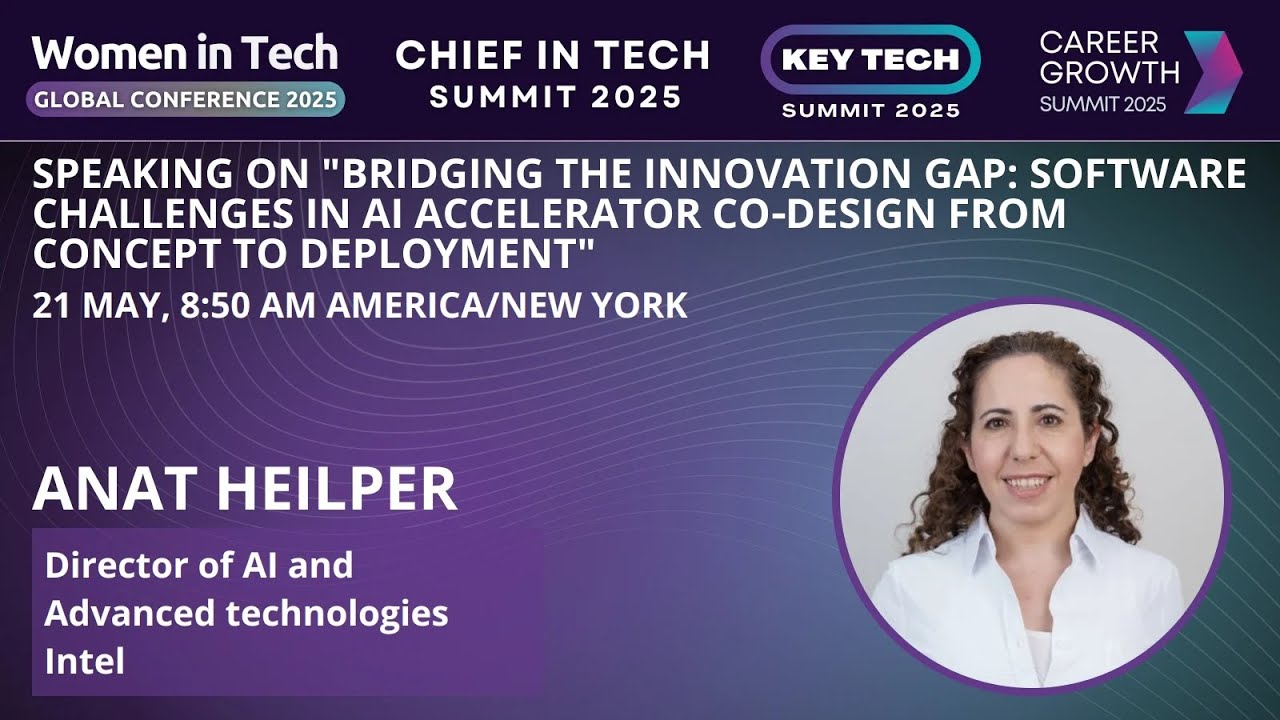
Bridging the Innovation Gap: Software Challenges in AI Accelerator Co-Design from Concept to Deployment
Anat Heilper22:022025
I chip di AI richiedono tre anni, i piani software cambiano in sei mesi
Realizzare un acceleratore di AI richiede almeno tre anni dall'ideazione al mercato, eppure i framework e i carichi di lavoro che dovrà eseguire possono cambiare in sei mesi, e un errore nella fase di concept può costringere a ricominciare l'intero processo. Anat Heilper, director in Intel con dieci anni di esperienza nell'architettura degli acceleratori di AI, sostiene che il chip è solo metà della storia. Come possono i team hardware e software progettare per un futuro che nessuno dei due riesce a vedere?
Scopra come il co-design hardware e software trasforma i chip di AI in prodotti che gli sviluppatori possono davvero usare
Anat Heilper, Director of AI and Advanced technologies di Intel, spiega perché gli acceleratori di AI esprimono il loro potenziale solo quando hardware e software vengono progettati insieme. Illustra le architetture degli acceleratori, il ruolo del software come ponte tra modelli e chip e le sfide di pianificare un hardware che richiede anni di sviluppo mentre framework e carichi di lavoro di AI cambiano nel giro di pochi mesi.
“Se il dispositivo non è facile da programmare, nessuno lo userebbe, anche se fosse il più efficiente e magari più economico da usare, perché non possiamo programmarlo e non riusciamo a farlo funzionare.”
“Nessuno di noi vorrebbe aspettare ChatGPT per tre minuti prima di ricevere una risposta. Quindi la latenza è una questione molto critica.”
What you will learn
Confrontare i compromessi tra flessibilità ed efficienza di CPU, GPU, FPGA e ASIC per i carichi di lavoro di AI.
Spiegare perché il software e la facilità di programmazione decidono se un acceleratore di AI verrà adottato.
Pianificare in parallelo il lavoro hardware e software nelle fasi di concept, sviluppo e deployment.
Bilanciare prestazioni, consumi, facilità d'uso e flessibilità nel decidere cosa implementare in hardware e cosa in software.
Prevedere come i lunghi cicli hardware e la rapida evoluzione di framework e modelli di AI influenzano la strategia sugli acceleratori.
Details
Level
Intermediate
Format
Talk
Technical depth
Introductory technical
For
Mid-career, Senior individual contributor, People manager
Length
22:02
Published
June 2025
Questions this talk answers
Perché i carichi di lavoro di AI richiedono acceleratori dedicati?
La complessità dei modelli cresce in modo esponenziale e le applicazioni in tempo reale, come la guida autonoma, richiedono prestazioni elevate e bassa latenza che i processori general purpose faticano a garantire.
Quali sono i compromessi tra CPU, GPU, FPGA e ASIC?
Le CPU sono le più flessibili ma lo pagano in efficienza, mentre gli ASIC sono progettati per la massima efficienza su carichi di lavoro specifici ma non possono eseguire altro.
Che cos'è il co-design hardware e software?
Significa sviluppare hardware e software in parallelo anziché in sequenza: gli architetti software devono comprendere le specifiche hardware e i team hardware devono coinvolgere il software nelle design review.
Perché la fase di concept è così critica nella realizzazione di un acceleratore di AI?
È la fase in cui si decide cosa deve stare in hardware e cosa può essere delegato al software, e gli errori commessi lì sono molto difficili e costosi da correggere, fino a costringere a ripartire da capo.
Qual è il principale collo di bottiglia software per un nuovo acceleratore di AI?
Supportare il vasto ecosistema di framework, soprattutto quando si compete da nuovi arrivati contro il software sviluppato da NVIDIA.
Perché il software decide il successo di un chip di AI (70 s)
Co-design contro l'approccio tradizionale hardware-first (85 s)
Progettare chip per un mercato tra tre anni (59 s)
Thank you for joining me for this lecture on Software Challenges and AI Accelerator Code Design. This presentation will explore the software bottlenecks that need to be overcome to fully unleash the potential of AI accelerators. We will cover the journey from initial concept to final deployment, highlight key obstacles and solutions. The key is to make you familiar with topics less discussed within the AI Buzz, which is the software that makes AI hardware run. A little bit about myself. So my name is Anat Heilper. I'm director of AI and software architecture at Intel. I have over 20 years of experience in software development with the last 10 years leading AI accelerators and co-authored several patents in compiler optimizations for this domain. I directed teams developing neural network compilers and runtime systems. You
can find more information about me in the LinkedIn below and feel free to ask questions. So this session, sorry, this session discusses the current hives that we have on AI domain, which started in 2012 with a breakthrough with neural network called AlexNet, a deep neural network that won ImageNet competition by a large margin, showing that deep learning could dramatically outperform previous AI methods in tasks like image recognition. AlexNet's success shifted AI research towards deep deep learning and neural network processing. Now with deep learning, architecture like BGGNet and ResNet kept pushing the boundaries and AI systems soon gloomed and powered everything as we see today from medical imaging to visual assistance.
And today AI boom, of course, with chat GPT and all the AI tools that surround us in our everyday life on generative AI. So all of this can be traced back, traced back to AlexNet that started in 2012. But the main question is why do we need it? The need for speed and efficiency. So the complexity of AI models is growing exponentially with larger and more sophisticated neural networks requiring specialized hardware to run efficiently.
Many real-time applications like autonomous driving and video analysis need high performance and low latency, which general purpose processors often struggle to provide. Traditional CPUs and GPUs have limitations in keeping up with computational demands of advanced AI, and assisting the development of dedicated AI accelerators. These accelerators are designed to handle the unique workloads and data patterns of modern AI, delivering the speed and efficiency required for demanding real-world applications.
And as we can see in the diagram on the right side, the complexity of models is keeping increasing in unprecedented pace, something that as me, as a software developer over the last 20 plus years, have never seen those challenges going to such demand in any other domain that I've been involved with. Okay, so the rise of AI accelerators and the main reason that I wanted to have this discussion is to have some overview and understanding about the different hardware architectures that are part of the AI domain.
So as AI is a rapidly evolving field, new models and applications constantly emerging to handle the increasing computational demands. And specialized hardware called AI accelerators are on the rise. These accelerators are designed to provide significant performance and efficiency gains over general purpose CPUs that we are all familiar with from our everyday life. So what are those AI accelerators that we keep hearing on the news from startups to those big high tech companies that are building?
So there are many four types of accelerators around them that GPUs, FPGAs, and ASICs. They are the most flexible ones that are used for graphics and AI workloads, FPGAs are configurable hardware that can be customized for specific accelerator needs, and ASICs are application specific chips that are built for maximum efficiency. And as we can see from the graph here, there are traders for each hardware that we can decide to use.
CPUs are the most flexible ones. We can practically try to write whatever problems that we want to do. The downside for that, that the flexibility comes with the price of efficiency. So because you need to support all various types of operators, they won't be the most optimized one. And on the other side of the spectrum, we have ASICs, the application specific accelerator, where you can design your hardware to write specific hardware, but it cannot run anything else.
This is especially good if you have very compute demanding workloads such as AI, that you can build specific hardware for that. But you cannot do any general purpose computing on that. So there are trade-offs for choosing this architecture. Okay, so up until now, I've only talked about hardware. Why am I, as a software architect, talking about software here?
So the software is a key enabler that bridges the AI models to hardware. It transit the algorithms into hardware instructions that the processor can understand and execute. The software optimizes the hardware and it's unlocking the full potential, and it's unlocking the full potential. And enabling powerful AI capabilities. The software layers on the vertical AI software stack are critical for harnessing the power of AI and driving the digital transformation that we all experience.
Without the software bridge, AI models cannot be effectively deployed on physical hardware. Another critical aspect, which becomes more and more important, is the ease of use and adoption. If it's not easy to program the device, no one would use it, even if it would be the most efficient and maybe cheaper to use because we cannot program it and cannot make it work.
So the ease of use is becoming more and more important in our decision on how to design software for those accelerators. It's a top priority. Okay, so how do we do that? I want to expose you in a nutshell, what does it mean to do the co-design between hardware and software together? Because this is an imperative part of designing such an accelerator.
So let's briefly discuss what it means for the hardware perspective. The three main components for that are concept, development, and deployment. The concept phase covers the initial phase of planning and design work, system, architecture, and functional design. The development phase focuses on building the hardware component, logic, circuit, and physical design. And last but not least, the deployment phase addresses the manufacturing and packaging of hardware.
This is a very complicated process of building a hardware from inception to deployment, and it's also very, very expensive. If there is any error in the concept design, concept phase, it's very difficult to fix it, if anything, and may require to do the whole process all over again, which results also in very expensive and delays of the project.
So what is the co-design that I want to do between hardware and software? It's an approach where hardware and software is developed in tandem rather in sequential manner. In traditional approach, hardware is developed first, and the software is built on top of that to work with the hardware, which is what I tried to show on the left side, the traditional approach.
While it's more simple to comprehend because the hardware process is difficult as it is, it comes with difficulties because it limited the possibilities for performance and optimization of hardware software co-design, and also delays the cycles and time to meet customers. And today we just want to be more effective with the come to market, which is a problem.
We want to speed up the development cycles as soon as possible. This is why the co-design approach is what we aim to do and to do hardware software in tandem, which means that we do the design in parallel. In parallel, it enables a seamless and optimized integration between the hardware and software components of the system. And for that, there needs to be a collaboration, which means that me as a software architect and leader of software groups, I need to understand much more than before.
What are hardware requirements and dependencies, how to read the hardware specs and understand the limitation. And on the other side, the hardware team must come and include me in their design reviews and to be part of the decision making of what are the capabilities that hardware needs to support such that we can do optimized and better solution as part of the end product.
Okay, so the power of synergy, there are three key attributes to the fact of doing the hardware software integration together, which is performance, efficiency, and flexibility. Optimal performance is achieved through the tailored hardware software integration, allowing the system to operate at peak levels. This is very, very important and much of the work that I had as leading those large scale software hardware accelerators is about doing those optimal performance.
And some of the patterns that I've coauthored are around this topic of how the compiler that is AI specific is able to optimize the hardware underneath it. The efficiency is again in terms of better energy usage, which is a hard limitation of the data centers today that are deploying the LLM models. Memory management, as we know or heard the LLM models are only getting bigger and bigger.
So memory becomes a real scarcity in deployment and the processing speed. We, none of us would want to wait for the chat GPT for three minutes until it gets a response. So latency is a very critical issue. The solution should be also highly flexible and adaptable because the models are keep changing on almost daily basis. So when we design our hardware and software, we need to be able to somehow foresee what changes can be in the coming models and to be able to adapt to that and respond as soon as possible in order to be the best product for our future customers.
Navigating the co-design journey is a structured process, although it seems so complex and it has unique challenges at each stage that we discussed before the concept development and deployment. So in the concept phase, the hardware software architects collaborate, as I just shared that from my own experience, when we work on pieces in parallel and to set the foundation for integration.
So in the development phase, as much as possible, we try to build the pieces in parallel and software tools are built on top of hardware simulation along with hardware specification. On the deployment phase, it's about the optimization of the performance across diverse AI workloads and environments and putting it all to work. I want to deep dive a bit about the concept phase because this is the most imperative phase of the workload.
It's where we lay the groundwork for hardware design and analysis to understand what we need from a computation perspective. What are the functionalities that are critical to be in hardware and what can be offload to software, whether because it's not as compute intensive or maybe we want to allow more flexibility for future generations. This phase is very important and we weigh the pros and cons for every possibility because there's no clear answer to that.
There are many ways to implement a solution and we need to do compromises from performance perspective, power, ease of use and flexibility. All of those needs to be somewhat consolidated as part of the hardware software co-design. This is done through prototyping simulations, feedback for market customers, if we have design customers, and also through early prototyping wherever is possible.
As I think we are running out of time, I'll jump on some of the slides here. Okay, so handling diversity is something that is also very important and difficult through the exploration of the architectural phase. When we build the hardware product, it's not enough to be good in one specific thing because the deployment and development is very, very expensive.
We try to build the product to be relevant to as much models as possible and here I'm only highlighting some of the AI models that we are using on everyday use. There's a lot of differences in the computation and memory needs between the large language models, computer vision models, recommendation system, and multimodal AI. And trying to address all of them in the most efficient manner in the hardware and software side is an impossible task.
And we need to consolidate and understand how to map it to be best for most use cases or the most apparent that will gain the most profit, which is very, very difficult. So, I may have hinted for that before, but during my journey as software architect and leader on those projects, I suddenly feel like I need to live in the future and get in the future.
There are many, many challenges. So, from the hardware perspective, when we build those accelerators, from the inception to the time that we actually meet the market, it's a process that takes on best case, three years and usually more than that. And in the crazy AI domain, this is very, it's like ages. Everything can change in the industry until we meet the customers.
So, we need to somehow guesstimate what would the market need. It's very, very complicated. This is on the hardware side. On the software side, the challenges are also similar in that respect. If you can think about the amount of frameworks and programming language and workloads that keep evolving and the software and the planning that you do for the software support that you need can change tremendously within even six months.
And you need to change and navigate your software teams to develop some and support other frameworks. The pace of change in the AI domain and AI infrastructure is just unbelievable. I think that we are out of time. So, unfortunately, I will skip the rest of the slides, but I really hope that you were able to learn a bit about the challenges on the AI hardware.
And I would be happy to answer the questions now. So, I will make, if possible, I will make the slides available. So, software bottlenecks, one of the main thing is, I think, is how to, how to support the ecosystem and the software because there's so much framework that you need to support. And, of course, the software that NVIDIA has built and to be as a new competitor is always a big challenge.
So, I think this is like the main challenge to be able to have that amount of support when introducing a new hardware. Any more questions? So, there is a question about environmental impact. I think that from that respect, the power consumption is a very huge deal and many, many hardware accelerators are trying to be as efficient as possible in that respect.
I think I've answered Osga question in that respect. Production. Yes. So, stability for production is also something that we simulate and also various batch sizes. This is also something that we simulate and it's also very important. There's a lot of implication about latency with the throughput trade-offs that are taken into consideration. It's also a matter of how you split and break the models across accelerators.
So, definitely this is something that we take into consideration. So, regarding Gen2, so, the convergence should be as soon as possible. I mean, for the design and both the architecture and the design phases, because we have very strong simulation tools. From the beginning, like for me as a software architect, almost from the beginning, because software is part of the product requirements.
So, software architecture is very vertical consideration. It's not only the high levels Python infrastructure of research, it's also like the firmware and APIs. Yes. Software hardware teams now have to collaborate together. This is what is done in modern development. How do I mention expectation? It's very difficult. There's no clear-cut answer for that. You start from something and you just, when you see, for example, the trade-offs and trends changes from, let's say, TensorFlow to Python or SGLang or whatever frameworks, you just need to change on the go.
Those are more easier changes because it's more like defocusing of software. If there's no new workload that is monumentally different in the optimization, that's more difficult to address. Technical standards, no, but it's a great idea. I don't think that we have. There are some benchmarks for performance that, for example, ResNet has been a benchmark for a lot of time for CNNs and stuff like that.
But no standards yet. But thank you so much for the questions. It's been a privilege to be here. And thank you, everyone.
Transcribed automatically; names checked against the speaker record. Select a time to jump there.
Article based on this talk
Perché un chip di AI vale quanto il software che lo fa funzionare
Anat Heilper di Intel spiega perché gli acceleratori di AI hanno successo solo quando i team hardware e software li progettano insieme fin dal primo giorno.
In breve
Un acceleratore di AI è utile solo quanto il software che permette di programmarlo. Anat Heilper, Director of AI and Advanced technologies di Intel, sostiene che hardware e software vadano progettati in parallelo, non uno dopo l'altro, perché i chip richiedono anni di sviluppo mentre modelli e framework di AI cambiano nel giro di mesi. Il suo talk spiega perché esiste un hardware dedicato all'AI, che cosa significa il co-design nella pratica e perché la fase di concept è quella con la posta in gioco più alta.
Punti chiave
Il co-design HW/SW è essenziale per realizzare acceleratori di AI efficienti e scalabili: ottimizzare entrambi insieme dà risultati molto migliori che lavorare su ciascuno in modo isolato.
Una stretta collaborazione tra team hardware e software porta a sistemi di AI più innovativi e pronti per la produzione.
Tecniche software avanzate, come la quantizzazione e l'ottimizzazione della memoria, possono aumentare drasticamente prestazioni ed efficienza per grandi carichi di lavoro di AI.
Perché l'AI ha bisogno di un hardware dedicato
Heilper fa risalire l'attuale boom dell'AI ad AlexNet, la rete neurale profonda che nel 2012 vinse con ampio margine la competizione ImageNet e spostò la ricerca verso il deep learning. Da allora, spiega, la complessità dei modelli è cresciuta in modo esponenziale, e applicazioni in tempo reale come la guida autonoma e l'analisi video richiedono prestazioni elevate e bassa latenza che i processori general purpose faticano a garantire. Sviluppatrice software da oltre 20 anni, afferma di non aver mai visto requisiti crescere così rapidamente in nessun altro ambito.
Passa poi in rassegna le principali opzioni hardware: GPU, FPGA e ASIC, accanto alla nota CPU. Il compromesso si colloca lungo uno spettro che va dalla flessibilità all'efficienza. "Le CPU sono le più flessibili." (4:49) Questa flessibilità ha un costo in efficienza, perché il chip deve supportare ogni tipo di operazione. All'estremo opposto, gli ASIC sono progettati per un unico compito e offrono la massima efficienza per carichi di lavoro ad alta intensità di calcolo come l'AI, ma non possono eseguire alcuna elaborazione general purpose.
Il software è il ponte
Dopo aver dedicato la prima parte del talk all'hardware, Heilper passa al proprio campo. Il software, spiega, traduce gli algoritmi in istruzioni che il processore può eseguire e sblocca il pieno potenziale dell'hardware. "Senza il ponte del software, i modelli di AI non possono essere distribuiti efficacemente sull'hardware fisico." (6:38)
Sottolinea la facilità d'uso come fattore sempre più decisivo e come priorità assoluta nella progettazione del software per acceleratori. "Se il dispositivo non è facile da programmare, nessuno lo userebbe, anche se fosse il più efficiente e magari più economico da usare, perché non possiamo programmarlo e non riusciamo a farlo funzionare." (6:38)
Come funziona il co-design nella pratica
Lo sviluppo hardware attraversa tre fasi: concept, sviluppo e deployment. È complesso e molto costoso, e Heilper sottolinea che un errore nella fase di concept è molto difficile da correggere e può richiedere di ripetere l'intero processo. Nell'approccio tradizionale l'hardware viene prima e il software viene costruito sopra. È più semplice da gestire, ma limita l'ottimizzazione e ritarda il time to market.
Il co-design cambia l'ordine. "È un approccio in cui hardware e software vengono sviluppati in parallelo anziché in modo sequenziale." (8:27) Ciò richiede una vera collaborazione: come leader software, Heilper deve leggere le specifiche hardware e comprenderne i limiti, mentre i team hardware devono coinvolgere il software nelle design review e nelle decisioni su cosa il chip supporterà.
Descrive il risultato attraverso tre attributi: prestazioni, efficienza e flessibilità. L'efficienza riguarda il consumo energetico, che definisce un limite rigido per i data center che eseguono large language model, e la memoria, che diventa scarsa con la crescita dei modelli. La velocità conta direttamente per gli utenti. "Nessuno di noi vorrebbe aspettare ChatGPT per tre minuti prima di ricevere una risposta. Quindi la latenza è una questione molto critica." (11:21)
La fase di concept e vivere nel futuro
Heilper considera la fase di concept la più importante. È lì che i team decidono quali funzioni devono stare in hardware e quali possono essere delegate al software, perché meno intensive dal punto di vista computazionale o per mantenere flessibilità per le generazioni future. "Ci sono molti modi per implementare una soluzione e dobbiamo scendere a compromessi in termini di prestazioni, consumi, facilità d'uso e flessibilità." (13:47) I team verificano queste scelte tramite simulazione, prototipazione e feedback dei clienti di design.
Il lavoro è ulteriormente complicato dalla varietà. Large language model, computer vision, sistemi di raccomandazione e AI multimodale hanno esigenze di calcolo e memoria diverse, e un chip costoso deve servirne il maggior numero possibile. Nel frattempo, afferma, un acceleratore impiega nel migliore dei casi tre anni per arrivare sul mercato, e i piani software possono cambiare in sei mesi con l'evoluzione di framework e carichi di lavoro. "Il ritmo del cambiamento nel dominio dell'AI e nelle infrastrutture di AI è semplicemente incredibile." (17:00)
Cosa ha chiesto il pubblico
Nella sessione di domande e risposte, Heilper indica il supporto all'ecosistema come principale collo di bottiglia software per un nuovo acceleratore, dato il numero di framework da supportare. "E, naturalmente, il software che NVIDIA ha costruito, ed essere un nuovo concorrente è sempre una grande sfida." (17:27) Osserva inoltre che il consumo energetico è una questione enorme per l'impatto ambientale, che la stabilità in produzione e le dimensioni dei batch vengono simulate e che gli architetti software sono coinvolti quasi dall'inizio, perché il software fa parte dei requisiti di prodotto. Non esistono ancora standard tecnici condivisi, aggiunge, anche se benchmark come ResNet sono usati da tempo per le prestazioni delle CNN.
Guarda il talk
"Bridging the Innovation Gap: Software Challenges in AI Accelerator Co-Design from Concept to Deployment" di Anat Heilper (22 minuti): https://www.womentech.net/video/bridging-innovation-gap-software-challenges-in-ai-accelerator-co-design-concept-deployment
La speaker
Anat Heilper è Director of AI and Advanced technologies di Intel, con oltre 20 anni di esperienza nel settore e dieci anni di specializzazione nell'architettura degli acceleratori di AI. È titolare di diversi brevetti nell'ottimizzazione dell'AI, ha ricevuto un Intel Achievement Award ed è mentor attiva e sostenitrice delle donne nella tecnologia.
Domande a cui risponde questo talk
Perché i carichi di lavoro di AI richiedono acceleratori dedicati?
Quali sono i compromessi tra CPU, GPU, FPGA e ASIC?
Che cos'è il co-design hardware e software?
Perché la fase di concept è così critica nella realizzazione di un acceleratore di AI?
Qual è il principale collo di bottiglia software per un nuovo acceleratore di AI?
Bozza redatta con l'AI dalla trascrizione del talk. Revisione editoriale in attesa.
Frameworks and ideas mentioned
Hardware and software co-design
Concept, development and deployment phases
Cite this talk
Anat Heilper. "Bridging the Innovation Gap: Software Challenges in AI Accelerator Co-Design from Concept to Deployment." WomenTech Network, 2025. https://www.womentech.net/video/bridging-innovation-gap-software-challenges-in-ai-accelerator-co-design-concept-deployment