Implementing a CDP is where success starts, not where it ends
MarTech utilization has been falling since 2020, as marketers grow tired of change and of stacks full of tools that miss their needs. A customer data platform picked on features alone risks becoming one more. Sangeetha Parsan, who leads customer data solutions at Informa after more than 20 years designing B2B data integration, shows what a 14,000-person company had to settle before and after go-live to make teams actually use it.
See how Informa rolled out its CDP team by team, from a 2021 MVP to seven weeks of hypercare
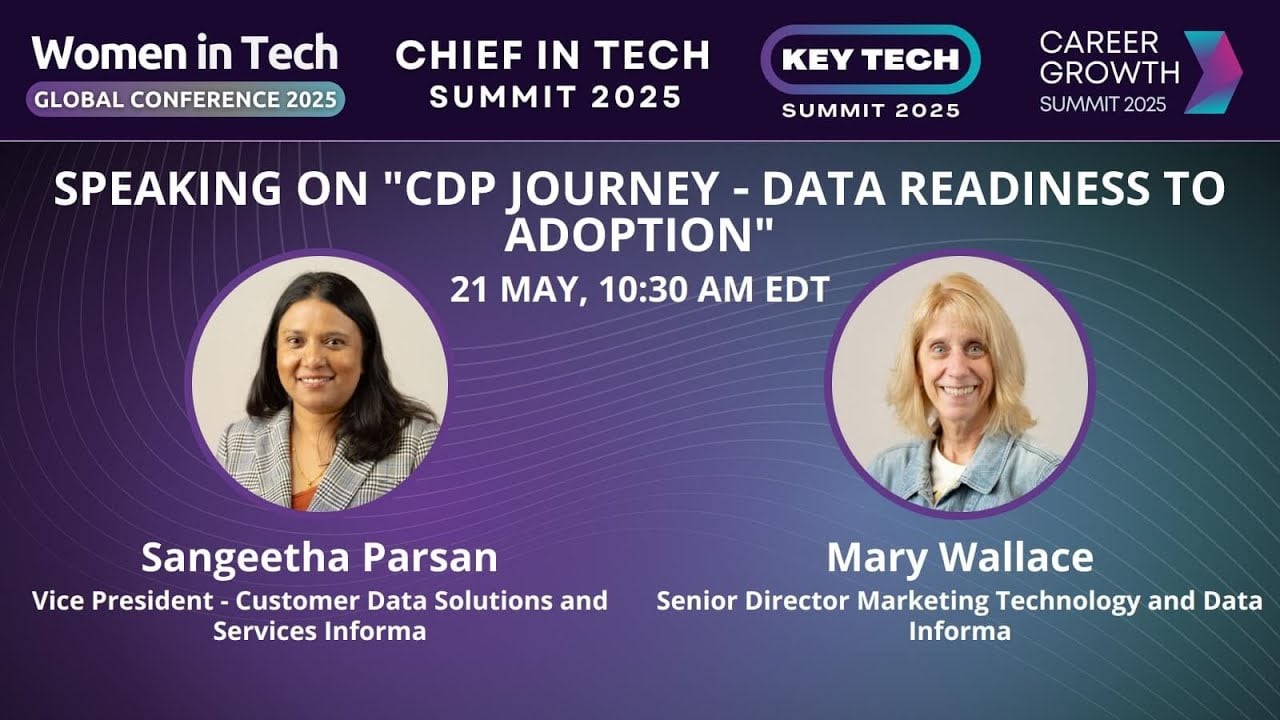
Sangeetha Parsan and Mary Wallace of Informa describe their company's customer data platform (CDP) journey, from setting program goals and choosing a vendor to preparing data and driving adoption. They argue that a CDP delivers ROI only when clear business goals, ready and standardized data, and deliberate change management come together, and that implementation is where success starts rather than ends.
“Any technology is only as good as the data that is coming into it, right?”
“The success starts with implementing, right? Because there should be adoption following, right?”
What you will learn
Define program goals, stakeholders, personas and a measurable definition of success before selecting a CDP.
Evaluate CDP vendors on vendor strength, a five-year cost model, SLAs, data integration and identity resolution, not only on features.
Prepare customer data for recency, completeness and standards applied from the point of capture.
Decide which fields to standardize and which to keep raw so marketers can segment easily.
Drive adoption with an MVP team, a team-by-team rollout, structured training, open documentation and a hypercare period.
Key takeaways from the speaker
#1 The importance of an organization's data when considering a CDP
#2 Understanding the key criteria for driving adoption with people and process
#3 What stands in the way of realizing ROI
Details
Level
Intermediate
Format
Tech talk
Technical depth
Practitioner
For
Mid-career, Senior individual contributor, People manager
Length
44:29
Published
July 2025
Questions this talk answers
Why do marketers stop using MarTech tools?
According to Mary Wallace, change fatigue, too many tools in the stack and tools that do not meet their needs drive declining utilization. Informa also faced diverse internal teams, competing priorities and difficulty defining success.
What should an organization decide before selecting a CDP?
It needs a strong rationale for why the CDP is crucial to the business, which stakeholders and personas will use it, and a clear definition of success such as users onboarded, divisions rolled out, cost savings or revenue growth.
What matters most when choosing a CDP vendor?
Know the vendor's customers, professional services and user community, model the full cost structure over about five years including hidden costs, and check SLAs, hosting, data integration pipelines, unification logic, encryption and channel support.
What is the difference between customer unification and ID resolution?
Unification is the overall process and workflows that bring customer data into a single view, while ID resolution is the specific algorithm that decides whether different IDs such as email, device or phone belong to the same person.
How did Informa drive CDP adoption?
It launched an MVP in 2021 with a committed, data-mature team, then rolled out team by team with workshops, three days of training, open documentation, a ServiceNow support process and about seven weeks of hypercare.
About this talk
The power of a data platform lies in the synergy between the data itself, the technology that drives it, and the team that uses it. Customer Data Platforms (CDPs) have emerged as crucial tools in today's data landscape, yet organizations that have not embarked on a CDP journey often struggle to justify and live up to the potential return on investment (ROI). While CDPs are promoted as a panacea for resolving data silos, without making cultural changes, the value of the CDP will never be realized.
Drawing from multiple data journeys spanning data warehouses, master data management systems, and CDP implementations, this presentation explores a practical approach to maximize the benefits of a CDP investment.
For organizations yet to embark on a CDP journey, justifying the return on investment can be challenging. Attend this session to learn how to evaluate your data's readiness for a CDP and maximize your investment by driving adoption with targeted measures, change management and training.
Unlock your CDP's true power - explore the facets of data, people, technology, and process when embarking on this transformative journey.
Our topic today is about our CDP journey. This is our own experience from, and we are planning to cover every phase of it from data readiness to adoption. So first I will start with an intro of myself. So I'm Sangeetha Parsan. I currently live in Seattle. My expertise is in designing, architecting, and implementing enterprise scale data platforms and solutions with a customer focus.
And the customer focus bit becomes paramount, especially in complex mergers and acquisitions, corporate mergers and acquisitions where change and transformation become very, very critical. And that's one of my areas where I specialize. And my partner in crime today is Mary Wallace. Mary, as you can see her accomplishments, she has a very diverse background in marketing technology and consulting, having designed and deployed cutting edge applications for several agencies. She's very passionate about both marketing technology and MarTech. And you can see that, you know, she's one of the top hundred influencers in 2017 and one of the top 30 influential women in B2B marketing.
So Mary, could I please ask you to mute? I think there is some noise probably, you know, on your end, we can try. Thank you, Mary. We can go to the next slide. So now that we've introduced ourselves, I'll go into talking a bit about the organization that both Mary and I work for. So we work for a company called Informa, which is leading international B2B business, whose purpose is to connect businesses and professionals with knowledge. Right.
And the goal is these connections can lead you to knowing more, learning more and doing more. So Informa currently has 14,000 employees in 30 countries, and we have clients in around 150 countries. Right. And we have listed some of our shows, you know, hopefully you, you know about these shows, Black Hat, World of Parcrete. We have shows in multiple verticals.
So Informa offerings include events, digital services, and our academic publishing wing, which is Taylor and Francis. So now a quick view of the multiple, five divisions inside Informa. Informa markets, it's more of a transaction led. It creates a marketplace for buyers and sellers to connect. Informa connect is more content led. Right. It creates a very unique and high, highly valuable content for its attendees, you know, including networking conferences, et cetera. And Informa festivals is, I would say, a unique experience led events, which are also very rich and immersive content.
Then we have our Informa tech target, which is our digital services wing. And then we have Taylor and Francis, which is our academic publishing and research wing. Through all of these divisions, we have multiple shows, some of which are what you're seeing here. I will now pass it on to Mary to take it over from here. Hi guys. So Stingita, she said, we are going to be talking about implementing a CDP with inside of Informa. A CDP is a tool used in the MarTech stack.
And as you can see, the MarTech utilization since 2020, kind of until now, this is a little dated. This is back to 2023. But the utilization of MarTech has continued to decline over time. That utilization, that declining of the utilization, Gartner's calling this out. There are other publications that call this out. But that decline in the utilization is for several reasons.
Change fatigue with marketers, who is the user base, that there's too many tools in the tech stacks. They really don't know which one to use. And any given tool is not necessarily meeting their needs. And as a result, they're just not going to utilize a tool that does not meet their needs. They're getting, marketers are getting a bit more circumspect in what they're choosing to use and not use.
So what we faced was really no different than what Gartner or McKinsey or whatever talks about. So one of the things that we faced when we started our CDP journey was change fatigue from our user community. They were tired of the next new platform, the next new tool. The business, the central technology team is constantly introducing new tools into their stack.
And they were just exhausted from it all. So we needed to find a way to get around that change fatigue and say, look, this is here to stay. The change after this is going to kind of minimize a bit. Excuse me. We also have a rather diverse internal customer base. As Sangeeta mentioned before, our businesses are through many, many, many different industry verticals from fashion to technology to concrete to just a million different to licensing, just a million different industries that we support.
And as a result, each of the marketing teams that support those different industries is diverse. Right. They have different needs, different ways of working, different wants, because they're aligned to the industry or the business they support. So whatever solution we were rolling out, we had to be able to address that diverse internal customer base. Our marketers have competing priorities.
We are not marketing and selling a widget. Instead, what we are doing is we're selling something that is basically built and goes away in, I don't know, nine months. So as a result of that, marketers, our users cannot take their eye off their ball in order to work with us for a technical implementation and then go back to marketing their products.
Instead, they have to do this at the same time. And as a result, there's a lot on our marketers at any given time while we are implementing our solution. And then last but not least, we struggle and struggled to clearly define success. The metrics on what we did, did implementing the CDP improve our market share, did implementing the CDP reduce the effort that the marketers needed to take, did implementing the CDP make anything better, improve it, whatever.
Those metrics for us were very, very difficult, not necessarily to understand what they should be, but to collect them because of the environment we work in and then to be able to share them out. We did have one team that was able to very concisely do this, but in general, most of the teams that we've worked with have struggled to clearly define what success is.
That doesn't mean we haven't had wide scale adoption, we definitely have, what it simply means is that it was difficult for the business to codify that success. And with that, I will turn it back to Sangeetha for her to start our journey. Thank you, Mary. Thank you for walking us through all the stats. Now, where does the CDP journey really start, right?
We've all been through multiple data programs, right? Starting with databases 20 years ago, to data warehouses, to customer hubs, master data management solutions. I mean, this is just another technology. The technology has to be accompanied by proper program, goals, people, and processes in order to make it successful. It's not a one factor that makes it a win, right?
If you look at it that way, I think our journey started sometime in 2020, but it usually starts with very clear program goals. We'll go into what these are in the next slides, right? In the program goals, you would want to think about who are your stakeholders and what are the functions within those stakeholders who are going to be using this technology and how are they using this technology, right?
And Mary very clearly articulated how measurement is very critical as well for an investment of this size. There has to be some way to prove ROI, right? So those are all the program goals you need to define. Then comes, okay, now you have a successful program. You have the right people to run the program. You have a way to measure success.
You have the investment. Where do you go from there? Now comes the technology selection, which is a very crucial bit. And we'll go into the different aspects of technology selection in the following slides. Great. Any technology is only as good as the data that is coming into it, right? So how do we make sure our data is recent, complete, standardized, right?
So that it can cover the technology. Literally, it's not the other way around, right? Where usually technology powers things here. Your data is really covering the technology in a way, if you think about it, right? And then what are the important aspects you need to think through in the technical design, right? We will cover some of those.
And then Mary will walk us through the critical bits. Well, great, you know, we have the technology. We have the data. We have implemented something. What do we do? Where do we go from there, right? How do we drive adoption? I think this is something that's usually overlooked, right? The success ends with implementing, but that's not really the case.
The success starts with implementing, right? Because there should be adoption following, right? So that's where we will cover the end-to-end journey. Thank you, Mary. Next slide, please. So we talked about how to organize a successful program, right? I think the key question, right, as Mary mentioned, is any technology you bring in, what is the purpose of that technology?
Who is it going to service? What problem is it going to solve, right? Because if you look around, you know, in any organization, there are already existing technologies which may be solving these problems or may be able to solve these problems with a little bit of an extension, right? If you think about it that way, then I think you need to have a very strong rationale for why you're implementing a CDP.
Is it crucial for your business? Is it crucial for your business growth, right? And what are the priorities for your stakeholders? What are they going to gain from that? Because as you know, we saw in the previous slides, change fatigue is real. Just because we give them the latest and greatest technology, it doesn't mean that users will be open to it.
It has to solve a purpose for them, right? And it has to, sorry, it has to serve a purpose for them and solve a problem for them. And now coming into stakeholder alignment, what are the functional requirements? Would it be the sales team using it? Would it be the marketing team using it? Would it be the content team?
I mean, these are all the use cases and personas that you need to consider before the selection of a CDP. And having all this will really help you drive your technology selection and implementation in a very positive way. And this is a topic that Mary already touched upon. There has to be a clear definition of success. Is success for me onboarding maybe, you know, 400 users?
Is success for me that I've rolled it out to 30 business divisions? Or is success for me that I have achieved cost savings is one part? Or have I increased revenue by using this tool, right? I think that is another area where sometimes we don't have a clear goal. And that leads to confusion later when you're trying to prove a return on investment.
Thank you, Mary. Next slide. Okay, so what happens if we don't define our program goals properly, right? We can either overcome it. That leads to, you know, in the future when the program is done, it doesn't have the oom, right? I've promised a thousand things that delivered a hundred things. There's a huge gap in between. Missed functionality leads to the business users are frustrated.
Now you have more technology costs. We cannot scale, right? And there are security vulnerabilities, et cetera. And our inability to define success or track success will mean that there is no clear ROI. It's difficult to scale. You know, how are you going to ask? How are we going to ask for more money if we are not able to prove the worth of the investment as so far?
And this is where adoption takes a hit. If we are not able to have a proper program with all these facets included, then we won't be able to make it a success. So we touched upon this as you saw in the journey. You know, technology selection is one of the most important aspects of a CDP journey. And the reason is it's a big investment.
It's a long-term strategic investment, right? So when you're looking for a vendor who's going to travel with you for the next five years, the next 10 years, and who's going to handle the most important asset in your organization, which is your user customer data, right? Now, you need to know your vendor, right? Yes, the technical features they offer, AI, ML, all that is great.
But at the core of it, who are their current customers? How are they engaging with their current customers or their customer advisory boards? Do they have a powerful professional services wing that can help you through the initial implementation phases? How is the user community, right? So these are all the angles you might want to think through, not just the technology part, right?
So that is what we have covered in vendor strength. I'm not going to read through all of this. I'm just going to highlight the most important bits. The core structure is, again, very critical, right? Today, I might have 20 million records. If this technology works great and we made a big impact and now we have 40 million records, is this going to scale?
Are we going to be able to afford it, right? That is a big question. So there is a modeling exercise I would suggest, right? Look at your current utilization or number of profiles and model out where you want to be in the next two years, three years, five years, and see how the cost is going to work for you.
Because there is one thing to have storage costs and compute costs, which is the most visible things. But there could be hidden costs, right? There could be activation costs. So work through all the costs, model it properly, you know, together with your vendor. So you understand the cost structure, not today and after implementation, but over a period of five years, because that's where your growth is going to be.
And of course, you know, SLAs, we all want 99.99, right? Five nines in everything. In this case, it's even more critical because it's going to, if the system is not stable, it's going to impact your baseline, which is reaching your customers. And some other technology considerations are your hosting options and the data integration, because this is all about data.
You want to have a lot of pipelines, right? Meaning that, you know, pipelines that can bring data, as well as pipelines that can push the data out to other channels. That's a very critical consideration here. Now, I'm going to go into the backbone of a CDP, right? If you think about a CDP, it's supposed to bring customer data from multiple channels, multiple interactions into one unified profile.
And what does that is customer unification, right? The unification logic is the crucial bit. So when you choose your technology, so unification is the overall part, you know, the workflows, everything that brings the customer data together to give you that single view of your customer. And your ID resolution is the specific part, which takes multiple IDs of this customer.
It could be a device ID, it could be an account ID, an email ID, it could be a phone number, right? And it gives that logic as to, is this the same person, right? And then you can bring all those facets of data together and unify. So unification is the overall algorithm. And ID resolution is the specific algorithm that brings these pieces of data together into a single customer view.
You might want to focus on that. We went with a deterministic one, but there are other options like probabilistic, right? It really depends upon the use cases you want to implement. And data encryption and PII, extremely important for compliance, especially with different countries, right? It varies between US and Canada and UK. So you might want to be cognizant about that. Your customers are going to come from multiple regions.
Now, finally, the marketing considerations. In our case, this tool was for our marketers, right? But it could be, you know, in your case, it could be for sales. It could be for different functions, but make sure that we understand what their needs are. In our case, it was omni-channel, not just email. They wanted to go social, LinkedIn, right?
Does the tool support all that natively and organically? You don't want to build something on top of the tool that you're already purchasing for a very high price. Is it easy to use? Are there metrics that are being generated as part of this usage, right? These are all some things you want to think about, you know, when you're doing your technology selection.
Next slide, please, Mary. OK, now we talk about the start of the show. It's not technology. It's the data. And the work for data should start really before you even think about the program, right? Because the earlier we start, the better and more data we have. Recency. Now, when I talk about data readiness, this should really be powered by your use cases.
What are your marketers or your personas going to be using this data for? I'll take a small example. In our case, you know, let's say somebody came to fill an event registration form. They left halfway through. We want to be able to target them personalized message when they come next to you and saying, hey, do you want to complete it?
Right. It's what we call an abandoned risk use case, which is very common, but you could personalize it. Right. In order to do that, you need to really have recent registration data, recent information flowing in as near real time as possible. It doesn't always have to be real time, but as near real time so that you can fulfill all these different use cases.
So in a way, your data should be powered by your use cases. Right. They go both go hand in hand and having recent data means it's more accurate and it helps you cover the next best action. You know, the typical example I gave the next best action was to target them, you know, on a website when they came back.
Right. Hey, do you want to finish the form or you could target them on an email saying, do you want to go back and finish the form? There are multiple ways you can personalize your next interaction with your customer. Now, coming to completeness. Right. This is the whole point of the CDP. We should be able to give as much information about the customer so that it can unify it and give us that single customer view or FCV or whatever we call it.
Right. More accurate data, meaning that you're in the future if you want to apply machine learning and do predictive modeling. An example would be I had this customer base attend an event. Who else can attend an event? Right. Again, you will be able to do models like that once your data is unified and is in a CDP.
Now, coming to standards. Right. Very critical. And standards, in my opinion, have to be applied all through the journey of the data at the capture, at the transformation and processing stages. And, you know, when you are using the data at the end. Right. Standards are not in one phase. It's throughout the journey of the data. When we don't have standards applied at the source, the result is you will be doing a lot of transformation.
Let's say at the capture, very simple example, I give a free text field for a country. People can enter anything and everything. USA, US of the United States, United States of America. Right. Then you will end up cleaning and transforming and standardizing it in your CDP, which is what you want to avoid as much as you can.
And the CDP can do it. It has workflows and orchestration processes to do it. But the point is, if a simple change can accomplish this at the data capture point, why not? Right. And that's where we talk about, you know, reducing the overhead on the CDP, which also will keep your costs down. Right. And if you have better data, better standardized data, it's easier to do enrichment on top of it. Right.
There are multiple external agencies which can, you know, take the data and give you additional attributes about the data. So now we talked about the program. We talked about technology selection and getting your data ready. And finally, we are coming into the technical design bit. Right. So in a CDP, the goal is for somebody to come and segment. Right.
And create a customer, a list of customers, essentially, that they can target. So what are the criteria they need for the segmentation? Right. Not only segmentation. What are the criteria they need for analytics? Right. We need to think through that as we design. And we touched upon this in the previous slide. What do we want to standardize? Because if you bring data as this, in the example that I gave about the country field, then when your marketer comes to segment, let's say I have not standardized.
Instead of picking United States, they will have to pick five values. Right. And imagine doing this over multiple, multiple fields there, you know, there in you lost your usability. So know what fields need to be standardized. Now, another example. Right. If you take a job title, they are job function is different. But if you take a job title, that's better as a free text field because no jobs are no job titles are standardized.
Right. That would be a good exercise to do. But it's not standardized. So it's OK to bring in those fields raw. Right. Because that provides the marketer with the power of the raw data that a customer entered. Right. So distinguish us between those fields. What needs to be standardized? What needs to be brought in as raw to power your marketer segmentation?
And like I mentioned previously, right, a unification logic, which is the overall process versus the ID resolution, which is a specific process. Very critical because this is the brain of your CDP. How do you bring in these pieces of data and make it as a single customer? And when you store data, there are always policies. Right. Data retention policies.
I think it's four years in some countries, you know, for customer data and also have a clear path to removing customer data, because if somebody asks the data to be removed, then we should have a process for that as well. It's not only about storing the data. Right. And the last bit is always make sure you have this is customer data. Right. This is the key asset, the golden record of your customer.
Make sure you have robust DevOps processes, not just inside the CDP, but also the code that is developed outside. Right. In terms of injection, everything, make sure you have a process so that it can all come together and you maintain a gold standard when it comes to every change that happens in and around your CDP. Thank you, Mary. Mary, I believe that is a question. Do you want to take that up?
The question is, can you discuss how risk and business strategy alignment is aligned with what you discussed? I think you're on mute, Mary. Yeah, sorry. I'm getting used to this system. So sorry about that. Yeah. So your business strategy is what defines the need for the CDP. Right. It's how you're going to market. And then you're using that business strategy. The strategy comes first. The technology bolts onto the strategy as a second piece. And then the risk piece would come in as part of kind of the different ways as you're walking across this process. Because if I'm understanding the question correctly, you're evaluating the risk as you go. So what is the risk if I do it? What is the risk if I don't? And what is the risk inherent in it?
Does that answer your question, Chitka? I don't think that would you add anything else into that? Sorry, I'm trying to still figure out how to mute and unmute. Chitkala, that was a really good question. Right. I think the risk, I would say, can happen in three friends. One is the ROI part. Right. Whether your investment is giving the returns you need. Second one is the adoption. And the third one is the stability of the technology itself.
So as Mary mentioned, the first thing is you have to have a strategy, whether it's a marketing strategy or a sales strategy, whatever it may be, for what you're using the CDP. Right. And then overlay the technology and the use cases on top of it. She replied in the chat. So yeah, exactly. You can have a CDP. So this is, I think, a lot of places there's a decision to take on a technology because it's the cool technology versus the technology that aligns to the business strategy.
I think that might be what you're poking at. And I think you're very much true. We definitely had a business strategy. That strategy laddered back into COVID and that we were no longer able to have physical events. And so we needed a better way to communicate with our audience. So we kind of started there for us. Approve as my mic. Hold on. Let me see if I can figure it out.
Mary, I'll figure it out. You keep going. Wait, wait. It's a red. There's a number one. It says moderate, but I can't. Yeah, I got it. Yeah, I got it. Hold on. Yeah, she should be enabled now. Yeah. Hi. Chitkala, are you able to speak? Yes. Hey, this is Chitkala here. Thank you for- Chitkala, I've approved your request. Are you able to speak?
Yeah, I can hear her. I could. Yes, can you hear me, Sanita? Yes, we can. Hey, great. Great to join your session. It's good to discuss something in detail alongside of program management and data solutions. My question was to saying that, okay, yes, we go through the data. We go through the complete process steps of analyzing the system, analyzing the data, analyzing how it maps to the solution which we are trying to build. But there is also a segment where we actually try to see how the risk actually gets involved in figuring out that patterns of data, and also how it actually connects back to existing business strategy and how it- sometimes there are like small business outcomes. Sometimes it's actually trying to connect to a bigger business strategy,
like if at all we need to expand our branches or try to launch a complete product in a new section of the geographical state. The business outcome and business strategy have to match at this point, right? Because we are actually trying to launch it in three different states. The business- the data solution and data patterns are different in each state, each geographically, and each outcome actually is very critical to connect back to business strategy. So the risk part of how these data points are actually playing a role to increase- increase the outcome. So we could actually create some ROI, try to re-budget, like you discussed, Sangeeta, and also try to have some kind of a geographical marketing where you're getting patents saved, like Mary you discussed before. So those- all those things play a role.
So how are we- I understand that there is a basic way how we actually connect back to the outcomes. I just wanted to- the viewpoint of you both to see how you measure those data points which connect back to an outcome, and then again, connect a little bit at a higher level to the business strategy. Okay. Mary, I can take that question if that's okay with you.
Thank you, Chitkala. That was a very detailed question, and I appreciate you participating, right? So I'll try to- you know, we talked about the geography part, all right? And then we talked about the data part. Now, I think I'll talk about the technology first, all right? I think the beauty- I'm not advocating for a CDP by any chance. That's not the goal here. But any technology that brings and unifies your customer data gives you a view that is above the region, all right? For Informa 2, we are not regional, we are international, all right? But there are patterns that you can observe between the customer behavior in multiple regions, all right? So I think, you know, having that would really- but now going back to the
second question, all right? Let's keep that in one area that we are able to unify and look at patterns. Now, the second part is the outcome and tying back to the strategy, right? So the outcome in our case is to better understand our audience. It's as simple as that. Our marketers had to understand the audience better. And I'll tell you why, right? I might have lived in India. I might have attended a show in India for 20 years. I'm a high-profile customer for you in India, right? For Informa. I moved to the U.S.
And suddenly, I stopped attending the shows in India, but I started attending a show in the U.S., right? The outcome in this case is for the marketer to know the audience better, right? The business strategy is to make more money, you know, to market the product better, right? Now, because this data is unified, at some level, now the marketer knows, oh, wow, this is the same person, right? So the messaging to me can change. I'm giving you a very granular example, right? But if you look at it in a high level, all this unification can give a very good view of the patterns, right? Which can then drive your outcomes, which will help you get to your strategy. You know, that's the way I look at it. I'm, you know,
that's just my view. I would add one more thing in there, Shetka. We started out with a generic use case, right, of better engaging our customers, better converting our customers from media buyers to event attendees to event sponsors, all that. To Sangeeta's point, we are not segregated or separated geographically, but we are 100% segregated or separated by the industry that we're supporting. So the fashion team is one segregation. The aviation team is another segregation.
The ag team is another segregation. The construction team is another segregation and so on. We structured the data based on the generic use case and that data structure is based on or allows us to kind of be, it's flexible enough, I think is the word I'll use, that even these industry specific use cases that we have, it complies, it allows us to do that. Right? So just, I think there's two sides of the answer. Sangeeta's side and then I think there's how we did build a data model that was adaptive and a solution that was adaptive, not necessarily geography, but more to different industries, which are as different in some cases is geography. I don't know if that helped or hurt. Yes, I think it gives me, sorry, I was stressed,
still trying to figure out. It gives me some kind of understanding on how you got, how the segmentation and also how the outcomes and products are actually aligned. Sorry, I was trying to figure out the mic in so I missed a couple of points of what Sangeeta was saying, but I did get the gist that she, the channeling of it is more towards how we actually view the market and also how we view the data center, center, data is segmented across different areas. Yeah. And finally, the final point, and I'll give the mic back to Mary Chikala, is that this is just step one, right? Consolidating your data, creating a unified view, bringing all the data points together. It's just a starting point. The applications of AI, ML, the modeling,
everything comes after, right? And I think that also adds to the power of what you know, of predicting where it can, where things can go or who can attend an event. I mean, the use cases are, I mean, out of the world, right? What we can do with this data once it's structured and standardized. Yes, because at the end of the day, trying to build, build the business is the key factor to everything.
Absolutely. Exactly. Growing the business. Exactly. And I think that leads us right back into like the MVP piece. And we launched a first MVP. We did that in 2021. We did that, we picked a team, that team had very siloed data. That team also had marketing and data maturity. So again, back to the that diversity, some teams that we have are very strong in data, strong in marketing maturity and some are not. So we picked a team that had the business need, that was committed to success and that had a maturity that was able to adapt to what we were rolling out, right? Then we ran a bunch of workshops with them, ways of working shifts, because we all know just putting in a technology is not the
answer. It's how we use that technology and how that technology is powered into a given business. So we worked with that team and then a few other teams to build out ways of working shifts so that the the new CDP was part of their daily lives. We also built out internal infrastructure. We built a support organization. We're using service now. So we built in the ticketing system. And then we built out, we built a hyper care structure. And again, we're back to auditing for success. We have a lot of leading indicators that what we were doing was right. We could clearly see more and more businesses coming on, wanting to come in more and more users using it on a daily basis. So we were auditing that success.
We went back, we ran surveys, we did all that other stuff to see what we could do, what we were doing right, and what we could do better. And we use that as a mechanism for us to roll forward. As far as adoption is concerned, we back to your point, we did a team by team rollout. So we didn't bring in everybody. We brought in one team at a time and focused on them, their needs, their priorities, etc. We did that from a discovery session all the way to implementation and activation. We created documentation and then we democratized it so anybody can get to that documentation. It opened up data, it showed the data that they had, and it made it easier to understand. So beyond the CDP, we did this
documentation. We had structured training programs. We do three days of training rollout. On the technical side, we will do ways of working discussions and change management shifts leading up into that. And after that, we'll do top-up training, all that type of stuff. And then we communicate wins, we embrace strategic thought leadership, and we're trying to bring the different teams together so they can start to cross-learn from each other. Here's just an example. I'm going quite fast because I think we only have two minutes left. But here's just an example of the different steps that we take with each marketplace that we're working with, each team that we're working with, from defining a specific, what their requirements are, all the way through the build stage. That includes system testing, that includes QA,
that includes them doing user acceptance testing to make sure that the data that's in the CDP aligns back to the source system and that they're comfortable with the data. It includes the onboarding training. We ask them to do a first activation. And then we run a period of hypercare period for about seven weeks. And back to Sangeetha's point, once that data is all kind of unified, all together, all structured, there is more that can be done off of that. And so there's a couple different models that we've built on scoring, on reporting, performance reporting, audience reporting, all that that comes out of the backend once we have that CDP in place. Just a little bit about the training structures that we have.
We've kind of, it's a big organization, as Sangeetha said, I think there's 14,000 people in the company. And so we had to organize all these different types of training, having quizzes, you know, absorb training that people can go in and do it, as well as, you know, we're physically with them when we bring them and we do the activation training. Here's a little bit about the documentation that we have. We've built our own website and this is where the business goes to get their answers. And if they can't get it here, then they are free to reach out to us. But it was kind of just opening up the data, letting them see the data outside of the technical platform and explaining it to them,
sharing with them, sharing with them, use case wins, all that, that allow them to see how others are using it, allow them to see what the data is that they have, and then kind of what the opportunities are for them. Just a little bit about communication, different ways we communicated, different forms ones we've communicated in.
Transcribed automatically; names checked against the speaker record. Select a time to jump there.
Article based on this talk
A customer data platform pays off only when goals, data and adoption come first
Sangeetha Parsan and Mary Wallace share how Informa took its CDP from data readiness to everyday use across a diverse business.
In short
A customer data platform (CDP) does not deliver return on investment just by being installed. Sangeetha Parsan, Vice President of Customer Data Solutions and Services at Informa, and her colleague Mary Wallace argue that clear program goals, ready and standardized data, and a deliberate adoption plan decide whether the investment pays off. Their talk walks through Informa's own journey, phase by phase.
Key takeaways
The importance of an organization's data when considering a CDP
The key criteria for driving adoption with people and process
What stands in the way of realizing ROI
Why marketers are tired of new tools
Mary Wallace opened with the problem every CDP program faces. MarTech utilization has been declining for years, and she pointed to Gartner calling this out, as the speaker cited. The reasons are familiar: too many tools in the stack, tools that do not meet users' needs, and marketers becoming more selective about what they use.
Informa faced the same pressures. "They were tired of the next new platform, the next new tool." (5:11) On top of that, its internal customers span industries from fashion to concrete, each marketing team works differently, and marketers run time-bound events while working on technical rollouts. The hardest problem was defining success: whether the CDP improved market share, reduced effort or made anything better was difficult to measure and share, even though adoption grew widely.
Start with goals, not technology
Parsan framed the CDP as one more chapter in a long line of data programs, from databases to data warehouses to master data management. Technology alone never wins. Programs need clear goals, the right people, processes and a way to measure success. She stressed that the work does not end at go-live: "The success starts with implementing, right? Because there should be adoption following, right?" (11:26)
Before choosing a platform, teams should ask what problem the CDP solves, who it serves, and whether existing tools could already solve it with a small extension. "Just because we give them the latest and greatest technology, it doesn't mean that users will be open to it." (12:18) Success might mean onboarding a number of users, rolling out to business divisions, saving cost or growing revenue, but it has to be named up front. Without that, programs overpromise, frustrate users, struggle to scale and cannot justify further investment.
Choosing a vendor for the long haul
Because a CDP is a long-term strategic investment that handles customer data, Parsan advised looking beyond AI and machine learning features. Teams should know the vendor's current customers, how it engages with them, the strength of its professional services and the health of its user community.
She recommended modeling cost over about five years: start from today's profile volumes, project growth, and include hidden costs such as activation alongside storage and compute. SLAs, hosting options and data integration pipelines in and out of the platform also matter. At the heart of the platform sits identity: "So unification is the overall algorithm. And ID resolution is the specific algorithm that brings these pieces of data together into a single customer view." (18:37) Informa chose deterministic ID resolution, though probabilistic options exist depending on use cases. Encryption and handling of personal data must reflect regional differences, and the tool should natively support the channels marketers need, such as social and LinkedIn, not only email.
The data is the star of the show
Parsan was blunt about priorities: "It's not technology. It's the data." (20:13) Data readiness should be driven by use cases and start before the program does. Her example was an abandoned event registration form: personalizing a follow-up requires recent, near real-time registration data.
Completeness makes the single customer view possible and enables later predictive modeling, such as finding who else might attend an event. Standards, she said, belong everywhere: "Standards are not in one phase. It's throughout the journey of the data." (22:33) A free-text country field invites many versions of "United States", forcing cleanup inside the CDP and raising costs. Fixing it at capture is simpler and makes enrichment easier.
In technical design, that choice shapes usability. Standardize fields marketers segment on, but keep fields such as job title raw where the original entry has value. Teams also need retention policies, a clear path to delete customer data on request, and robust DevOps processes for code inside and around the CDP.
Aligning strategy and driving adoption
An audience question about risk and business strategy prompted a clear answer from Wallace: "The strategy comes first. The technology bolts onto the strategy as a second piece." (27:11) Parsan added that risk shows up in three places: ROI, adoption and technology stability. Informa's own strategy traced back to COVID, when physical events stopped and the company needed better ways to reach its audience.
For adoption, Informa launched an MVP in 2021 with a team that had siloed data, a real business need, commitment and enough data and marketing maturity to adapt. It ran workshops on ways of working, built a support process on ServiceNow and set up hypercare. Rollout then continued deliberately: "So we didn't bring in everybody. We brought in one team at a time and focused on them, their needs, their priorities, etc." (40:06)
Each team moves from requirements through build, system testing, QA and user acceptance testing, then onboarding training, a first activation and about seven weeks of hypercare. Three days of training, top-up sessions, self-paced courses with quizzes and an internal documentation website that opens up the data help teams learn from each other's wins.
Watch the talk
CDP Journey - Data Readiness to Adoption, by Sangeetha Parsan with Mary Wallace, 44 minutes: https://www.womentech.net/video/cdp-journey-data-readiness-adoption
About the speaker
Sangeetha Parsan is Vice President, Customer Data Solutions and Services at Informa, with more than 20 years of expertise designing and implementing data, technology and data integration solutions for B2B organizations. She leads a team of data experts focused on integrating businesses onto data platforms, particularly in complex corporate mergers and acquisitions, and co-presented with marketing technology leader Mary Wallace.
Questions this talk answers
Why do marketers stop using MarTech tools?
What should an organization decide before selecting a CDP?
What matters most when choosing a CDP vendor?
What is the difference between customer unification and ID resolution?
How did Informa drive CDP adoption?
Drafted with AI from the talk transcript. Editor review pending.
Frameworks and ideas mentioned
MVP
Single customer view
Deterministic and probabilistic ID resolution
User acceptance testing
Hypercare
Cite this talk
Sangeetha Parsan. "CDP Journey - Data Readiness to Adoption." WomenTech Network, 2025. https://www.womentech.net/video/cdp-journey-data-readiness-adoption