
In short
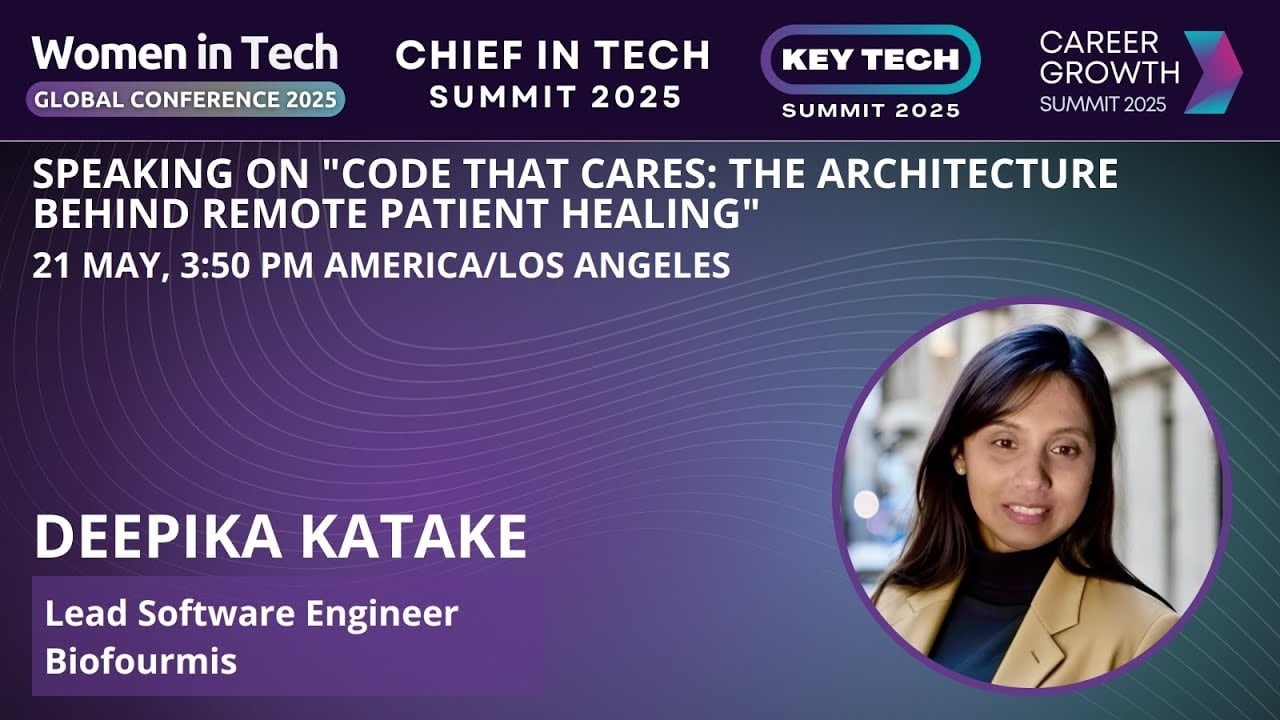
Deepika Katake, Lead Software Engineer at Biofourmis, argues that in healthcare, software that merely functions is not enough. Drawing on years of building remote patient monitoring and telehealth platforms, she shows that systems heal when they rest on three pillars (data ingestion, an intelligence layer and a human in the loop) and when empathy, simplicity and inclusion are designed in from the start.
Key takeaways
- Bridging two worlds, technology and humanity: discover what it takes to innovate in healthcare as a technologist and how to build systems that truly listen, learn and heal.
- Lessons from building tech that saves lives: explore real examples of how precision, simplicity and purpose-led coding can create high-impact remote care solutions.
- Empowering women in healthtech to lead with vision and voice: hear personal insights from navigating two traditionally male-dominated fields, tech and healthcare, with clarity, care and confidence.
- Why empathy must be engineered into digital healthcare: learn how thoughtful UX, inclusive design and data-driven alerting directly influence patient safety and outcomes.
When a line of code feels human
Katake opens by asking what code could do beyond passing tests or powering APIs. Her answer comes from a post-operative care app for patients recovering from major surgery. The team added a non-clinical morning check-in that simply asked patients how they were feeling. As the speaker reported, "Within a week, we saw a 30% increase in patient engagement." (0:57)
She tells a similar story from the COVID pandemic, when her team launched a platform for patients to report symptoms and vitals from home. An elderly patient wrote that she felt someone was watching over her even though she was alone. For Katake, that changed how she approached system design: "Remote care doesn't have to feel remote if done right. It can feel more human than ever." (3:04)
The dashboard that was right and still ignored
The turning point in her argument is a vitals monitoring dashboard that generated over 100 alerts a day. "It was technically perfect, of course, because it was accurately spitting out all those alerts." (3:04) Clinicians ignored it because it overwhelmed them. The team reworked the design with tiered alerting, adding patient photos and brief health summaries, and clinicians began responding. The lesson Katake draws is that accuracy without usability does not protect patients; the data has to read as a person.
Three pillars of remote patient monitoring
Katake built her framework during a maternity remote monitoring project for expectant mothers logging vitals daily from rural areas. The data ingestion layer pulls in blood pressure, weight and heart rate; the intelligence layer flags anomalies against personalized baselines; and the human in the loop follows up. In her account, one phone call after an alert stopped a case from becoming critical.
On ingestion, she describes a sensor that duplicated data packets, producing erratic blood pressure spikes on patient dashboards until the team added a deduplication layer. "That incident reminded me that precision in data pipelines is not just technical, it's clinical." (6:22) Her teams use standards such as HL7 and FHIR so data can move safely between teams, and encrypt everything at rest and in transit.
In the intelligence layer, Katake led a team building a fluid retention alert system for heart failure patients. The first model was too sensitive and flagged too many patients. Clinician feedback loops, retrained models, alert throttling and an event-driven architecture that triggered alerts only when thresholds were met consistently brought fewer false positives and more timely interventions. "And then I would say predictive intelligence should not only support, but not stress healthcare workers." (7:53)
The human in the loop is, in her words, the heart of the system. Clinicians asked for what matters rather than another screen of numbers, so the dashboard was redesigned to highlight critical trends with color coding and patient context such as previous hospitalizations and medication changes. Patients got plain language. "That's what I call bi-directional trust." (9:18) She links this approach in a heart failure program, where predictive alerts were paired with timely nurse outreach, to a drop in hospital readmissions she gave as 28 percent.
Inclusion is engineering
Katake treats inclusion as an engineering requirement, not a nice-to-have. Her teams added voice-prompted onboarding for a senior intimidated by touch screens, tested the app in different languages, switched to color-safe palettes after a color-blind clinician missed alerts, and updated content with gender-neutral language. She rejects the label of edge cases: "So I strongly, strongly believe that design that includes everyone heals more patients, right?" (12:08)
Working across tech and healthcare, she says, has shown her the value of diverse voices at the table. She has often been the one asking how a feature feels to the patient, or whether it would work in a rural village without internet, something she saw growing up in India. To women in the room she offers a direct message: "With this, I would say, just every time, just lead with empathy." (13:13) She calls empathy strategic rather than soft.
What healing systems need
Katake closes with four principles: precision, because every decimal counts; simplicity, because patients and clinicians are already overwhelmed; purpose, because a clear mission takes teams further; and people, because a human sits behind every heartbeat graph. She extends the test beyond healthcare to anyone who builds software: "The next time you build something, ask, does it work? But also, does it care?" (14:40)
Watch the talk
Code That Cares: The Architecture Behind Remote Patient Healing, Deepika Katake, 16 minutes: https://www.womentech.net/video/code-cares-architecture-behind-remote-patient-healing-deepika-katake
About the speaker
Deepika Katake is Lead Software Engineer at Biofourmis and a digital health innovator with extensive experience building scalable, secure and intelligent platforms for remote patient monitoring and telehealth. She advocates for diversity in tech and healthcare and mentors other women in tech on their journeys to leadership roles.
Questions this talk answers
- What are the core building blocks of a remote patient monitoring system?
- How can teams stop clinicians from ignoring alerts?
- Why does data pipeline precision matter so much in healthcare?
- What does inclusive design look like in a patient app?
- What do healing systems need?
Drafted with AI from the talk transcript. Editor review pending.


