
In short
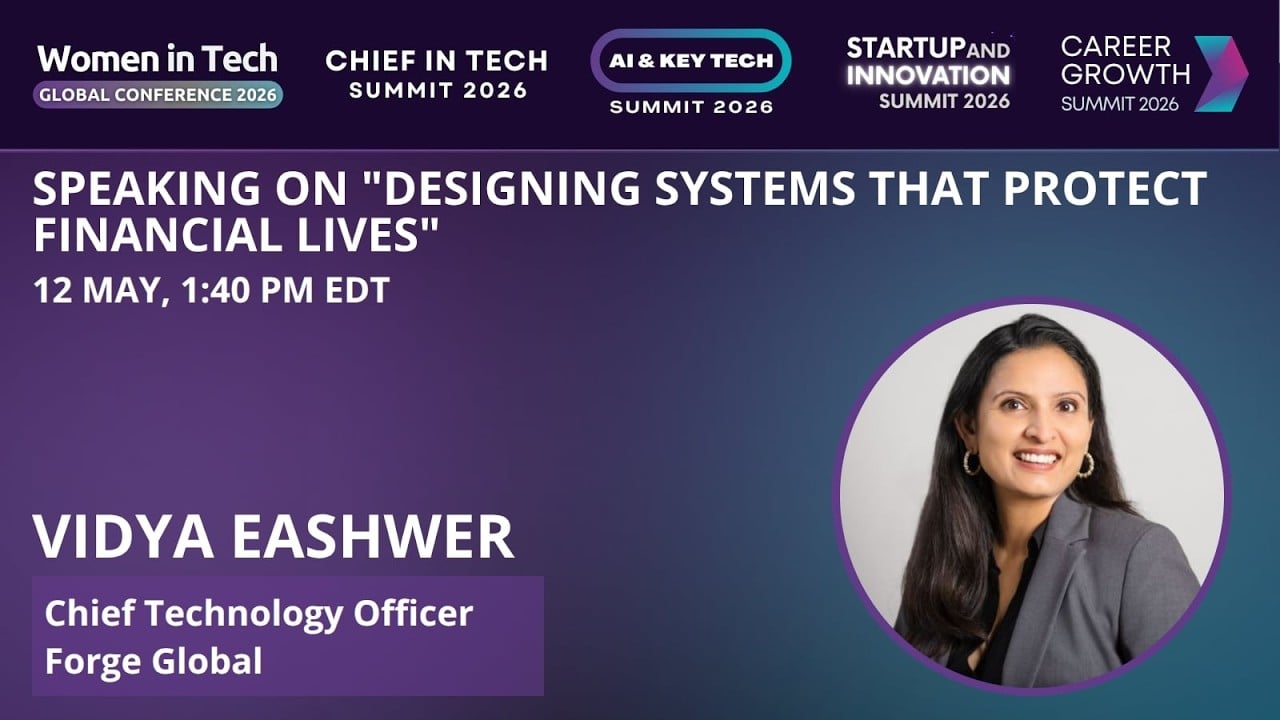
Vidya Eashwer, Chief Technology Officer at Forge Global, argues that trust in financial technology is not a feature added later. It rests on three legs: transparency people can verify, resilience designed for the worst moments rather than the average ones, and teams diverse enough to ask who gets hurt when something fails. Most transformations, she says, break at the people layer, not the technology layer.
Key takeaways
- Explore how to design trusted, scalable systems in complex financial environments.
- Learn how connected data can power more intelligent, efficient market infrastructure.
- Hear leadership lessons from modernizing platforms at NYSE, ICE, and Forge.
- Gain insights on fostering mentorship, resilience, and inclusion within technical teams.
A market crash that set the lens
Eashwer opens with a moment from early in her career at the New York Stock Exchange, during what she describes as the 2007 market crash. Volume spiked far beyond what systems were built for, automated trading lacked controls and guardrails, and companies trading at hundreds of dollars started trading at pennies. As she recounts it, people lost billions of dollars and 401k retirement accounts were wiped out, affecting everyday people rather than only institutions. Regulatory changes followed, including circuit breakers and short sale restrictions, designed to protect people when markets move too fast for humans to intervene.
That experience gave her a lens she has carried into every project since: "So when systems fail at scale, the consequences are real and personal." (1:30)
Trust starts with what people can see
When Eashwer joined Forge in 2021, the company was still defining the private market category. Private shares come with bespoke rules for each company, no centralized clearing and no centralized data, yet the space is highly regulated and pricing lacked transparency. She also inherited a monolithic platform built on Ruby that was not working well for investors, shareholders or brokers.
Her answer was to make data visibility, compliance and security foundational from day one. "And trust is not shiny new features. It's actually what people can see, what they can verify, and what actually holds up when things get messy." (3:25) She gave her team four promises to the user: clear rules, clear data, clear expectations and clear protections when things go wrong. The logic is direct: "And if you can't explain a system, you can't ask anybody to trust it." (3:51)
Forge also set out to become the source of truth for private company pricing. It built Forge Price, a proprietary price with dozens of automated checks. As the speaker cited, CNBC uses the pricing on air, Yahoo Finance shows it alongside public markets, and ICE Data Services distributes it to institutions with $40 trillion in assets. Showing customers historical trends and a real-time book, she explains, leads to more informed decisions and greater confidence.
Resilience is an organizational problem
The second leg is resilience. Building a new platform at the NYSE about 10 years ago, her team looked past averages and peaks and focused on what 99.99% latency looks like, working to reduce standard deviation so customers get a consistent experience under both high and low loads.
At Forge, that thinking led to a hard call: rebuild the legacy platform instead of building on top of it, knowing it would take a long time, cost a lot and require running the business in parallel. Eashwer stresses that such decisions need the right people, the right culture and an executive team that backs them. "So resiliency to me is not just a technology problem. It's an organizational one." (7:43) Teams must balance speed, risk and regulation, and understand the downstream financial and reputational consequences of every decision.
Who is in the room, and the messy middle
The third leg is representation. The people designing a system shape which failure modes get considered and which users are protected. Eashwer wants architects who can name five ways a system will fail and show they have tested for them, including recovery time and what customers see in a degraded experience.
She then names a mistake she admits to making herself: designing the end state while failing to plan for the middle. Transformation is a sequence of cutovers, parallel systems and handoffs. "And the riskiest moments are usually not in the old system or the new system that people think. It's actually during the overlap, because that's when you have two systems that are active, the ownership gets fuzzy, and most mistakes get made." (10:57)
Over more than 20 years, she has seen transformations fail mostly at the people layer, a point she calls especially relevant now that AI is changing technology faster than organizations can understand or govern it. The problem, she says, is not resistance but underestimating how hard it is to live inside change. Transformation works when the people doing the work feel trusted, feel included and can influence the outcome.
Trust is earned when things break
Eashwer closes by returning to her earliest lesson: "So coming back to one of the lessons I learned in 2007, trust is not earned when things are easy. It's actually earned when they break, when things are hard." (12:18) Getting it right 80% of the time is not enough, she argues, because trust is built in edge cases, failures and moments of stress. As AI systems move from implementing decisions to making them, bias, blind spots and shortcuts can land on users nobody treated as the default.
She sees a specific role for women in tech, who she says ask different questions: what is at stake, who gets hurt, what happens if this fails. Her call to action is simple: "Push for guardrails, demand transparency, design for failure, not perfection. And when something feels off, speak up." (13:12) Her closing advice is to build the team as deliberately as the system and to treat trust as a core principle at every step.
Watch the talk
"Designing Systems That Protect Financial Lives" by Vidya Eashwer, 15 minutes: https://www.womentech.net/video/designing-systems-protect-financial-lives-vidya-eashwer
About the speaker
Vidya Eashwer is Chief Technology Officer at Forge Global and has 20 years' experience creating and executing innovative fintech strategies. Before Forge, she was Head of Technology, Edge Systems, at Intercontinental Exchange, and spent six years as Managing Director of IT at the New York Stock Exchange managing software development across the U.S. and Europe.
Questions this talk answers
- Why must trust be built into financial systems from day one?
- How did Forge make private market pricing trustworthy?
- How should teams measure system resilience?
- Where do technology transformations usually fail?
- What role can women in tech play in building safer systems?
Drafted with AI from the talk transcript. Editor review pending.


