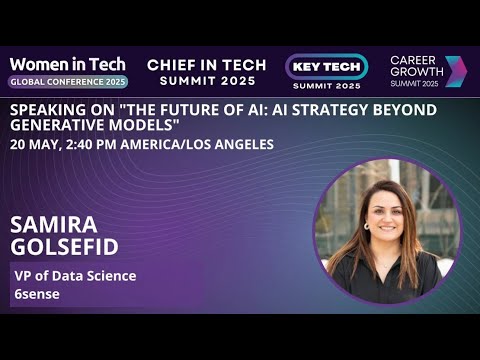
The Future of AI: AI Strategy Beyond Generative Models
Samira Golsefid15:072025
Generative AI doesn't know why, and your AI strategy can't stop there
Ask a language model to finish "the cat sat on the..." and it picks whatever word its data repeats most, with no idea what a cat is. That gap matters for any leader betting revenue, forecasting or customer decisions on GenAI. Samira Golsefid, VP of Data Science at 6sense with around 20 years in machine learning, asks what comes after generative models and how leaders should plan for it.
Learn which kinds of AI fit which decisions, plus five moves that turn AI into a strategic edge
Samira Golsefid, VP of Data Science at 6sense, argues that generative AI is a milestone rather than the destination, because language models predict frequent patterns without understanding, memory or business context. She explains why models hallucinate, names the traps leaders fall into, and points to agentic AI, causal AI, knowledge graphs and reinforcement learning as the next layer. She closes with five recommendations for building an AI strategy around value and execution.
“But the key part is they cannot understand the content.”
“But we need the tools that can reason, adopt and act.”
What you will learn
Explain why generative AI hallucinates by understanding next-word prediction from pattern frequency.
Spot the limitations of language models before relying on them for forecasting or customer-facing products.
Avoid three leadership traps: demo-driven projects, fragmented tools and treating GenAI as every kind of AI.
Match agentic AI, causal AI, knowledge graphs and reinforcement learning to the decisions they suit.
Plan an AI strategy around business value, usable data, execution and AI-native cross-functional teams.
Key takeaways from the speaker
This session helps leaders understand these complexities and craft effective AI strategies that align with the evolving technology.
Details
Level
Intermediate
Format
Talk
Technical depth
Introductory technical
For
Executive, People manager, Senior individual contributor
Length
15:07
Published
June 2025
Questions this talk answers
Why does generative AI hallucinate?
Language models predict the most frequent next word from patterns in their data without understanding the content. With unlucky data they confidently pick an irrelevant word, which is not lying but pattern matching.
What are the main limitations of generative AI for business use?
Models do not truly reason, do not remember past interactions unless integrated into a system, are weak with numbers and logic, give different answers to the same prompt, and do not know your business unless your data is added.
What mistakes do leaders make when adopting generative AI?
They fund exciting demos that solve no real business problem, let teams use fragmented tools that are not connected to CRM data, and overgeneralize GenAI as a replacement for every type of AI.
If generative AI is not the future of AI, what is?
Golsefid points to tools that can reason, adapt and act: agentic AI that pursues a goal across tools, causal AI that explains why, knowledge graphs for hyper-personalization at scale, and reinforcement learning.
How should leaders build an AI strategy beyond generative models?
Rethink strategy around value and the problem being solved, make messy data usable, use the right kind of AI for each decision, design systems that take action, and build AI-native cross-functional teams.
About this talk
Is generative AI the destination, or just a milestone on the path to something bigger? In this fast-paced session, we’ll challenge the hype and look ahead to what’s coming next in AI: from agentic systems to self-supervised learning and beyond.
You’ll walk away with a clear lens for what’s truly transformative vs. what’s just trending and learn how to craft AI strategies that don’t just catch up but leap ahead. Whether you're a product leader, technologist, or executive, this talk will help you future proof your thinking and position your organization for long-term impact.
Samira Golsefiad: Hi, everyone. My name is Samira Golsefiad. I have around 20 years' experience in machine learning and AI, building a scalable AI product, helping companies to generate their revenue by using AI. I was working for different companies, generating more than 200 million revenues annually. Right now, I'm working as a VP of data science at 6sense. And today, we want to talk about the future of AI, which is my favorite topic. Let me start with this question. If the Gen.ai is the end point or is just starting, what do you guys think? And how many of you are using Gen.ai already today? I bet that many of you are using it in your daily tasks.
And how many of you feel confident that it's delivering real strategic value for you? And by Samira Golsefiad: I don't mean the cool demos or having some one-off wins. We are talking about the retention, revenue, optimizing operation, and helping decision-making at scale. Samira Golsefiad: Gen.ai is powerful for sure. There's no doubt. But it's not all-purpose. And it's definitely not magic.
Samira Golsefiad: To use it well, we have first to understand how this model works. Probably it helps us to Samira Golsefiad: So we've started with a very simple end-gram models back to 50s to 80s. Samira Golsefiad: And now after 70 years, Samira Golsefiad: we are seeing Samira Golsefiad: a wave of breakthroughs that lead to Gen.ai, as we all of us know.
Samira Golsefiad: But what is really happening inside these models, Samira Golsefiad: we can imagine them as a huge library with millions of books. Samira Golsefiad: And Gen.ai can find a pattern in all texts and answer questions in a fraction of a second. Samira Golsefiad: Probably if I want to find that answer, so I need 10 years to read all of these books.
Samira Golsefiad: But the key part is they cannot understand the content. Samira Golsefiad: It's just really good at predicting the next word in a sequence. Samira Golsefiad: It looks at the patterns in the data Samira Golsefiad: and predict the most luckily next word again and again, but really fast. Samira Golsefiad: When we are talking about these models are learning, Samira Golsefiad: what they are really doing is counting how often patterns show off Samira Golsefiad: and then predicting what's the most relevant next word.
Samira Golsefiad: I give you a very simple examples. Samira Golsefiad: Here you can look at this sentence if, for example, the cat sat on the blank. Samira Golsefiad: And if this is your data set. Samira Golsefiad: For sure in this data when you look at that. Samira Golsefiad: The answer would be math. Samira Golsefiad: But the model didn't understand cats or maths.
Samira Golsefiad: They just look at the frequency of the pattern and choose the most frequent pattern. Samira Golsefiad: And if you are not lucky, for example, you have a data set look like this. Samira Golsefiad: Then probably what would be the answer. Samira Golsefiad: Based on this data. Samira Golsefiad: Hello. Samira Golsefiad: Sorry to interrupt, but we don't see your slides.
Samira Golsefiad: Oh, you are not actually telling. Samira Golsefiad: Oh, sorry. Samira Golsefiad: Sorry for that. Samira Golsefiad: I mean, it's not showing. Samira Golsefiad: Now, so whenever you enter full screen, Samira Golsefiad: because you're sharing just the PowerPoint screen, Samira Golsefiad: we see the edit view still, not the full screen view. Samira Golsefiad: Thank you for telling me.
Samira Golsefiad: One way is to either enter full screen, Samira Golsefiad: then alt tap, stop sharing, then start sharing again. Samira Golsefiad: Or the other way is to use view and then Samira Golsefiad: reader mode and share it like this. Samira Golsefiad: Sorry, can you repeat the second one? Samira Golsefiad: Second one is you share the screen Samira Golsefiad: and then enter inside the PowerPoint view, Samira Golsefiad: then reader mode.
Samira Golsefiad: If you share the screen, I can show you. Samira Golsefiad: I share the screen. Samira Golsefiad: Okay, then what should I do? Samira Golsefiad: I share my entire screen, correct? Samira Golsefiad: Yes. Samira Golsefiad: This is my entire screen. Samira Golsefiad: Okay, then go to the PowerPoint. Samira Golsefiad: And then at the top, go to view.
Samira Golsefiad: This one, yeah? Samira Golsefiad: No, no, at the very top, at the top menu. Samira Golsefiad: Go to view. Samira Golsefiad: Oh, yeah. Samira Golsefiad: I don't know, it's a bit to the right. Samira Golsefiad: View is a word, spelled out as a word. Samira Golsefiad: Sorry, everyone. Samira Golsefiad: And then reading view. Samira Golsefiad: It's a bit to the left.
Samira Golsefiad: Okay, now it's good? Samira Golsefiad: Yes. Samira Golsefiad: I'm sorry. Samira Golsefiad: Then, you know, I go quickly to the point. Samira Golsefiad: I think this is like, probably the question we were with you together. Samira Golsefiad: But we were talking about the, you know, how Genea is a library and you can pull the data.
Samira Golsefiad: And basically, it's more processing technique rather than understand the pattern and why the sequence of pattern is happening. Samira Golsefiad: Basically, it's just counting and Samira Golsefiad: Finding what is the next word. Samira Golsefiad: And here it was an example that I was talking. Samira Golsefiad: Now you can see the data Samira Golsefiad: And this helps you to understand Samira Golsefiad: what is the most relevant word to pick, Samira Golsefiad: as you can see in this data.
Samira Golsefiad: So what model will choose? Samira Golsefiad: Probably it would be math. Samira Golsefiad: Again, they don't understand cat or math. Samira Golsefiad: They just pick the one that is most relevant, Samira Golsefiad: most frequent basically. Samira Golsefiad: But in the other side, if your data, Samira Golsefiad: you are not lucky and you see this data, Samira Golsefiad: probably what would be the answer?
Samira Golsefiad: Internet, which is not relevant. Samira Golsefiad: And this is why we are sometimes saying that, Samira Golsefiad: you know, Gen.ai hallucinates. Samira Golsefiad: They are not lying. Samira Golsefiad: Basically, they are just pick the one that is most relevant Samira Golsefiad: and is most frequent. Samira Golsefiad: They are not understand the content. Samira Golsefiad: They just match the patterns.
Samira Golsefiad: This is important to know because then we can Samira Golsefiad: adjust our expectation about these models. Samira Golsefiad: Let's look at the key limitation of these models. Samira Golsefiad: They are not truly understand or reason. Samira Golsefiad: Again, it's just matching pattern. Samira Golsefiad: They don't know why. Samira Golsefiad: They just pulled what is more frequent.
Samira Golsefiad: They don't remember the past interaction. Samira Golsefiad: If you ask a question, have a chat with Samira Golsefiad: GPT, unless you integrate it to the system Samira Golsefiad: so you don't have access to your memory. Samira Golsefiad: So every time is kind of you started from the beginning. Samira Golsefiad: Also, they are not that much great within numbers and logic.
Samira Golsefiad: What does it mean? Samira Golsefiad: For example, if you ask them to forecast your cells, Samira Golsefiad: they just may come up with some numbers, Samira Golsefiad: which is not true because you can use them to build a model, Samira Golsefiad: but they cannot actually cop and understand because they are just looking to the general Samira Golsefiad: library to pull that data.
Samira Golsefiad: Not your specific data. Samira Golsefiad: And they're unpredictable. Samira Golsefiad: So one time you run the prompt and the second time run this same prompt, Samira Golsefiad: you can get the different answers. Samira Golsefiad: And there is no way that you understand why. Samira Golsefiad: And when you're building a product, Samira Golsefiad: You want to make sure that you have a robust answers.
Samira Golsefiad: And this is not something that. Samira Golsefiad: Is acceptable from your customer. Samira Golsefiad: Also, as I mentioned, they don't know your business, Samira Golsefiad: so they just look at that big library and pull from that library. Samira Golsefiad: Unless you put your book, which is your data is related to your company there. Samira Golsefiad: So if it's not, so they usually give you a generic answer.
Samira Golsefiad: So this limitation. Samira Golsefiad: Sometimes we as a leader may actually face some of the challenges. Samira Golsefiad: The first one that I have seen actually a lot is we are just. Samira Golsefiad: See the very exciting demo, Samira Golsefiad: which is not necessarily solving any. Samira Golsefiad: Challenges that we have in a business and it's just a cool demo.
Samira Golsefiad: This may end that you spend a lot of resources, Samira Golsefiad: But at the end, you are not solving any problem or adding any value to your company. Samira Golsefiad: Also, the other challenges is fragmented tools. Samira Golsefiad: Different team use different tools. Samira Golsefiad: The sales team use the general to generate the email. Samira Golsefiad: Marketing tool use another one.
Samira Golsefiad: And then you wanted to have a follow up of this email, have a different structure. Samira Golsefiad: Or worse than that, they are not connected to your CRM data. Samira Golsefiad: Then basically all of them, you just use the generative capability of Gen.AI, Samira Golsefiad: But is not connected to your data and lost the context.
Samira Golsefiad: Also, the other problem is that I have seen we are overgeneralizing Gen.AI. Samira Golsefiad: We felt that Gen.AI can solve everything because it sounds smart and Samira Golsefiad: give you some response for any questions, but it doesn't mean that Samira Golsefiad: It can be replaced with all type of AI. Samira Golsefiad: It has generative capabilities, but for forecasting, for causality, for different other things.
Samira Golsefiad: So you need to use the right AI. Samira Golsefiad: So then if Gen.AI is not really the future of AI, what would be? Samira Golsefiad: I give you some of examples here. Samira Golsefiad: But the main part is that, again, Gen.AI is super cool for generating the content. Samira Golsefiad: But we need the tools that can reason, adopt and act.
Samira Golsefiad: And here are some of the examples like agentic AI, which you define a goal. Samira Golsefiad: And then this agent interact with the different tools and processes to accomplish that goal. Samira Golsefiad: Or causal AI, which is tell you why. Samira Golsefiad: And this is a very important part because so far everyone said that AI is a black box.
Samira Golsefiad: This could be help us to understand the reason behind any prediction or anything that is happening. Samira Golsefiad: Also, when we are talking about the hyper personalization at the scale, by using knowledge graph, Samira Golsefiad: You can keep the context of each business and then give the solution that is customized per customer need. Samira Golsefiad: The other important thing in AI is reinforcement learning, how we help Samira Golsefiad: system learn, see what works, and then keep repeating the thing that they are learning.
Samira Golsefiad: These are not only cool functionality. Samira Golsefiad: For sure, they can open the new doors for us. Samira Golsefiad: To revolutionize what we are offering as an AI product. Samira Golsefiad: And I have some recommendation here. Samira Golsefiad: First of all, rethink about your strategy around the value. Samira Golsefiad: As we discussed, it's not only about the tools.
Samira Golsefiad: Focus on what problem you are trying to solve. Samira Golsefiad: And the problem statement for all the businesses, usually the same. Samira Golsefiad: Still always, for example, Sixth Sense as a marketing platform wants to find a prospect. Samira Golsefiad: And this is the important part. Samira Golsefiad: But we can rethink to see that how new technology can help us to make this better.
Samira Golsefiad: Data for sure is a system without the data. Samira Golsefiad: AI without the data is look like a car without gas. Samira Golsefiad: So it's not going to work. Samira Golsefiad: Always data is messy. Samira Golsefiad: Everyone knows that. Samira Golsefiad: We don't need the perfect data, but we should make sure that we can use our data.
Samira Golsefiad: And also, as I mentioned, go beyond the language model. Samira Golsefiad: Language model is one of the piece of the puzzle. Samira Golsefiad: So we should see what kind of AI is right for what kind of decision and Samira Golsefiad: what we want to accomplish. Samira Golsefiad: Use each of these techniques in the proper way.
Samira Golsefiad: And also design for execution. Samira Golsefiad: Just AI for describing or predicting is not enough. Samira Golsefiad: So we should go from building the system that can do the action. Samira Golsefiad: And the last one is very important for sure. Samira Golsefiad: You should have it. Samira Golsefiad: AI native teams, which is a cross functional, not only data science or AI team, Samira Golsefiad: also engineering team, product team and domain experts.
Samira Golsefiad: It depends on what problem you are solving. Samira Golsefiad: You need to work together, finding the good question to answer Samira Golsefiad: and collaborating to build the AI product. Samira Golsefiad: And at the end, I know everyone excited. Samira Golsefiad: I'm excited too. Samira Golsefiad: But it depends on us how we want to actually use AI.
Samira Golsefiad: Is becoming a strategic age or is just another tools in the background of your office. Samira Golsefiad: It depends on how you positioning AI.
Transcribed automatically; names checked against the speaker record. Select a time to jump there.
Article based on this talk
Why generative AI is a milestone, not the destination, for AI strategy
Samira Golsefid explains what language models really do, where they fail businesses, and how leaders can plan for the AI that comes next.
In short
Samira Golsefid, VP of Data Science at 6sense, argues that generative AI is powerful but neither all-purpose nor magic. Because language models predict likely words rather than understand content, leaders who treat them as the whole of AI end up with cool demos instead of business value. Her answer is a strategy built around the problem, usable data, the right kind of AI for each decision, systems that act, and cross-functional AI-native teams.
Key takeaways
This session helps leaders understand these complexities and craft effective AI strategies that align with the evolving technology.
Is generative AI the end point?
Golsefid opens with a pointed question for the room: most people already use GenAI in daily tasks, but how many feel confident it is delivering real strategic value? She is clear about what she means by value. Not demos or one-off wins, but retention, revenue, optimized operations and better decision-making at scale. Generative AI is powerful, she says, but it is not all-purpose, and to use it well leaders first need to understand how these models work.
What language models actually do
To explain, Golsefid traces a line from simple n-gram models through roughly 70 years of research to today's generative models. She then offers an analogy: a model is like a huge library of millions of books, able to find patterns across all of that text and answer in a fraction of a second, where a person would need years to read it all.
The catch is in what the model does with the library. "But the key part is they cannot understand the content." (2:42) What looks like learning, she explains, is counting how often patterns appear and predicting the most likely next word, again and again, very quickly.
Her example is a simple sentence: the cat sat on the blank. If the training data mostly completes it with one word, the model picks that word, without any idea of what a cat is. If the data is unlucky, it picks something irrelevant. That, she says, is what people call hallucination. "They are not lying." (6:59) The model is simply matching patterns, and knowing this helps leaders adjust their expectations.
The limits leaders need to plan around
Golsefid lists the limitations that matter most for business use. Models do not truly reason. They do not remember past interactions unless they are integrated into a system, so every conversation starts from the beginning. They are weak with numbers and logic: ask one to forecast sales and it may produce figures drawn from the general library rather than your data. And they are unpredictable, giving different answers to the same prompt. "And there is no way that you understand why." (8:36) For a product that customers depend on, she notes, that lack of robustness is not acceptable. Finally, the model does not know your business unless your own data is part of what it draws on, so it tends to return generic answers.
These limits show up as three common leadership challenges. The first is the exciting demo that does not address a real business problem, which can consume a lot of resources. "But at the end, you are not solving any problem or adding any value to your company." (9:48) The second is fragmented tools: sales uses one generator for emails, marketing another, and none of them is connected to CRM data, so context is lost. The third is overgeneralizing GenAI, assuming that because it sounds smart and answers anything it can replace every type of AI, including forecasting and causality.
What comes after generative AI
If GenAI is not the future of AI on its own, what is? Golsefid keeps its role clear: it is excellent for generating content. "But we need the tools that can reason, adopt and act." (10:57) She gives four examples:
Agentic AI, where you define a goal and an agent works across tools and processes to accomplish it.
Causal AI, which explains why something happens and helps open up the black box behind predictions.
Knowledge graphs, which keep the context of each business and make hyper-personalization at scale possible.
Reinforcement learning, which helps systems learn what works and keep repeating it.
These are not just interesting features, she says. They open new doors for what organizations can offer as AI products.
Five recommendations for AI strategy
Golsefid closes with practical guidance for leaders. First, rethink strategy around value rather than tools. "Focus on what problem you are trying to solve." (12:57) Business problems tend to stay the same; using 6sense as an example, finding prospects remains the core problem, and the question is how new technology can solve it better.
Second, take data seriously. "AI without the data is look like a car without gas." (13:24) Data is always messy, she acknowledges, and it does not need to be perfect, but it must be usable.
Third, go beyond the language model, which is only one piece of the puzzle, and choose the kind of AI that fits each decision. Fourth, design for execution: AI that only describes or predicts is not enough, so build systems that can act. Fifth, build AI-native teams that are cross-functional, bringing together data science, engineering, product and domain experts to find the right questions and build the product together.
Her final point is that the outcome depends on leadership choices: whether AI becomes a strategic edge or just another tool in the background of the office. "It depends on how you positioning AI." (14:53)
Watch the talk
The Future of AI: AI Strategy Beyond Generative Models, Samira Golsefid, 15 minutes: https://www.womentech.net/video/future-ai-ai-strategy-beyond-generative-models-samira-golsefid
About the speaker
Samira Golsefid is VP of Data Science at 6sense, an AI executive and entrepreneur with over 15 years in the industry who has led AI, GenAI and agentic system initiatives and previously built AI fraud detection products at PayPal. She founded an AI company in Iran, holds a PhD in Industrial Engineering focused on AI, and contributes frequently to machine learning and AI journals and conferences.
Questions this talk answers
Why does generative AI hallucinate?
What are the main limitations of generative AI for business use?
What mistakes do leaders make when adopting generative AI?
If generative AI is not the future of AI, what is?
How should leaders build an AI strategy beyond generative models?
Drafted with AI from the talk transcript. Editor review pending.
Frameworks and ideas mentioned
Agentic AI
Causal AI
Knowledge graphs
Reinforcement learning
N-gram models
AI-native cross-functional teams
Cite this talk
Samira Golsefid. "The Future of AI: AI Strategy Beyond Generative Models." WomenTech Network, 2025. https://www.womentech.net/video/future-ai-ai-strategy-beyond-generative-models-samira-golsefid