The simplest habit that makes people want to work for you is the one we skip
When Jeannette Grace asks 834 working professionals who they trust and want to work for, their answers overturn some of her own theories, built over 20 years in communication training. The winning trait sounds almost too simple, yet most of us miss chances to show it all the time. So why does it draw others in, and what makes one version of it land while another falls flat?
Learn the top G factor and research-backed ways to express it so it builds real trust
Jeannette Grace presents G factor, the gravitational pull that makes people want to work with or for someone, based on her survey of 834 working professionals. She focuses on the top-ranked factor, gratitude, and argues that appreciation only builds trust and influence when it is genuine, specific and expressed the way each person values, ideally in a handwritten note.
“And you would think that it isn't, except we're missing opportunities all the time to express appreciation, to express our gratitude.”
“So this is what's so cool about G-Factor is not only does it increase somebody else's happiness, but it increase yours. So there's like a double return on investment.”
What you will learn
Explain what G factor is and why gravitational pull shapes who people want to work with or for.
Express gratitude that is genuine and meaningful rather than a reflexive thank you.
Tailor recognition to each colleague by learning how they prefer to be appreciated.
Build a daily gratitude habit, such as writing three specific gratitudes and handwriting notes of thanks.
Counter the common excuses ('why should I have to' and 'I'm too busy') that stop people from showing appreciation.
Key takeaways from the speaker
Find out what makes someone not want to work with you.
Discover how to be the person others trust and respect.
Learn how to increase your gravitational pull.
Details
Level
All levels
Format
Talk
Technical depth
Non-technical
For
All career stages
Length
20:23
Published
June 2021
Questions this talk answers
What is G factor?
G factor is the gravitational pull a person has that draws others to them. It improves your ability to influence others so people want to work with you or for you.
What is the number one trait that makes people want to work with you?
In Grace's survey of 834 working professionals, gratitude, meaning showing appreciation, ranked first among the eight G factors.
Is saying thank you enough?
No. Grace stresses that gratitude has to be genuine and meaningful, and that people like to be recognized in different ways, so you need to learn what each person values.
What is the most effective way to express gratitude?
Write it down and deliver it personally, ideally a handwritten card rather than an email or text. Grace cites Martin Seligman's research showing that writing and delivering gratitude letters greatly increased the writers' happiness.
Why should I thank people for just doing their job, and what if I'm too busy?
You don't have to, but genuine appreciation reinforces the behavior you want to see. Making gratitude a daily practice, such as writing three specific gratitudes each evening, makes it quick and routine.
About this talk
The company you want to work for. The leader whose team you want to be on. The coworker you want to collaborate with. These are all people with G Factor – gravitational pull. It is what makes people trust you and want to work with you or for you. Over 800 working people across the United States were surveyed, uncovering the secrets of people with G Factor. Learn if you have it and how to get more of it.
Speaker 1: Welcome to you and thank you for joining me for this next 20 minutes. I am Jeanette Grace. I am the CEO and owner of a communication consulting company called Expressive Communication Consulting & Training. And I've been doing this in some form of training or education for well over two decades. And what I'm here to talk with you in this next 20 minutes is one of my most favorite things to talk about. And it's about secrets of people that like to work with us or work for us.
So it's about how do we create our influence. A couple of things I want to start off saying. There is a poll. So if you would, you know, participate in that, you should be able just to click on the little tab that says polls and there are four options. It would be interesting to see how you perceive yourself. Also feel free to ask questions anytime. I have my eye on the chat, questions, comments, sharing. It always creates a better environment for people to learn as you invest your time here at this conference. So with that, I want to jump in with something that you probably all can relate to and that is babies. So babies have this incredible ability to attract people to them, right? Strangers, neighbors, animals. There's something about babies that we're very much drawn to.
And I was curious about this type of behavior as I went through my career. What I noticed is that there were some people that I worked with and I imagine you can relate. There are people that you like to work with. People you want to maybe get on their team or teams that you want to be a part of.
And at the same time, there are people that you avoid. People when they, back when we were all in the same workplace, that when they passed you in the hallway, maybe you looked away. You acted like you were busy. People that you think, oh my gosh, don't put me on a project with that person because I know they're not going to pull their weight. Whatever the reason is. So this little baby right here in front of you grew up and had this insatiable curiosity about human behavior and kind of what gives people that it factor. You know, that same it factor that babies have and that baby grew up to be me. So what I knew several years ago with my curiosity is that I had some theories of my own about what are the secrets
that make people want to work with us and work for us. But I also was smart enough to know that those were just my theories and I needed to test them. So what I did is I came up with this concept of G factor. G factor defined as the gravitational pull that a person, any of us has, that draws other people to us. So things that create or improve our ability to influence others. What we can do so that people do want to work with us or work for us. If you're a leader or you own a company, what can you do to attract great talent and keep those people? If you are an individual contributor, what can you do to be sought to be sought after, to be seen as possibly a source of expertise, to increase your own personal brand?
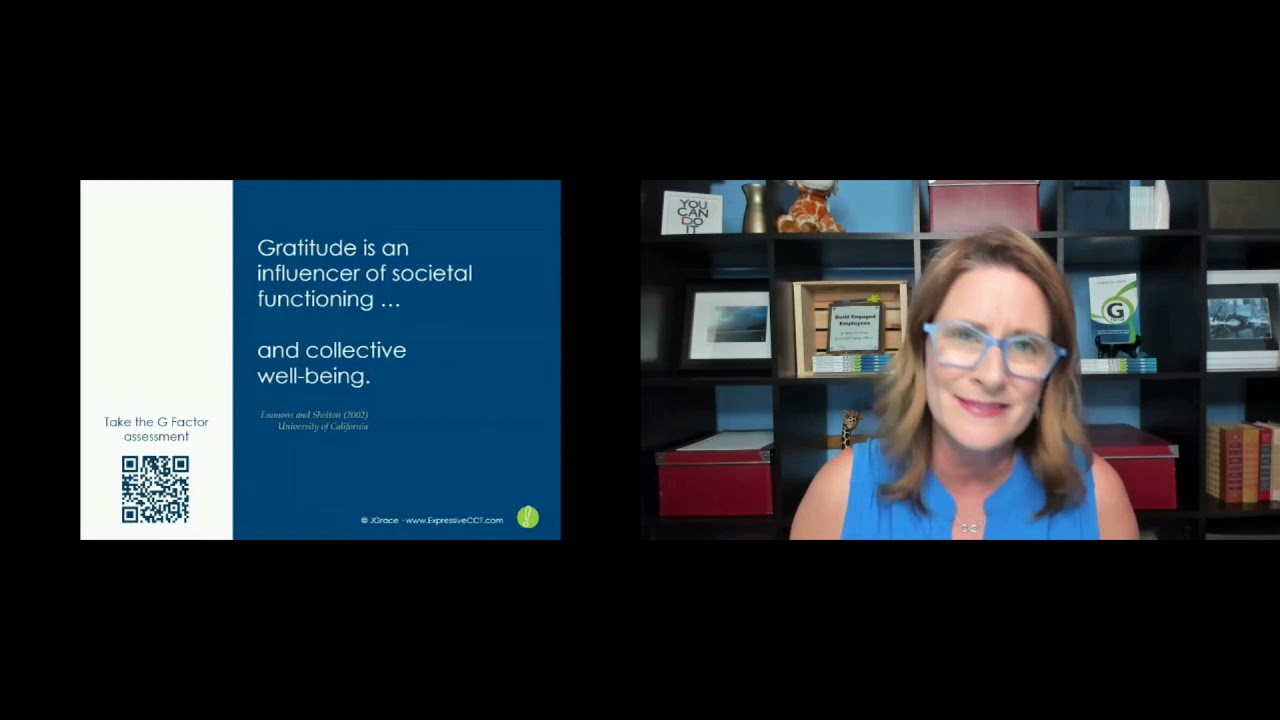
By the way, so what you're going to see before I go forward is a QR code over there in the bottom left corner. That is if you would like to take the G factor assessment. So what I'm talking about today, I did create this book that I'm going to talk about in a moment so you can get the book on Amazon. But if you want to take the assessment to find out where your G factor is, feel free to do that. There are actually eight G factors and with 20 minutes, I only get to share one with you today. So it's a great way to get access to learn what the other ones are. All right, so let's talk about G factor, right? What creates this this gravitational pull? Here's what I did. I surveyed 834 working professionals.
I put a survey out into the public, people I knew, people they knew, random strangers, and gathered both demographic data, as well as data that answered the question, why do you like working with people? What makes you trust someone? What makes you want to work for them? What makes you want to work with them? And I provided over 20 different descriptors. Now, what I didn't do is label them because I didn't want to bias any of the answers based on labels. So instead, I just pretty much put characteristics or behaviors. And I asked people, which ones are your top ones? And I took that data. And after I looked at that data, I was really surprised because some of the things that I thought my own theories, what I thought created G factor was not necessarily what
did create G factor. So from those 834 people, what I did is I wrote and published this book called G factor eight secrets to increasing your gravitational pull at work. And in this book, yes, there's the assessment. But again, you can take the assessment for free, click on that QR code, and it will take you right to the assessment. But I wanted to do a little more than just write on what those 834 people said, what they reported on. So I did more research. And I reflected on my own experiences, like, who are people in my life that represent these G factors? Who are the people in my life that I've wanted to work for, loved working for, loved working with. And from that, I developed some stories. I
also did some looking at what are the excuses we use? You know, how do we get in our own way? Because if you're someone that you want other people to gravitate to, you need to know what gets in your own way. And then also, I looked at the research that already exists that supports these concepts. So I'm going to be sharing some of that with you today. All right. So here is number one. What you get to hear today is the number one G factor, the number one secret that makes people want to work with us or for us. The number one secret that helps us to be influential, to help us to be sought after, that where we are seen as someone others want to be around, kind of having that it factor. So gratitude,
it means showing appreciation. So you might be thinking, wow, that doesn't sound very complicated. And you would think that it isn't, except we're missing opportunities all the time to express appreciation, to express our gratitude. So here's some research that I found that supports what these 834 working professionals said. There was research done in 2002. So this research is almost 20 years old. So you may say, well, Jeanette, that's kind of dated. And I get that. But what I can tell you is the other research that I've looked at continues to support this. So this was Eamons and Shelton. This was out of the University of California here in the United States. And what they found is that gratitude does influence societal functioning, as well as collective well-being. So how does this relate today? When
we're talking about employee engagement in the workplace, one of the tenets of employee engagement is employee well-being. Do employees feel like their leaders care? Do employees feel like their organizations care? So one way we create more well-being in the workplace and getting people to work with each other teams to work effectively and productively is we use gratitude. Now, what I want to say is that you just can't be throwing out thank yous here and there. It's really important. There's some research. If you have ever heard of the book, The Five Love Languages, they've also continued on and looked at that same concept in the workplace. And there are five languages of appreciation. So when we express gratitude, what those authors say is that it has to be genuine. It has to be genuine. It's by
Gary Chapman and Paul White, if you want to Google that, the five languages of appreciation in the workplace. So if you really want to enhance well-being and societal functioning in your workplace and on your teams, the gratitude you express really needs to be genuine and it needs to be meaningful. Here's some other interesting research. This came from Burson and Associates in 2012. Saying thank you, thank you, two words in however you say it in your language, saying thank you or making employee recognition a priority. Remarkably results in a 14% increase in employee engagement and their productivity. So employees are doing better when they're hearing thank you or that they are being shown that they are appreciated through recognition. So let's talk about recognition a little bit. Everybody likes to be
recognized differently. So it's important that we get to know one another in the workplace. So for example, one way for me to feel recognized or that a leader appreciates me is when they spend one-on-one time with me. That quality time where they know what I'm working on, where they're there to answer my questions, where they are curious about my ideas.
But that may not be the same language of appreciation for you. So we want to get to know the people around us, the people we work for, the people that we lead and figure out really what it is that makes them tick. How does the thank you need to sound? What does it need to look like? All right, some other interesting research. This comes out of the field of positive psychology.
Martin Seligman is considered to be probably the father of positive psychology. Excuse me for a moment. And what he found when he did some research, this was published, by the way, in the Harvard Medical School Health Letter about 10 years ago, he had students write and then personally deliver a letter of gratitude. So not an email, not a text message, but write with their hand on a card, on a piece of paper, and then deliver to that person that letter of thanks, that letter of appreciation, the gratitude. And what he found is when people did that, their happiness scores had a huge increase.
So this is what's so cool about G-Factor is not only does it increase somebody else's happiness, but it increase yours. So there's like a double return on investment. I'm going to look at something here. Oh, Melinda. So it is saying that it is not secure. Okay. So Melinda put in the chat, I noticed to take the G-Factor assessment and it says it is not secure. Is there any other way to take this? Tell you what, Melinda, if you, I'm, what I'm going to do is throw my email here into the chat, because I, honestly, I cannot tell you why it's doing that. It should be secure. It's attached to my website and my website is supposed to be secure. So very concerning. So thank you for that, Melinda.
So if you, there's my email in, in the chat and any of you, if you're finding you're having problems with it as well, or you're uncomfortable with that notice, um, send me an email and I'll make sure that I get the link to the assessment with you after I figure out what's going on on the back end. So, so thank you for that.
All right. So, um, going on, cause we have, gosh, we're already at seven minutes. So think about this. If, when you want to express appreciation, where are the opportunities to write it down? Even if it's on a post-it, but even better, a card with, you know, an envelope that you have to close and write somebody's name on it and personally deliver it to them. You know, in the time of COVID, we may not have that luxury, so it's okay to pop it in the mail, but you are going to increase your ability to get others to want to work with you or for you just by expressing appreciation by writing a note of gratitude.
All right. So some excuses I hear from people, let's talk about those for a moment. One is why should I have to? And the sentiment here is why should I have to thank you for doing what you were hired to do or for doing your job. You're supposed to create that report. You're supposed to edit that. You're supposed to share your ideas. You're supposed to be on time for a meeting. And the truth is, you don't have to. Absolutely. It is your right. It is your choice not to express appreciation. But what the research is telling us is that when you do recognize it, that somebody made an effort to do something well, to do it on time, to be there on time, when you express that appreciation, guess what?
You perpetuate that behavior because human beings are really simple. We respond to that positive reinforcement. So if you ever ask yourself, but why should I have to thank this person for fill in the blank? Know that you don't have to. But if you do, and if it is genuine, you are going to increase your g-factor. Okay. And Ella says the QR code worked for her. Okay. So the QR code and it's not showing insecure. So again, for those of you, if you didn't see that, my -- and thank you, Graziella, for putting my website in there.
And if you email me, because I have to give you a particular link for that g-factor assessment. If you email me, I'll make sure that you get that. Oh, you're also helpful. Thank you. I am grateful for you. I honestly do appreciate it. Okay. Another excuse I hear is, you know what, I'm just too busy. I'm too busy to take time to thank people. I have too much work to do. I have my own stuff that I need to take care of. But if you are to make gratitude a practice, a daily practice, genuine gratitude, you will not feel like you're too busy. So for example, one thing that I did, and again, this comes from positive psychology, is doing -- there's decades of research around this -- but writing down
three gratitudes at the end of every day, and being specific about what they are, and then sharing those things with people. Once I got into the habit, I wasn't too busy. And once I got into the routine, it actually was very quick to do. So make a goal for yourself where you seek out reasons to express your appreciation. Seek out people so that you start noticing that beauty around you. Because again, that's going to increase your G factor. All right. So as I said, there are eight different G factors, and you'll see those pop up here on your screen. And they go in order from the highest percentage from the research that I did to the lowest percentage. Now, remember, I asked about over 20 different
behaviors. So these were the top ones that came out of that research. I have some of my favorites. Gratitude is the number one. I think having a good sense of humor is a great, great skill to have as well. Generosity -- that is about showing kindness and concern to others. Guiding is how do we coach people better instead of directing? How do we ask more questions instead of telling people what to do?
Generate -- that is how do you inspire and be infectious? That is figuring out what makes you uniquely you. Because there's also some research around that that says with Generate, if you figure out your one distinguishing strength, something that makes you extra special, you double your chances of being inspiring. So that's really great news, right? Genius -- this is really about knowing what you're good at and also knowing what you're not good at.
Grant. Grant -- I talked about Grant earlier in my session this morning about psychological safety in the workplace. And Grant is giving yourself and other people permission to make mistakes. Intelligent failure. And then gather -- that one is about who do you have in your sphere of influence? Who do you have in your circle? And are they people who are lifting you up? Are they people who are helping you? Or are they the people that are dragging you down? So we want to think about who those people are? Because we want to be filling our world. Not with just guest people. Not just people who nod their head and tell us what we want to hear.
But people who are genuinely interested in giving us a good feedback so that we can continue to grow. So this is me. If you want to connect with me, feel free. You can find me on LinkedIn. There are two N's in my first name. That might be helpful. You can also find me on Twitter @ExpressiveTRNG for training and then Expressive CCT. That is my business Facebook page. And those are places where you'll find information. I do monthly webinars with the exception of June, free webinars around psychological safety. I put out an article every week. I'm posting some things that I read that are really interesting. So if this information is interesting to you and you want to learn more, that's a way to connect or hear what it is that I
share with you. So with that, we are at the final minute. Are there any questions that... Oh, thank you, Melinda. I love talking about this. It's one of my keynotes. So when I keynote, I get to talk about a couple others and we do some fun activities. But in 20 minutes, I had to really shrink it down.
Anything? Thank you so much. Janine, I hope I'm pronouncing your name correctly. Yes, I would love to connect. Reach out to me. The Gather Slice is so important. Knowing your tribe. I love it, Graziella. Knowing your tribe. So Amanda, thank you. Thank you. Whitney, thank you. Any tips if one gets less than 10? That's where the book really comes in and help. That was from Ella. The book, what I have at the back of the book is actually an action plan. So you can look at what your G factors are and it has multiple suggestions and then it also takes you a plan to figure out how to apply that so you can grow your G factor. So my time is up. Thank you so much for being here. Enjoy the rest of your conference.
Transcribed automatically; names checked against the speaker record. Select a time to jump there.
Article based on this talk
Why gratitude is the top reason people want to work with you
Jeannette Grace's survey of 834 working professionals puts genuine appreciation at the heart of workplace influence.
In short
Jeannette Grace, CEO of Expressive! Communication Consulting & Training, argues that the trait most likely to make people want to work with you or for you is gratitude. Drawing on her survey of 834 working professionals and research from positive psychology, she shows that appreciation builds influence only when it is genuine, specific and expressed in a way the other person values. Her advice is practical: write it down, deliver it personally and make it a daily habit.
Key takeaways
Find out what makes someone not want to work with you.
Discover how to be the person others trust and respect.
Learn how to increase your gravitational pull.
Why some people pull us in
Grace starts with something everyone recognizes: babies attract strangers, neighbors and even animals. At work, she noticed the same pattern. There are people whose teams we want to join, and people we avoid in the hallway or hope never to share a project with. Curious about what gives some people that "it factor", she formed her own theories, then decided to test them.
"But I also was smart enough to know that those were just my theories and I needed to test them." (2:50)
She calls the result G factor: the gravitational pull that draws other people to us and improves our ability to influence them. For leaders and company owners, it is about attracting and keeping great talent. For individual contributors, it is about being sought after, being seen as a source of expertise and strengthening a personal brand.
To find out what really creates that pull, Grace surveyed 834 working professionals, asking what makes them trust someone and want to work with or for them. She offered more than 20 descriptors and deliberately avoided naming them.
"Now, what I didn't do is label them because I didn't want to bias any of the answers based on labels." (4:38)
The results surprised her: some of her own theories did not hold up. She turned the findings into the book G Factor: 8 Secrets to Increasing Your Gravitational Pull at Work, adding stories from her own career, the excuses people use to get in their own way and existing research behind each factor.
Gratitude, and why it has to be genuine
The number one G factor is gratitude, which Grace defines simply as showing appreciation. It sounds easy, she admits, and that is exactly the problem.
"And you would think that it isn't, except we're missing opportunities all the time to express appreciation, to express our gratitude." (7:11)
She supports the survey result with outside research, as the speaker cited it. A 2002 study by Emmons and Shelton at the University of California found that gratitude influences societal functioning and collective wellbeing. Grace links this to employee engagement, where a core question is whether employees feel their leaders and organizations care. She also cites 2012 research from Bersin & Associates finding that saying thank you, or making employee recognition a priority, resulted in a 14% increase in employee engagement and productivity.
But throwing out thank yous here and there is not enough. Pointing to Gary Chapman and Paul White's work on the five languages of appreciation in the workplace, she stresses that appreciation must be real.
"So if you really want to enhance well-being and societal functioning in your workplace and on your teams, the gratitude you express really needs to be genuine and it needs to be meaningful." (9:08)
People also like to be recognized differently. Grace herself feels most appreciated when a leader spends one-on-one time with her, knows what she is working on and is curious about her ideas. That may not be true for others, so she urges viewers to learn what makes the people they work with and lead tick, and what a thank you needs to look and sound like for them.
Write it down and deliver it
From positive psychology, Grace cites Martin Seligman, often described as its father. In research reported in the Harvard Medical School Health Letter, students wrote a letter of gratitude by hand and delivered it in person. Their happiness scores rose sharply. The benefit, she notes, flows both ways.
"So this is what's so cool about G-Factor is not only does it increase somebody else's happiness, but it increase yours. So there's like a double return on investment." (11:54)
Her practical suggestion: look for opportunities to write appreciation down. A sticky note works, but a card in a sealed envelope with the person's name on it, delivered personally, is even better. If meeting in person is not possible, mailing it is fine.
The excuses that get in the way
Grace addresses two excuses she hears often. The first is "why should I have to?", the feeling that people should not be thanked for doing the job they were hired to do. Her answer is that you don't have to. It is your choice. But recognizing effort, quality and punctuality encourages more of it.
"You perpetuate that behavior because human beings are really simple. We respond to that positive reinforcement." (14:28)
The second excuse is being too busy. Grace's answer is to make gratitude a routine. She writes down three specific gratitudes at the end of every day and shares them with people, a practice from positive psychology. Once it became a habit, it took very little time.
"But if you are to make gratitude a practice, a daily practice, genuine gratitude, you will not feel like you're too busy." (15:04)
The other seven G factors
With only 20 minutes, Grace briefly lists the remaining factors, ranked by how often survey respondents chose them: a good sense of humor; generosity, showing kindness and concern; guiding, coaching by asking questions instead of directing; generate, finding your one distinguishing strength to become more inspiring; genius, knowing what you are and are not good at; grant, giving yourself and others permission to make mistakes; and gather, surrounding yourself with people who give honest feedback and help you grow rather than simply nodding along. For anyone who scores low on the assessment, she points to the action plan at the back of her book.
Watch the talk
"Secrets of People We Like to Work for and With" by Jeannette Grace, 20 minutes: https://www.womentech.net/video/secrets-people-we-work-and
About the speaker
Jeannette Grace is CEO of Expressive! Communication Consulting & Training and a communication, training and development expert with over 20 years of experience, who helps leaders build psychological safety and remove communication roadblocks in their organizations. She is also the author of G Factor: 8 Secrets to Increasing Your Gravitational Pull at Work.
Questions this talk answers
What is G factor?
What is the number one trait that makes people want to work with you?
Is saying thank you enough?
What is the most effective way to express gratitude?
Why should I thank people for just doing their job, and what if I'm too busy?
Drafted with AI from the talk transcript. Editor review pending.
Frameworks and ideas mentioned
G Factor (eight G factors)
Five languages of appreciation in the workplace
The Five Love Languages
Positive psychology
Three gratitudes daily practice
Resources mentioned
G Factor: 8 Secrets to Increasing Your Gravitational Pull at Work (book, on Amazon)
G Factor assessment (via QR code on the speaker's website)
The 5 Languages of Appreciation in the Workplace by Gary Chapman and Paul White
The Five Love Languages
Speaker's free monthly webinars on psychological safety
Cite this talk
Jeannette Grace. "Secrets of People We Like to Work for and With." WomenTech Network, 2021. https://www.womentech.net/video/secrets-people-we-work-and