
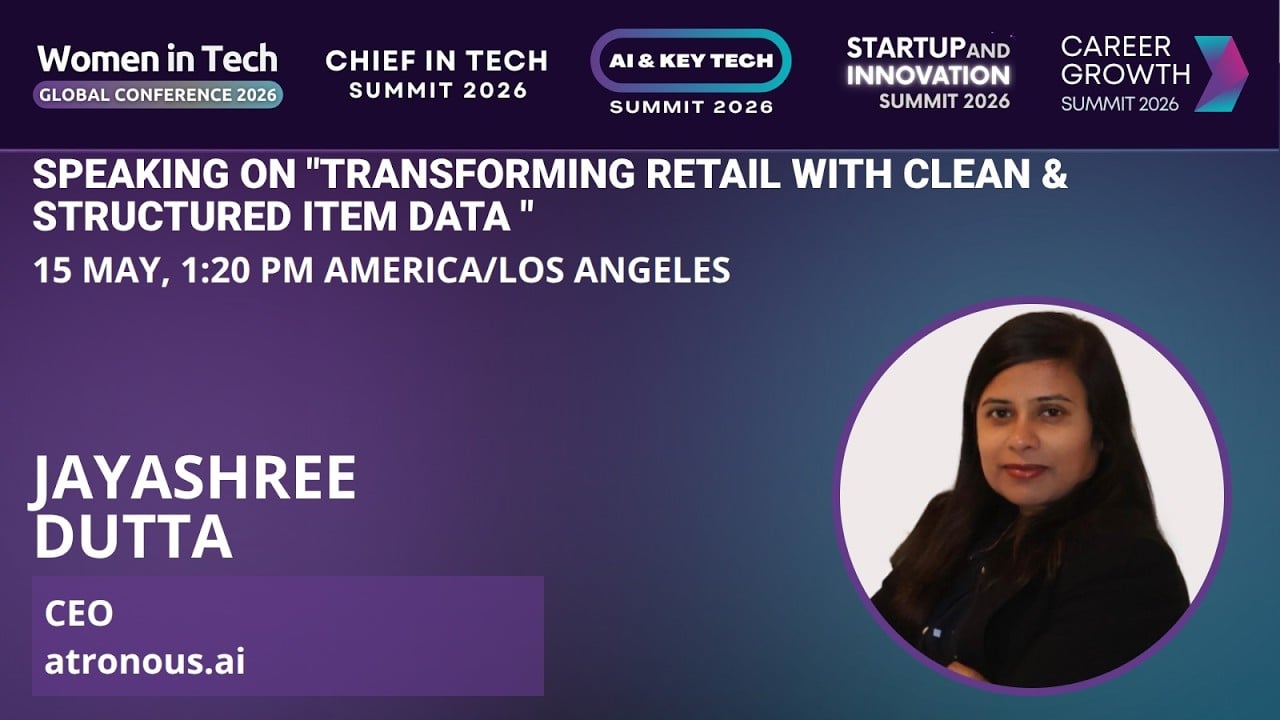
Transforming Retail with Clean & Structured Item Data
Retailers can't list 70% of their products, and AI agents raise the stakes
Retailers cannot list 70% of their products because the data arriving from suppliers, brands and distributors is sparse, stale and fragmented. As shoppers move from keyword search to AI agents, that broken catalog data threatens search, recommendations and conversational commerce alike. Jayashree Dutta, CEO of atronous.ai, who previously led a real-time data platform team at Walmart Labs, asks why simply prompting a general-purpose LLM cannot fix the problem.
See where LLM prompting fails on retail catalogs and what agent-ready product data needs
In short
Jayashree Dutta, CEO of atronous.ai, argues that broken, sparse and fragmented upstream product data stops retailers from listing most of their products. She says the problem now matters more because AI agents need clean, structured, machine-readable data, and general-purpose LLM prompting can't fix it reliably. Her answer is to fix data quality first, then attribute products intelligently, then build dynamic, personalized attributes.
“Now, the data downstream as is as good as the data upstream.”
“So first we need to fix the quality of data. Then we need to intelligently attribute.”
What you will learn
- Recognize how sparse, stale and fragmented supplier data stops products from being listed and costs revenue
- Explain why agentic and AI-driven commerce needs clean, structured, machine-readable product data
- Identify where general-purpose LLM prompting fails on retail catalogs, from variant grouping to parent and child SKU sizes
- Sequence product data work: fix quality first, then attribute intelligently, then prepare for AI commerce
- Plan for dynamic, personalized product attributes that change with the shopper, such as contractor versus DIY homeowner
Key takeaways from the speaker
- Understanding the breadth and scope of broken data and how AI can address this challenge for the retail industry
Details
- Level
- Intermediate
- Format
- Lightning talk
- Technical depth
- Introductory technical
- For
- Mid-career, People manager, Executive
- Length
- 8:20
- Published
- September 2026
Questions this talk answers
Why can't retailers list so many of their products?
Data from upstream suppliers, brands and distributors is sparse, missing key attributes, stale and fragmented, so about 70% of products cannot be listed and revenue is left on the table.
Why is fixing product data more urgent now?
Shopping has shifted from keyword search to influencers and now to AI agents, and agentic commerce requires clean, structured, machine-readable data that the retail ecosystem largely lacks.
Why not just prompt an LLM like Claude or Gemini to clean catalog data?
Horizontal LLMs are not specialized for retail and create hallucination risks. They group variants in fixed ways, get apparel measurements wrong, pick parent rather than child SKU sizes and struggle to spot duplicates.
What order should retailers follow to prepare data for AI commerce?
First fix data quality, then attribute products intelligently, and only then are they ready for AI commerce.
What will product attributes look like in the future?
They will be dynamic and personalized, for example suggesting different fasteners and related products to a contractor than to a DIY homeowner.
About this talk
The scale of the item data problem in retail is real: poor or incomplete product data is estimated to cost retailers nearly $3.9 trillion annually in lost sales and abandoned carts (data from VMG Partners). It's something we hear about constantly across the broader retail ecosystem, retailers managing thousands of SKUs across dozens of channels, losing conversions not because of product quality, but because their upstream catalog data is incomplete, inconsistent, or simply not structured for how modern commerce actually works. As AI agent-led discovery increasingly dominates commerce, a trend that is only accelerating, the bar for clean, structured product data has never been higher.
Topics
Highlights
- Shopping has shifted from keywords to AI agents (65 s)
- Why LLM prompting can't fix retail catalogs (71 s)
- The future: dynamic, personalized product attributes (44 s)
Jayashree Dutta: Hi, everyone. It's a pleasure to speak about the challenges in the modern era for retail data. And I'm Jayashree Dutta, co-founder and CEO of Atronus AI. A little bit of background before we get started. My entire career has been at the juncture of AI, data, and retail and e-commerce. So most recently, before starting Atronus, I got a little bit of background before we get started. My entire career has been at the juncture of AI, data, and retail and e-commerce. So most recently, before starting Atronus, I started atronus.ai.
I used to work at the data platform team at Walmart. So let's talk about this problem that retailers face today. So 70% of their products cannot be listed because of data issues. And what does that mean? The data that retailers receive from upstream suppliers, brands, and even distributors is really broken. That data is sparse, it's missing key attributes, sometimes Jayashree Duttay: stale and fragmented, and that results in big challenges. And the problem is if retailers are not able to list the products, they're leaving revenue at the table. And significant amount of products have, we have the opportunity to really list a lot more products than we do today.
Jayashree Duttay: And so typically, what does the shape of data look in a retail e-commerce operations organization? So these operations folks deal with data that come to them from multiple different systems, unstructured data coming from like supplier spreadsheets, or pricing sheets, or an ERP export, or from a PDF or from images. So it's all Jayashree Duttay: all over the place. And then they need to use this data to make sense of everything else downstream. Now, the data downstream as is as good as the data upstream. So when you have clean structured data that is being generated from all your upstream sources, your downstream data becomes much, much better. But if you have clean, if you have unstructured data, Jayashree Duttay: large data missing data missing data in your upstream sources, then guess what, your conversational commerce will be broken, your AI driven search will be broken, your entire agentic experience will be broken.
Jayashree Duttay: So why is this problem more important than ever to fix now? That's because AI commerce and agentic commerce is here and here to stay. And agentic commerce, Jayashree Duttay: AI driven commerce requires clean structured machine readable data, which unfortunately is very much missing in the retail ecosystem. And the shopping behavior is changing across agents. So we were in a world where people used to directly search for keywords on Google and Amazon. Then shopping behavior online shifted to more of influencer Jayashree Duttay: So we have an influencer based searching and influencer based searching and influencer based following. And now it is now shifted to agents. People are searching for styles for recommendations for things they like for suggestions. And that needs clean structured and again machine readable data.
Jayashree Duttay: So you would think that the best way to fix this problem today is through LLM prompting. So we have Claude and Gemini and open AI. So why don't we prompt those LLM agents to create these data sets? The problem is that that creates hallucination risks. And the information that these, you know, vertical Jayashree Duttay: Or these essentially horizontal agents have is not verticalized to retail or any particular domain. And so it causes all sorts of discrepancies. So sometimes in a retail scenario, it is important to have the Jayashree Duttay: The products that you know are grouped together which are known as variants to it is important for merchandisers to decide on what products should be grouped together. But LLMs always group them in a certain way. LLMs always group like get some measurements wrong about different apparel items. They always pick the
Jayashree Duttay: The sizes associated with the parent's skew rather than the child skew. Then it's hard to know which products are duplicate because every brand and retailer tags them differently. Jayashree Duttay: So what is the future then and how should we think about creating this data for the future of commerce? So first we need to fix the quality of data. Then we need to intelligently attribute. And then only can we be ready for the future of AI commerce.
Jayashree Duttay: So let's take an example. In this particular problem, these nails or fasteners, it's very hard to find them and you have to have the right keywords on your Home Depot or Amazon site to discover them, right? But then you can make it further intelligent by providing Jayashree Duttay: Relationships between different fasteners and other door handles and other installation products so that it shows up better. But that is the current state. But the future state is more Jayashree Duttay: More personalized attribute attribution. So you know that a contractor or a DIY homeowner is coming in and you make suggestions according to that. So data attributes need to be dynamic and they need to be personalized in the future world.
Jayashree Duttay: And so this is where I want to use this as a plug to introduce our company. Atronus AI is a foundational product data intelligence layer, which creates this clean structured data for the future. Jayashree Duttay: So we look at data from all of the different incoming upstream sources and we aggregated and we provide that system of intelligence which connects the dot between the entire operational data in retail.
Jayashree Duttay: And we don't work based on just an LLM prompting we have built a proprietary knowledge graph consisting of 30 million plus products and continuously learning and with that graph, we are creating better relationships between different products. Jayashree Duttay: We are creating different dynamic attributes and public and also better attribution overall. So this is how it works in practice. This is upstream data coming from vendor. This is how atronus enriches with all of this information derived intelligently through our product knowledge graph.
Jayashree Duttay: Again, let's take another example. This is how the current data looks in on a PDP side for this distributor. This is the data with the Trotus clean unified with taxonomies. The schema correctly defined and small the ability to process multiple such products in a day. Jayashree Duttay: Ultimately, I want to leave you with this clean data is really important for brands and retailers in today's world that drives the future of revenue.
Jayashree Duttay: And also in this era of the agentic commerce, your data is has to be perfect. It has to be contextual. It has to be absolutely representative of the target demography viewing the data. Jayashree Duttay: It needs to be personalized. And if it is not ready for the for the future, the data is not ready for the future, then your entire AI and agentic commerce will break. So with that, thank you very much for the for listening to me.
Transcribed automatically; names checked against the speaker record. Select a time to jump there.
Frameworks and ideas mentioned
- Fix quality, intelligently attribute, then AI commerce readiness
Cite this talk
Jayashree Dutta. "Transforming Retail with Clean & Structured Item Data." WomenTech Network, 2026. https://www.womentech.net/video/transforming-retail-clean-structured-item-data
Related talks
Browse the library
Data Strategy for AI Adoption
 Pooja Kelgaonkar
Senior Data Architect, Rackspace Technology
Teams can borrow AI skills, but not a decade of AI-ready data

Weaving the Fabric of Data
 Amanda Darcangelo
Data Consultant, CTI Data
Without usability, your data fabric is just an expensive paperweight
Agentic AI: The Next Evolution in Data Modernization for Enterprise Success
 Harsha Upadhyay
Founder, allaboutdata.net
AI agents can act on their own, but only on data that is ready for them

Harnessing the Potential of Unstructured Data to Drive Enterprise Success
 Dhivya Nagasubramanian
Lead AI Solutions Architect, Fortune 500 Company
Ignoring unstructured data is a bigger risk than taming its complexity

The Future of AI: AI Strategy Beyond Generative Models
 Samira Golsefid
VP of Data Science, 6sense
Generative AI doesn't know why, and your AI strategy can't stop there

A Product Manager’s Toolkit for Building AI‑Powered Products
 Manasi Ghogare
Senior Technical Product Manager, Takeda Pharmaceuticals
A new AI model arrives almost every week, so your product is never done