She asked to be made partner and was promoted within a month
Schneider Electric's leaders scored high on resilience, yet an internal exercise flagged adaptiveness as the area to strengthen. Tina Mylon, the company's Chief Talent and Diversity Officer, is moving 160,000 employees to a skills-first career model, and she points to data showing women pitch for jobs and promotions less often. So what keeps a career sustainable when AI keeps changing which skills count?
Get her four career fundamentals, including how she pitched her own partner promotion
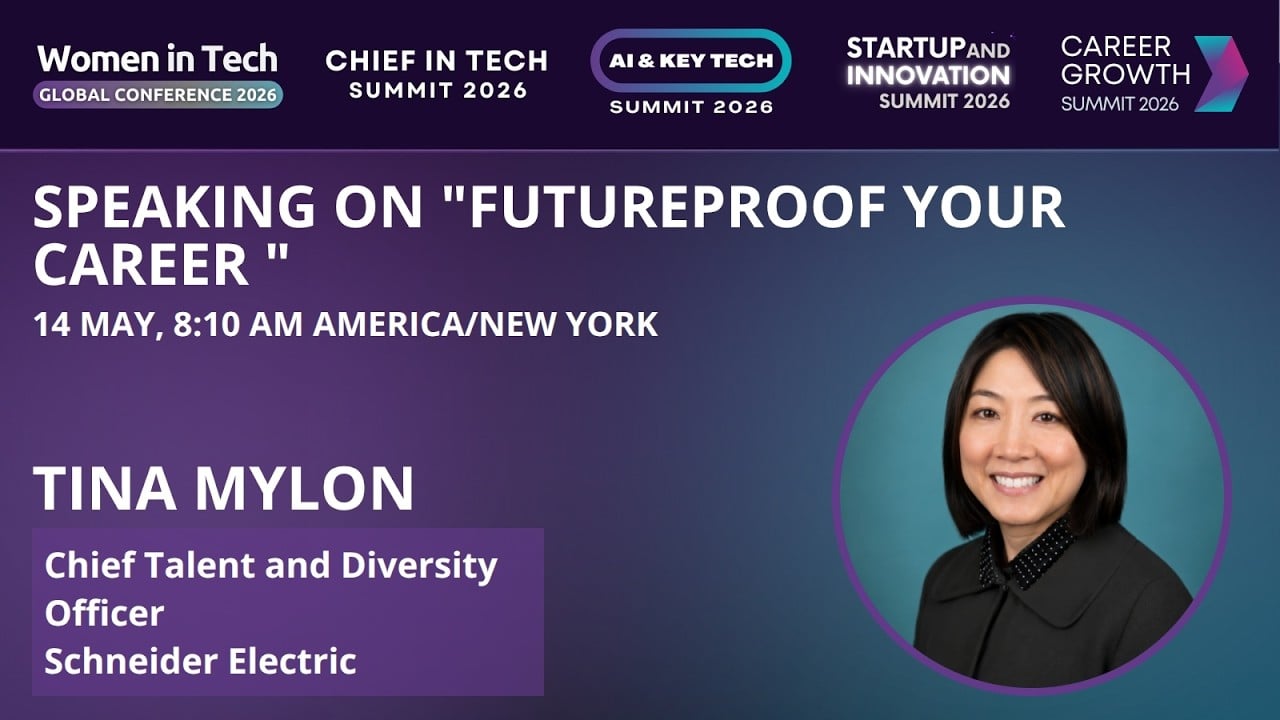
Tina Mylon, Chief Talent and Diversity Officer at Schneider Electric, draws on the company's skills-first career transformation for 160,000 employees to explain what keeps a career sustainable during disruptive change. She offers four fundamentals: build a career map, power up human skills alongside technical ones, seek sponsorship rather than just networks, and pitch for the job instead of waiting to be noticed.
“At Schneider, the premise is that we want to, just like for sustainable energy, we want to support sustainable careers.”
“But in our experience, we also found that resilience doesn't mean adaptiveness.”
What you will learn
Build a career map by defining a destination and working backwards to the steps and skills that lead there.
Distinguish resilience from adaptiveness and strengthen human skills such as empathy, presence, opinion, creativity and hope alongside technical expertise.
Identify five to ten sponsors with a vested interest in your growth instead of relying on the size of your network.
Pitch for a job, promotion or newly imagined role using data rather than waiting to be recognized.
Recognize how an employer can support employee-owned careers through skills data, a career hub, learning and equitable access.
Key takeaways from the speaker
gain insights and tips on owning own's career
Details
Level
Intermediate
Format
Talk
Technical depth
Non-technical
For
Early career, Mid-career, Senior individual contributor
Length
16:51
Published
June 2026
Questions this talk answers
What does it mean to build a career map?
It means defining your destination point rather than only the next job, then working backwards to the logical steps and skills that will get you there. The map gives you an anchor while leaving room for pivots and alternatives.
Why do human skills matter if you already have strong technical skills?
Mylon says Schneider and external data show human skills matter most as careers progress, while technology such as generative AI keeps changing. She cites an MIT study naming empathy, presence, opinion, creativity and hope as skills rising in importance with AI.
How is a sponsor different from a mentor or a wide network?
A sponsor is an advocate who takes a vested interest in your growth, whereas a mentor often acts as a sounding board. She suggests finding your top five to ten sponsors beyond your thousands of connections.
Should you wait to be recognized for good work before getting promoted?
No. Mylon argues you should ask for the opportunity and pitch it with data, as she did when she asked to become partner at her consulting firm and was promoted within a month.
How is Schneider Electric helping employees own their careers?
Through a skills-first transformation with a career hub, a consistent global data foundation on in-demand skills and career paths, learning programs and a culture reset. It is built on equity, data transparency, accountability and agency.
About this talk
Tina will share insights from Schneider Electric's leadership, skills and culture transformation journey on what really matters when it comes to building a sustainable career, especially during times of rapid and disruptive change.
Speaker 1: My session is on future proof your career, and this is not going to be a locked in panacea of how we each for future proof your career, but I'd like to share a few perspectives on what we're learning at Schneider Electric and our overall career and skills transformation journey and how that might apply to you when you're thinking about how you are growing yourself over the course of your career. So let's get started. Starting a little bit on Schneider Electric, and I think you know our business and our mission, but just as a reminder, and this was the impetus for our career and skill transformation at the company, that at the end of the day, we are very much in the space of energy and really thinking about the future of energy in a more
resilient and sustainable way, and that it, in fact, touches all of us around the world. Speaker 1: This was the impetus that our CEO and also our leadership gave us as we really start to refresh last year, our company mission about really being energy technology partner to everyone, both in terms of customers and business, but also society at large to think about digitizing, automating, electrifying energy at all levels so that we're really providing efficiency and sustainability in every end center that we think about from homes to buildings to data centers, infrastructure and industry. So when you think about that, and you think about it for your own organization, every company has a mission. And part of what was we were taken as a task is, okay, what do
you do about it? How do you animate and energize our workforce, 160,000 people equally distributed around the regions of the world, both on shop floor and also in an office setting? How do you animate and encourage them to take that mission to heart and apply it not only to customers in business, but to themselves to drive more performance, more simplicity, more speed? That was our like to do, if you will, from a career and skill perspective. What we started last year, and I have to say we're in early stages, is really thinking then what that means for an employee. And what we thought about was a true skills first transformation, right skills, right time, in the spirit of an end to end way that our bill part of our
workforce, our employees really taking responsibility and agency to drive their own career. It sounds very straightforward. You can imagine at scale to really have the right data, to have the right employee experience, to have the right framework or architecture for career, to have the right programs and processes so that employees can take up that agency and also accelerate career and build skill. That is something we're in the exciting journey of. And we really wanted at the endpoint for employees at all different levels and all different domains, but especially in the energy tech space where we operate, to understand, shape and build and grow career. Not that they're left on their own, but that they have the tools and the agency and the responsibility to do that. I share here, this was also produced as part of our project,
or our transformation, my own starter pack of some of the power skills that I knew I wanted to not only leverage and highlight for my own career evolution, but also to continue growing, whether it be strategic visioning, to data insights, to communicating with influence, to really having a global mindset. We produce these starter packs as a way to, you know, stimulate where are you today? Where do you want to be tomorrow? And the whole transformation was based on the sense of equity. So starting with level playing field, having that data transparency and access to that data to understand what skills mattered, what career paths were most in demand at Schneider Electric, and then ultimately the accountability and agency. Like I said, employees not being on their own, lots of guardrails with people and systems and tools, but really making
sure that empowerment and agency is there. In this early part, some months in, what have we achieved? We have gotten a good portion of our employee base, but not as many as we have need yet, in the career hub, engaged on thinking about their profiles, defining their career destination, identifying skills, and especially in the areas of where they want where they want to upskill and where they want to accelerate career. We've built out that data foundation of architecture consistently across the world. We have people then downstream also taking action when it comes to skilling and learning, because we know at the end of the day, that is probably the one of the most differentiated ways to stay ahead of the game. And then we've really thought about a culture reset in terms of
working smart and mission-based to focus on the things that matter the most for the business and also make sure that people are supporting and feeling equitable in that experience. In a nutshell, it's been quite an exciting ride. We have a long way to go, and we know that from our people, and also when I look at my talent management lens, what have we learned? What have we learned on this career and skill transformation when it comes to helping our people future-proof, stabilize, and anchor a career evolution? At Schneider, the premise is that we want to, just like for sustainable energy, we want to support sustainable careers. The honest truth is, whether someone stays with us five years or 50 years, our job is to make sure in the time that they're with us, they get that chance and they take that
opportunity. I try to apply four fundamentals to all of us here. They're really straightforward, so my job is to kind of stimulate your thinking on how they apply to your context, but we've learned a lot from our experience. The first one is to build a career map. We all know in this environment, especially now, when you look at the job market figures around the world, it is an interesting time, and in some cases, it's quite a volatile time, right? So we know that having a map, not just laser focus on what job do I need to do next, but truly what is my destination point, and from there working backwards, what are the logical steps that will get me to my destination point? That's what I mean by a map. That really
matters because it allows you to have an anchor point, but also to create some pivots and different alternatives to your destination. What we do at Schneider through this transformation is quite straightforward. It's what's your target destination? What are the steps that might get you there based on the supply and demand data of what jobs and careers are available? And then most granularly, and quite importantly, the skills. What are some of the skills that you need to kind of strengthen that pace to your career destination? So number one is build a career map. Number two is, I wrote here, power up your human skills too.
I know I'm speaking to super talented, super tech savvy group here, and almost taken for granted, fair or not, I assume all of us here have those technical, digital qualifications when it comes to deep domain expertise. You should continue that. But as we see in the Schneider data, but also in external data, as one moves up in career and career and evolves, we know equally those human skills matter most. Technology, even if you look at the space in AI, generative AI, it's constantly changing. And we know that to be able to really survive and thrive in that space, you have to build up some of some of those human skills. On the left, I share a very snippet exercise that we did at Schneider Electric when we looked at our leaders.
In those different various dimensions of human skills, what we found and where we see an opportunity to improve, we saw a high degree of resilience. And you hear that language all the time. Be resilient, adapt to a VUCA environment. That is absolutely true. But in our experience, we also found that resilience doesn't mean adaptiveness. And adaptiveness as a human skill is something where, at least at Schneider, but I imagine also applies more broadly, is somewhere where we want to continue to enhance and strengthen.
So what we did there is really also look at not only being resilient and fighting spirit, but how agile in your learning, in your confronting change, in your adaptivity to business environments that are shifting every day, how much can you do there? On the right, I also share a recent study from some professors from MIT, who is a key partner with us in some of our leadership development programs, especially for tech talent. Again, just to reinforce, with the importance of tech skills, digital skills, AI skills, don't forget those human skills too. This framework is a simple one. I like it. They call it the EPOC framework of the top five human skills that increase in importance as digital and AI gains in prominence as well. In their analysis, empathy, presence, opinion, creativity, and hope were those real
differentiators. Let's be clear, not all of those are easy that you can just go into a classroom and build. Some of them require real practice, and some of them are part of your innate kind of way of how you think and learn. But I wanted to emphasize element number two of really powering up your human skills as well.
Number three, and I have four, just to manage your expectations. This is an oldie but goodie, but I really believe this is something that we need to spend more time with. I think in this day and age where we are constantly channeled by speed and numbers, everyone's seeking the 1 million eyeballs or the 10 million clicks. Sometimes we've moved or forgotten that a network or a relationship in terms of its depth probably has more impact on your career and future proofing it as well as your career growth. And so the simple premise or a reminder here is that building out an extensive network is awesome, should always be done. People do it through all forms, including social media, LinkedIn, etc.
But having some deeper, more meaningful, meaning folks that can really be advocates for you versus just sounding boards like a mentor. That notion of sponsorship, I think still matters and maybe even matters more in this very volatile environment that we're in. So how do we do that? At Schneider Electric, we also have select programs around that, you know, targeting certain areas or certain profiles, but actually including anyone who wants to join. We really want to make sure that the spirit of equitable access and leveling the playing field will be able to access and leveling the playing field. And sponsorship sometimes can have that, right?
If you're living in a certain market, they not be where the headquarters is or you're working in an area in your company that may not be as interconnected or transversely linked to other aspects of the company. We want to make sure, certainly at Schneider, that we level the playing ground and the sponsorship programs and matching key sponsors who are going to take not only a mild interest, but a vested interest in one's growth. This was something we found to be much deeper and much more meaningful and impact impactful.
So straightforward lesson to all of us is how do you find those top five to 10 sponsors, if you will, that are more than just part of your thousands and thousands of network? So that's one other piece. Last one, and I want to spend a little bit of time on this is pitch the job. And I think this one is also something that is quite straightforward. But in the same way that we've learned, sometimes asking for something, however basic, yet in the end, ultimately easily surpassed or easily put to the side, however basic that that may be, that matters, right?
If you've done those other things of really mapping your career, upskilling in all those areas, building out your sponsorship network, ultimately, that last mile is up to us, right? And what I've seen in the past, and what works is ultimately making sure that you ask for the opportunity. And sometimes you have to pitch that. It doesn't necessarily mean you will see the job open in a system and it naturally flows to you.
Or if I put my head down and do good work, I will be recognized and, you know, the job will come. In many instances, and I look back at my own career when I spent quite a number of years in the human capital consulting space. The moment for me that really was a shocker, and it was so obvious, was at some stage working in that job, I brought my data together and I asked for the job.
I asked for the promotion to be partner at my old consulting firm. And I wasn't doing that because it was just something that, you know, it was a natural thing to do. It was at collecting the data and actually having a sponsor, a sponsor of mine say, Tina, when you look at the data in terms of what's required, you fulfill all of that criteria.
If they are not seeing it, meaning the company, maybe you should just pitch it. And that's what I did. And within a month, I was granted that promotion. Now, that's just a case of one, and it doesn't, it ended up being a positive outcome. But my emphasis here is sometimes we do have to be self advocates with the data, of course, to pitch for the job, the opportunity, the promotion.
And in many instances, it's also maybe not a job description that's in the applicant tracking system for an open position. Maybe it's something that your organization hasn't even imagined before. Culling together, curating some of your own passions and skills, that could be an opportunity as well. So from that, and with the Schneider Electric experience, this is what we're trying to do when it comes at scale, really thinking about how we can have all our employees build sustainable careers.
Like I said, whether they stay five years or 50 years, of course we care. But the more important thing is that we believe, whatever the tenure, they really were able to optimize their career growth and their skill development. Of course, in recognition and in support of growing Schneider, but also in recognition and support of growing themselves. That was the spirit of our transformation.
I'll definitely keep you guys posted on that. But then back to your own career, I go back to these four fundamentals. Build a career map. Power up your human skills, too, in addition to your technical skills. Seek sponsorship, not just networks. And pitch the job. Especially in the last data tells us that women tend to do this less.
And it's a real database reminder that agency and advocacy for oneself really matters at the end as well. So with that, I'm coming to a close. I know we have a few more minutes left, but wanted to close here. And hopefully you've got an insight into our Schneider Electric story and you can apply some of these aspects to your own moment in your career, whatever stage you're in.
And take away something that you can really use to grow yourself. Thank you.
Transcribed automatically; names checked against the speaker record. Select a time to jump there.
Article based on this talk
What keeps a career sustainable when work changes fast?
Tina Mylon of Schneider Electric shares four fundamentals drawn from a company-wide skills transformation: map your destination, build human skills, find sponsors and pitch for the job.
In short
Tina Mylon, Chief Talent and Diversity Officer at Schneider Electric, argues that a career holds up through disruption when its owner takes real agency over it. Drawing on Schneider Electric's skills-first transformation, she offers four fundamentals: build a career map, power up human skills alongside technical ones, seek sponsorship rather than just networks, and pitch for the job you want.
Key takeaways
Gain insights and tips on owning your own career.
A company mission that became a career transformation
Mylon opens with the context behind her advice. Schneider Electric refreshed its mission around being an energy technology partner, focused on digitizing, automating and electrifying energy for homes, buildings, data centers, infrastructure and industry. The question for her team was how to energize a workforce of 160,000 people, spread across the regions of the world and working both on shop floors and in offices, to carry that mission into their own performance and growth.
The answer was a skills-first transformation, aiming for the right skills at the right time, in which employees take responsibility for their own careers, supported by data, a consistent career architecture, programs and tools. She stresses that agency does not mean being abandoned: "Not that they're left on their own, but that they have the tools and the agency and the responsibility to do that." (2:29)
The approach rests on equity: a level playing field, transparent data about which skills and career paths are most in demand, and accountability. Some months in, a good portion of employees have used a career hub to define career destinations and the skills they want to build, though Mylon is candid that the company is in early stages with a long way to go. The guiding premise is simple: "At Schneider, the premise is that we want to, just like for sustainable energy, we want to support sustainable careers." (5:03) Whether someone stays five years or 50, the goal is that they grow while they are there.
Build a career map
The first fundamental responds to a volatile job market. Rather than focusing narrowly on the next role, Mylon recommends defining an end point and working backwards. "So we know that having a map, not just laser focus on what job do I need to do next, but truly what is my destination point, and from there working backwards, what are the logical steps that will get me to my destination point?" (5:57)
A map provides an anchor while leaving room for pivots and alternative routes. At Schneider Electric the process asks three things: what is your target destination, which steps could get you there given supply and demand data on available roles, and, most granularly, which skills need strengthening along the way. Mylon shares her own starter pack of power skills, including strategic visioning, data insights, communicating with influence and a global mindset, as an example of comparing where you are today with where you want to be.
Power up your human skills too
Speaking to a tech-savvy audience, Mylon encourages continued investment in deep technical and digital expertise, but notes that both Schneider's internal data and external data show human skills matter more as careers progress. Technology, including generative AI, keeps changing, and thriving in that space takes more than domain knowledge.
An exercise with Schneider leaders revealed a useful distinction. Leaders scored high on resilience, yet: "But in our experience, we also found that resilience doesn't mean adaptiveness." (8:20) Adaptiveness, meaning agility in learning, in confronting change and in adjusting to business environments that shift every day, became an area to strengthen.
She also highlights a study by MIT professors (MIT is a partner in Schneider's leadership development programs for tech talent) describing the EPOCH framework: empathy, presence, opinion, creativity and hope, five human skills that gain importance as digital technology and AI become more prominent. Mylon is realistic about how these are built: "Some of them require real practice, and some of them are part of your innate kind of way of how you think and learn." (9:55)
Seek sponsorship, not just networks
The third fundamental is an old but reliable piece of advice. In a culture chasing millions of clicks and connections, Mylon argues, people forget that the depth of a relationship often has more impact on a career than its breadth. Wide networks, including on LinkedIn, remain valuable, but sponsors differ from mentors who act as sounding boards: sponsors advocate for you and take a vested interest in your growth.
Schneider Electric runs sponsorship programs that target certain profiles but are open to anyone who wants to join, aiming to level the playing field for people working far from headquarters or in less connected parts of the business. Her practical challenge to viewers: "So straightforward lesson to all of us is how do you find those top five to 10 sponsors, if you will, that are more than just part of your thousands and thousands of network?" (12:18)
Pitch the job
The final fundamental is the last mile, and Mylon says it is up to each person. Mapping, upskilling and sponsorship set the stage, but opportunities rarely flow automatically to people who keep their heads down and wait to be recognized. "And what I've seen in the past, and what works is ultimately making sure that you ask for the opportunity. And sometimes you have to pitch that." (13:00)
She illustrates this with her own story from her years in human capital consulting. After she gathered her data, a sponsor told her she met all the criteria for partner and suggested that, if the firm was not seeing it, she should pitch it. She did, and within a month she was promoted. She is careful to call it a single case, but the lesson holds: "But my emphasis here is sometimes we do have to be self advocates with the data, of course, to pitch for the job, the opportunity, the promotion." (14:22) The opportunity may not even exist yet; it might be a role the organization has never imagined, shaped from your own passions and skills.
In closing, Mylon notes that data shows women tend to pitch for jobs less, a reminder that agency and self-advocacy matter at every career stage.
Watch the talk
Futureproof Your Career, Tina Mylon, 17 minutes: https://www.womentech.net/video/futureproof-your-career-tina-mylon
About the speaker
Tina Mylon is the Chief Talent and Diversity Officer at Schneider Electric. She is responsible for talent, learning, inclusion and care, leadership and culture.
Questions this talk answers
What does it mean to build a career map?
Why do human skills matter if you already have strong technical skills?
How is a sponsor different from a mentor or a wide network?
Should you wait to be recognized for good work before getting promoted?
How is Schneider Electric helping employees own their careers?
Drafted with AI from the talk transcript. Editor review pending.
Frameworks and ideas mentioned
EPOCH framework
VUCA
Resources mentioned
MIT study on the EPOCH human skills
Cite this talk
Tina Mylon. "Futureproof Your Career." WomenTech Network, 2026. https://www.womentech.net/video/futureproof-your-career-tina-mylon