But what is Machine Learning? : A complete starter pack
Mayuri Madhur30:572021
Deep Learning ersetzt Machine Learning nicht, es ist ein Teil davon
Den Wiederverkaufspreis eines Autos kann man allein anhand seines Alters leicht schätzen, bis Zustand und Kilometerstand in die Tabelle kommen und das Kopfrechnen versagt. Genau diese Lücke schließt Machine Learning, sagt Mayuri Madhur, Software Development Engineer bei Flipkart, und Neulinge verlieren sich oft im Fachjargon. Wo also stehen klassische Modelle, Ensembles, Reinforcement Learning und neuronale Netze wirklich, und wann ist welches Verfahren überlegen?
Erhalten Sie eine verständliche Übersicht der Machine-Learning-Arten und erfahren Sie, wann Sie welche wählen sollten
Mayuri Madhur, Software Development Engineer bei Flipkart, gibt Einsteigerinnen und Einsteigern eine strukturierte Übersicht über Machine Learning: was es ist, worin es sich von traditioneller Programmierung unterscheidet und wo es innerhalb der KI angesiedelt ist. Sie erläutert klassisches überwachtes und unüberwachtes Lernen, Reinforcement Learning, Ensembles und neuronale Netze und argumentiert, dass die Wahl des Modells vom Problem abhängt und nicht vom Hype um Deep Learning.
“Beim ersten Ansatz denken wir. Beim zweiten Ansatz denkt die Maschine.”
“Daher sind Daten das Wichtigste, damit unsere Maschinen lernen. Je vielfältiger die Daten, desto besser das Ergebnis.”
What you will learn
Unterscheiden Sie traditionelle regelbasierte Programmierung von Machine Learning, bei dem die Maschine die Regeln aus Daten und Ergebnissen ableitet.
Ordnen Sie Machine Learning innerhalb der KI ein, und neuronale Netze sowie Deep Learning innerhalb von Machine Learning.
Unterscheiden Sie überwachtes von unüberwachtem Lernen sowie Klassifikation von Regression anhand alltäglicher Beispiele.
Erklären Sie, wie Stacking, Bagging und Boosting schwache Lerner zu einem stärkeren Modell kombinieren.
Wählen Sie zwischen einem Ensemble-Modell und einem neuronalen Netz abhängig von Echtzeitanforderungen und Problemkomplexität.
Details
Level
Beginner
Format
Tech talk
Technical depth
Introductory technical
For
Student, Early career, Career changer
Length
30:57
Published
July 2021
Questions this talk answers
Worin unterscheidet sich Machine Learning von traditioneller Programmierung?
Bei der traditionellen Programmierung schreiben Menschen die Regeln und die Maschine erzeugt Ergebnisse; beim Machine Learning erhält die Maschine Daten und Ergebnisse und ermittelt die Regeln selbst. Diese gelernten Regeln können auf unterschiedliche Arten von Daten unterschiedlich wirken.
Sind neuronale Netze und Deep Learning dasselbe wie Machine Learning?
Nein. Machine Learning ist ein Teil des umfassenderen Fachgebiets KI, neuronale Netze sind eine Art von Machine Learning, und Deep Learning ist die moderne Methode, neuronale Netze zu bauen, zu trainieren und einzusetzen.
Was ist der Unterschied zwischen Klassifikation und Regression?
Klassifikation ordnet Daten Kategorien zu, etwa ob ein Student bestanden hat oder durchgefallen ist, während Regression eine Zahl vorhersagt, etwa die erreichte Prozentzahl.
Wann sollte man Reinforcement Learning einsetzen?
Wenn Sie keine Daten, aber eine Simulationsumgebung haben, sodass das System aus Belohnungen und Strafen für seine eigenen Aktionen lernen kann, wie es selbstfahrende Autos tun.
Sollte man einem klassischen oder Ensemble-Modell immer ein neuronales Netz vorziehen?
Nein. Madhur vergleicht es mit der Wahl zwischen einem Sportwagen und einem beladenen Lkw: Ensembles wie Random Forest eignen sich für Echtzeitanforderungen, neuronale Netze für sehr komplexe, unvorhersehbare Probleme.
Traditionelle Programmierung vs. Machine Learning (84 s)
K-means erklärt mit Kebab-Kiosken (58 s)
Wird Deep Learning Machine Learning verdrängen? (84 s)
Let's get started. Hello and welcome everyone. Thank you so much for joining in today. I am Mayuri Madhur, a software developer from India. Today we are going to go through the very basic, like foundation level information about machine learning. So if you're very new and confused about how to move forward in this domain, you are at the right level.
And even otherwise it would be a good brush up. So let's get started. So the agenda for today is pretty, pretty clear. What is machine learning? Why do we need it? Then some basics around machine learning and its relation with AI. And then we'll dive deeper into the details of the types of machine learning. Speaker: Okay. So what is machine learning? Machine learning is the science and art of programming computers so that they can learn from the data that is provided to them. And its goal is also pretty clear. Predict results based on the incoming data.
Speaker: Okay. So that was what is machine learning. But why do we want machines to learn? In the traditional programming, we input the data to the machines. Machines give us the output based on some rules that we set to it. In machine learning, we input the data and the output of it to the machines. Machines try to find out the relation between the two and figures out the rules.
Speaker: Based on which the machine is going to make predictions based on which the machine is going to make predictions about the upcoming data or incoming data in the later stages. Speaker: So in the first approach, the rules are rigid and same for all kinds of data. In the second approach, the rules are formed out of relationship between the data and the output. So these rules which are formed will be different.
Speaker: Different and act differently on different kinds of data. In the first approach, we do the thinking. In the second approach, machine does the thinking. Speaker: So, okay, you might think that why can't we just feed the rules and let the machine do the input and output part? Why do we need the machines to learn? What is the need here? For that, let's take a step back.
Speaker: You are given this data set with the age of the car and the resale price of the car that you are going to get. So if you resell your brand new car, then you are going to get $20,000. If the age of the car is $19,000. It's one year. Then you're going to get $19,000. If the age of the car is two years, $18,000. Three years, $17,000.
Speaker: Without a second thought, you will be able to tell that at the age of four, the car is going to get you $16,000. But what about this situation? When I add a little more information to this data set? I have added the car. Speaker: The car's condition and the odometer reading as well. Now, how about now? How are we going to be able to predict the cost of the car as conveniently now? So there exists a lot of problem statements where we are not able to do all the cost of the car.
Speaker: As conveniently now. So there exists a lot of problem statements where we are not able to do a lot of thinking and calculation. And that is where machine learning comes into picture. Speaker: So I hope we don't have any doubts until now. Speaker: Okay. So components of machine learning. Speaker: So what is the most important component one can think of from the definition?
Speaker: Data. Whenever we make a prediction, we take into consideration the previous observations which were made, the previous data that we have. Speaker: Hence, data is the most important thing for making our machines learn. The more diverse the data, the better is the result. Speaker: There are two types of data, manual and automatic. Manual is of better quality and expensive and automatic data is of lesser quality and cheap.
Speaker: Google captures data from us all the time. Whenever it asks us to identify images for capture, it is actually fetching data from us. Free labor. Speaker: So the next important component is features. The other factors for a machine to look at. And that is what the machine is learning from. Speaker: And that is what is trying to. That is the point from where the machine is fetching the data or learning to make the predictions. It is very important to choose the right features.
Speaker: Because they are the affect the machine learning the most. Not all details in the data might be important. We need to consider only the ones which will matter the most while predicting the data or for the learning of the machine. Speaker: So not all the details will be necessary. That is something we have to keep in our mind.
Speaker: Sometimes the features might not be explicitly visible in data. Speaker: And then we have to derive those features from our data set. Speaker: The most obvious component is the algorithm. So it's just how you solve a problem. Right. Speaker: Algorithm identifies the relation in the data and uses these relations to predict the results. It affects the precision performance and the size of the model.
Speaker: So as you can see that machine learning is at the heart, is at the intersection of data features and algorithms. Speaker: Okay. This is super important. Look at this picture for once. Speaker: Artificial intelligence is a whole field of study. It's like chemistry or biology or physics. It's a whole field of study. Machine learning is a part of it, but not all of it.
Speaker: AI has other parts as well, like NLP. Neural networks similarly are a type of machine learning. Speaker: They are not the complete machine learning. There are, they are a type of machine learning. Speaker: They are super important, but they are not the only ones there. And deep learning. Deep learning is the modern way of building, training and using neural networks.
Speaker: The study of neural networks has been around for a very long time now, but it gained its present day importance and boom with the advancement of the computational powers and the technology in the recent years. Speaker: So basically deep learning is the new architecture. Speaker: So these are the main types of machine learning, classical machine learning, reinforcement learning, ensembles, neural networks.
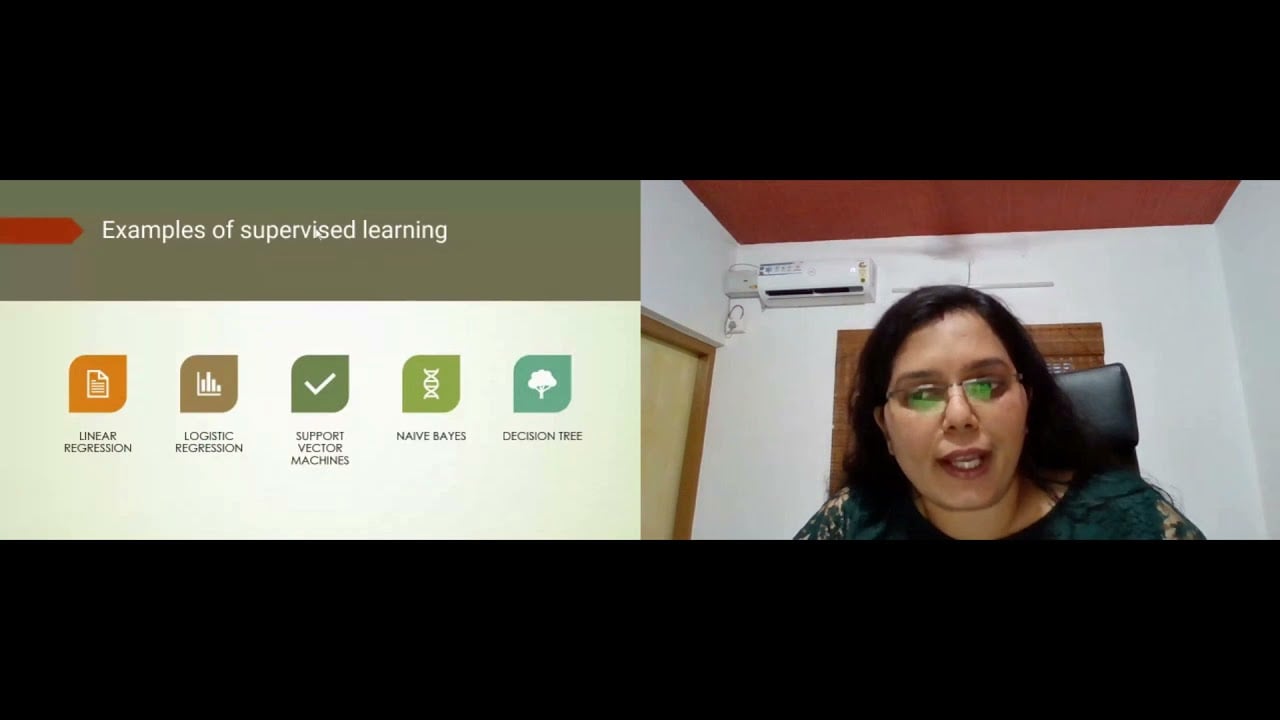
Speaker: And we are going to go through the details of each one of them now. Speaker: Classical machine learning comprises mainly of two types, supervised and unsupervised learning. Supervised learning is when the data you have is labeled. Speaker: Unsupervised learning is when you don't supervise the model, you let the model work on its own to discover the information, which is inherited to the data.
Speaker: Supervised learning is like having a teacher to teach you. And the teacher has the data labeled for you. For example, if you point towards a mango and call it as an orange, then the teacher is going to tell you that you're wrong. Speaker: And it's an, it's a mango. It's not an orange. So that is what supervised learning basically means.
Speaker: Supervised learning is of two types, classification and regression. Speaker: Classification in the student, whether they have passed or failed. Speaker: But as for regression models, the result would be the percentage scored by the student. Speaker: Classification as its name suggests is basically categorizing the data based on the features or attributes that we have in hand, like classifying emails as spam or not.
Speaker: Classifying a patient to be cancer, to be having cancer or not. Speaker: Now we are going to go through a few classification models. Speaker: This is a simple spam filter used until 2010. It uses name based classifier name based classifier is among the earliest and simplest machine learning models. Speaker: The earliest models were based on pure statistical formulae application on the data.
Speaker: It is based on Bayes theorem calculating the probability of occurrence of mail being spam. Speaker: Then the number of good letters and spam letters as shown in this in this slide. Speaker: So the class with higher probability is chosen as the label later. Speaker: This was not used for spam filters because basically hackers became smarter and they started adding more good words or more good letters to the email.
Speaker: This was also called Bayesian poisoning decision tree. Speaker: Let's have Daisy here and deciding her weekend plan. Speaker: And oh, by the way, she's fully vaccinated so she can go out. Speaker: So if it is raining, she is going to stay in. Speaker: If not, she's going to go out. Speaker: If she's staying in and there is cable signal, she will watch a movie.
Speaker: If not, she can play board games. Speaker: If she's going out, then if it is too sunny, she could go for movies. Speaker: If not, then she could go for shopping. Speaker: This is how a decision tree is made. Speaker: The machine comes up with such questions to split the data best at each step. Speaker: The higher the branch, the broader the question.
Speaker: Decision trees are widely used in highly responsible places like diagnostics, medicine, finances. Speaker: They might not be used purely, but they're on sample. Speaker: Random forest is extremely popular and is faster than your networks. Speaker: Support vector machines. Speaker: The main objective is to segregate the given data in the best possible way. Speaker: The distance between the either nearest point is known as the margin.
Speaker: And the data points which are present at the farthest distance or on the margin are known as the support vectors. Speaker: The objective is to select a hyper plane that the with the maximum possible margin between the support vectors in the given data set. Speaker: These are fairly accurate and used to be extremely popular until neural networks became so easily accessible to us.
Speaker: And even today support vector machines find great significance at some problem zones. Speaker: But the algorithm inside is basically of the order O of N square in terms of time complexity. Speaker: So it takes a lot of time with a large data set in comparison to the other classical models like decision tree or K and N or NAV base.
Speaker: Regression is basically classification where we forecast a number instead of a category. Speaker: Examples are car price by its mileage traffic by time of the day demand volume by the growth of the company. Speaker: Regression is perfect when something depends upon time. Speaker: And it's super smooth inside. Speaker: The machine simply tries to draw a line that indicates average correlation.
Speaker: When the line is straight, it is linear regression. Speaker: When it is curved, it's polynomial regression. Speaker: Technically speaking, the model is basically trying to bring out these coefficients in the equation, Speaker: which will help us minimize the cost function. Speaker: So simply put, the machine is going to come up with the coefficients during the training.
Speaker: These coefficients are the one it is going to try to find during the training. Speaker: Okay, a special mention to logistic regression. Speaker: If this is your hair moment, you're not alone. Speaker: The first time I came across this fact, I also scratched my head. Speaker: So you can think of logistic regression as a special case of linear regression where the outcome variable is categorical, Speaker: where we are using log of odds as dependent variable.
Speaker: In other words, it predicts the property of occurrence of an event by fitting the data to a log it function, Speaker: or basically by putting a threshold to the probability which the regression model had predicted or calculated. Speaker: Unsupervised learning was invented a bit later in 1990s. Speaker: It is used less often, but sometimes you just don't have any options.
Speaker: You'll usually have different groups of users that can be split across a few criteria. Speaker: These criteria can be as simple as age, gender and or as complex as persona or their purchase procedure. Speaker: Unsupervised learning can help you accomplish this task automatically. Speaker: One of the one of the most popular unsupervised learning types is clustering.
Speaker: Clustering algorithms will run through your data and find these natural clusters if they exist. Speaker: For your customers, that might mean one cluster of 30 something artists and the other one of millennials who own dogs. Speaker: You can typically modify how clusters are being taken in your data. Speaker: Like how many clusters do you want? Speaker: And how many clusters are we looking at?
Speaker: Which lets you adjust the granularity of these groups. Speaker: There are various different types of clustering algorithms which are out there. Speaker: And the most popular one is K means clustering. Speaker: Clustering your data points into a number K of mutually exclusive clusters. Speaker: A lot of complexity surrounds around how you're going to pick that data or the right number for K.
Speaker: Apple Photos and Google Photos use more complex clustering. Speaker: They are looking for faces in the photos to create albums of your friends. Speaker: Now the app doesn't know how many friends you have or how do they look? Speaker: But it's trying to find the common facial features and that is one of the applications of clustering.
Speaker: Another popular issue is image compression. Speaker: When saving the image to PNG, you set the palette to let's say 32 colors. Speaker: It means clustering will help you find all the reddish pixels, calculate the average red and set it for all the red pixels. Speaker: So the fewer the colors, the lower the file size and hence more profit.
Speaker: Here we are trying to illustrate K means clustering with the help of putting kiosks in the best or the optimal way. Speaker: Here the value of K is three. Speaker: So first of all, you put your three centers or the kebab kiosks at random places. Speaker: And then you watch how your buyers choose the nearest one.
Speaker: And then you move the kiosk closer to the center of their popularity. Speaker: And you keep doing this unless you have found the perfect spots for your kebab kiosks. Speaker: These are a few other popular unsupervised learning methods. Speaker: Dimensionality reduction is basically when we try to project our data to a lower dimensional subspace, which captures the gist of the data.
Speaker: Dimensionality reduction has principle component analysis and latent semantic analysis techniques, which are useful for data pre-processing and topic modeling. Speaker: You can also find it useful for recommendation systems and collaborative filtering. Speaker: It's barely possible to fully understand this machine abstraction, but it's possible to see some correlation on closer look. Speaker: Some of these correlate with the user's age.
Speaker: For example, kids play Minecraft and watch cartoons more often and others correlate with the movie journal or user hobbies. Speaker: Association rule learning is no revolution. Speaker: Businesses have been using it for gaining more profit for a very long time now. Speaker: It includes all the methods to analyze shopping carts, automate marketing strategies and other event related tasks.
Speaker: When you have a sequence of something and want to find patterns in it, you can try association rule learning. Speaker: For example, putting diapers next to baby food or peanuts next to beer counter can help the store grow in terms of the profit earned. Speaker: In this picture, we can see a robot. Speaker: It is put in an environment and asked to make a move.
Speaker: When it goes near fire, it is given a penalty. Speaker: Suppose it goes near to the water tap and closes it to stop water wastage. Speaker: And it is rewarded in this way. Speaker: It learns by its own actions. Speaker: What is good? Speaker: And what is that? Speaker: Just like babies in machine learning world. Speaker: This is called reinforcement learning.
Speaker: So then you don't have any data, but you do have a simulation environment. Speaker: That's when reinforcement learning comes into picture. Speaker: Another example of this kind is self driving cars. Speaker: They are put in a simulating environment. Speaker: There they might use two different approaches, model based and model free. Speaker: Model based means that car needs to memorize a map or its part.
Speaker: But it's pretty outdated approach because it's impossible for a self driving car to learn the complete planet. Speaker: So in model free learning, the car doesn't memorize every moment, but tries to generalize situation and act rationally when obtaining a maximum reward. Speaker: Ensemble methods. Speaker: So in this picture, there are a bunch of kids playing touch and tell.
Speaker: They are asked to touch an elephant and describe what it is to them. Speaker: Each of them gives the description of what they touched. Speaker: Now, individually, they might not be able to guess that it's an elephant. Speaker: But when we put all their observations together, we'll get the right answer. Speaker: This is an example of ensemble methods.
Speaker: Ensemble is the art of combining diverse set of learners, individual models together to improvise on the stability and predictive power of models. Speaker: The main principle behind the ensemble model is that a group of weak learners come together to form a strong learner, thus increasing the accuracy of the model. Speaker: Some of the popular ones are random forest and gradient boosting.
Speaker: They are typically used in object detection and search methods. Speaker: So one of the popular ensemble methods is stacking output of several parallel methods. Speaker: Parallel models is passed as the input to the last one, which makes the final decision. Speaker: But use different algorithms because same algorithm on the same data set won't make any sense.
Speaker: But at the final layer, regression is mostly preferred. Speaker: But more popular than stacking is bagging and boosting. Speaker: So bagging is bootstrapping plus aggregating training some classifiers. Speaker: So what we are going to do here is we are going to generate random subsets of the data set that is given to us. Speaker: And we are going to model or we are going to train the same classifier on these different data sets, which were randomly generated out of the original data set.
Speaker: And we are going to take the result as the maximum voted or as the average, as the final answer, as the ensemble answer. Speaker: And the other more popular one is boosting. Speaker: Algorithms are trained one by one sequentially. Speaker: Each subsequent one paying most of us attention to the data points that were mispredicted by the previous one.
Speaker: We use subsets of our data, but this time they are not randomly generated. Speaker: Now in each sub sample, we take a part of the data that the previous algorithm failed to process. Speaker: Thus, we make a new algorithm learn to fix the errors which were made by the previous one. Speaker: Neural networks. Speaker: A neural network is a class of computing system.
Speaker: They are created from a very simple processing nodes formed into a network. Speaker: They are inspired by how our brains work, although it is not as complex as our brains right now. Speaker: So the basic unit of computation in a neural network is a neuron, which is based on the basic computational units of our brains. Speaker: Any neural network is basically a connection collection of neurons and connections between them.
Speaker: Neuron is a function with a bunch of inputs, as you can see, a bunch of inputs and one output. Speaker: It takes simply takes all the inputs, does some computation on top of it and presents the result at the output. Speaker: When the connection is like the channel between these neurons, they have only one parameter, the weight.
Speaker: So during building a neural network, these connections like the weights of the connections and these generator functions of the neurons are the things which are being generated. Speaker: Convolutional neural networks. Speaker: They are used to search for objects on photos and in videos, face recognition, style transfer, generating and enhancing images, Speaker: creating effects like slow motion and improving image quality.
Speaker: Nowadays, CNNs are used in all the cases that involve pictures and videos. Speaker: So if you have to understand how this works, let's do this. Speaker: We will divide the whole image of the cat into eight cross eight pixel blocks and assign to each a type of dominant line. Speaker: It can be horizontal, vertical, or one of the vertical, one of the diagonals.
Speaker: It can also be that several would be highly visible. Speaker: As you can see, several will be highly visible. Speaker: This happens and we are not always absolutely confident. Speaker: Output would be several tables of sticks. Speaker: Um, which, um, uh, in fact, the simplest features representing object edges in the image. Speaker: There are images on their own, but build with sticks.
Speaker: And, uh, we are going to once again, uh, carve out eight cross eight pixels. Speaker: Um, uh, and we are going to do this matching and see if they match together all over again. Speaker: And we are going to do this for, uh, several times. Speaker: So this operation is called new is, is called convolution. Speaker: Convolution.
And, uh, this is what gave the name for the method. Speaker: Convolution can be represented as a layer of neural network because each neuron is, uh, uh, can act as any function. Speaker: The current networks gave us useful things like, uh, neural machine translation, uh, speech recognition, Speaker: and voice synthesis in smart assistance. Speaker: It is basically about learning through a network of neurons, while keeping the information Speaker: learned till now with it, because of this internal memory, RNNs can remember important things Speaker: about the input that they have received, which allows them to be very precise in predicting Speaker: what is coming next, which makes them best for sequential data like voice, text or music.
Speaker: So this is what the world map of machine, uh, machine learning will look like. Speaker: So machine learning basically has a classical learning, which has a supervised and unsupervised learning. Speaker: Uh, and then it has, uh, ensemble methods, which consists of stacking, bagging, boosting. Speaker: Reinforcement learning is when we don't have the data, but we do have a simulating environment.
Speaker: Uh, neural networks, uh, are, uh, are something inspired from how our brain works. Speaker: And, uh, this is what basically, uh, machine learning is all about. Speaker: Uh, but here are a few things I would like to address. Speaker: Uh, like there are some myths, like, uh, we all have must have often heard, uh, stuff like is deep learning Speaker: Going to eat away machine learning or something like that on some of the websites.
Speaker: Uh, so now, since we are clear that neural networks are a part of machine learning Speaker: and data, a deep learning is a new way of, uh, a new architecture for, uh, neural networks. Speaker: So when you're comparing a neural network to any of the classical models or even their ensemble, for example, Speaker: Decision tree is the model and that it's ensemble is called random forest.
Speaker: And, uh, if you're comparing any classical model or the ensemble to a neural network, Speaker: it's like you're comparing a sports car to a loaded truck. Speaker: So each one of them have their own pros and cons, and you have to, uh, pick for yourself Speaker: that, uh, what is it that this is going to do for you?
Speaker: Like how and which one would be the best for your problem statement? Speaker: For example, you, if you want your data to be, uh, you know, if, if your problem Speaker: statement requires the data to come, uh, the, you know, the stuff to be real time, then it Speaker: it would be better to go for, uh, uh, random forest than, uh, going for a neural network.
Speaker: But again, that is, uh, like, for example, when you open your, uh, camera phone's camera, and it Speaker: it is trying to drop boxes around your face. Speaker: Uh, that is something what, uh, random forest is doing. Speaker: That is something what ensemble model is doing. Speaker: But if your problem is extremely very complex and your data is extremely very, um, unpredictable Speaker: and very difficult, and that's just what your problem is demanding, then you can go for a neural network.
Speaker: So that is, uh, something I wanted to give you as a takeaway. Speaker: And, uh, if you're wondering where to get started from, these are some of the good, uh, resources Speaker: with which you can get started. Speaker: And thank you.
Transcribed automatically; names checked against the speaker record. Select a time to jump there.
Article based on this talk
Wo steht Machine Learning in der KI, und welche Art passt zu Ihrem Problem?
Mayuri Madhur ordnet klassische Modelle, Reinforcement Learning, Ensembles und neuronale Netze für Einsteigerinnen und Einsteiger ein.
Kurz gesagt
Machine Learning ist der Teil der KI, in dem Computer die Regeln aus Daten ableiten, statt sie vorgegeben zu bekommen, und es gibt vier Hauptfamilien: klassisches Lernen, Reinforcement Learning, Ensembles und neuronale Netze. Mayuri Madhur, Software Development Engineer bei Flipkart, führt Einsteigerinnen und Einsteiger mit alltäglichen Beispielen durch jede Familie und argumentiert, dass keine einzelne Art überall gewinnt. Deep Learning wird Machine Learning nicht verschlingen; es ist eine Methode, neuronale Netze zu bauen, die selbst ein Zweig des Machine Learning sind.
Die wichtigsten Erkenntnisse
Ein klareres Bild von Machine Learning, ideal für alle, die einen Einstiegspunkt suchen.
Räumt einige Missverständnisse über Machine Learning und Data Science aus.
Eine sehr grundlegende Session, die erklärt, was Machine Learning ist und wo es in der KI steht.
Warum einer Maschine überhaupt das Lernen beibringen
Madhur beginnt mit einer Definition: "Machine Learning ist die Wissenschaft und Kunst, Computer so zu programmieren, dass sie aus den ihnen bereitgestellten Daten lernen können." (0:30). Das Ziel, sagt sie, ist es, Ergebnisse aus eingehenden Daten vorherzusagen.
Sie stellt dem die traditionelle Programmierung gegenüber. Dort geben Menschen der Maschine Daten und Regeln und erhalten Ergebnisse. Beim Machine Learning geben Menschen Daten und die zugehörigen Ergebnisse ein, und die Maschine findet den Zusammenhang und bildet die Regeln. Diese Regeln sind nicht starr; sie wirken auf unterschiedliche Arten von Daten unterschiedlich. Ihre Zusammenfassung ist prägnant: "Beim ersten Ansatz denken wir. Beim zweiten Ansatz denkt die Maschine." (2:13)
Um zu zeigen, warum das wichtig ist, nutzt sie eine Tabelle mit Wiederverkaufspreisen von Autos. Hängt der Preis nur vom Alter ab, kann jede Person den nächsten Wert vorhersagen. Kommen Zustand und Kilometerstand hinzu, funktioniert das Kopfrechnen nicht mehr. Viele reale Problemstellungen sehen wie die zweite Tabelle aus, und genau hier kommt Machine Learning ins Spiel.
Daten, Features und der Platz von Machine Learning in der KI
Madhur nennt drei Komponenten: Daten, Features und Algorithmen. Daten stehen an erster Stelle: "Daher sind Daten das Wichtigste, damit unsere Maschinen lernen. Je vielfältiger die Daten, desto besser das Ergebnis." (4:12). Sie weist darauf hin, dass manuell gelabelte Daten hochwertiger, aber teuer sind, während automatisch gesammelte Daten günstiger, aber von geringerer Qualität sind, und nennt Captchas zur Bilderkennung als eine Methode, mit der Google gelabelte Daten sammelt.
Features sind die Faktoren, aus denen die Maschine lernt, und nicht jedes Detail in einem Datensatz ist relevant; manchmal müssen nützliche Features erst abgeleitet werden. Der Algorithmus findet Zusammenhänge in den Daten und beeinflusst Präzision, Performance und Modellgröße.
Anschließend räumt sie mit einer verbreiteten Verwirrung über die Einordnung auf: "Künstliche Intelligenz ist ein ganzes Studienfach. Sie ist wie Chemie, Biologie oder Physik." (6:18). Machine Learning ist ein Teil davon, neuronale Netze sind eine Art von Machine Learning, und "Deep Learning ist die moderne Methode, neuronale Netze zu bauen, zu trainieren und einzusetzen." (6:51)
Klassisches Lernen: überwacht und unüberwacht
Klassisches Machine Learning teilt sich in überwachtes Lernen, bei dem die Daten gelabelt sind, und unüberwachtes Lernen, bei dem das Modell Strukturen selbst entdeckt. "Überwachtes Lernen ist, als hätte man eine Lehrkraft, die einen unterrichtet." (8:16)
Überwachtes Lernen umfasst Klassifikation und Regression. Madhur stellt Naive-Bayes-Spamfilter vor (und wie Spammer sie überlisteten, indem sie E-Mails mit "guten" Wörtern auffüllten), Entscheidungsbäume (veranschaulicht an Daisy, die ihr Wochenende plant) und Support Vector Machines, die sie als genau, aber langsam bei großen Datensätzen beschreibt. Zur Regression liefert sie eine elegante Definition: "Regression ist im Grunde Klassifikation, bei der wir statt einer Kategorie eine Zahl vorhersagen." (12:35). Die logistische Regression, erklärt sie, wendet einen Schwellenwert auf vorhergesagte Wahrscheinlichkeiten an, um Kategorien zu erzeugen.
Unüberwachtes Lernen wird seltener eingesetzt, aber manchmal gibt es keine Alternative. Clustering findet natürliche Gruppen unter Kundinnen und Kunden, Gesichter in Foto-Apps oder Farben in einem Bild, das komprimiert werden soll. In ihrem K-means-Beispiel werden drei Kebab-Kioske zufällig platziert; man beobachtet, welchen die Käufer wählen, und verschiebt die Kioske immer weiter in Richtung der Nachfrageschwerpunkte. Außerdem behandelt sie Dimensionsreduktion für Empfehlungen und Assoziationsregel-Lernen für Warenkorbmuster.
Reinforcement Learning und Ensembles
Reinforcement Learning passt zu einer anderen Situation: "Dann haben Sie also keine Daten, aber Sie haben eine Simulationsumgebung." (19:51). Ein Roboter wird in der Nähe von Feuer bestraft und dafür belohnt, einen laufenden Wasserhahn zuzudrehen, und lernt so aus seinen eigenen Aktionen. Selbstfahrende Autos, erklärt sie, setzen auf modellfreies Lernen, das Situationen verallgemeinert, statt Karten auswendig zu lernen.
Für Ensembles nutzt Madhur das Bild von Kindern, die Teile eines Elefanten beschreiben: Allein liegen sie falsch, gemeinsam treffen sie es. "Das Grundprinzip des Ensemble-Modells ist, dass sich eine Gruppe schwacher Lerner zu einem starken Lerner zusammenschließt und so die Genauigkeit des Modells erhöht." (21:16). Sie erklärt Stacking, Bagging (ein Klassifikator wird auf zufälligen Teilmengen trainiert, dann wird abgestimmt) und Boosting (Modelle werden nacheinander trainiert, wobei jedes die Fehler des vorherigen korrigiert).
Neuronale Netze und die Wahl des richtigen Werkzeugs
Neuronale Netze sind vom Gehirn inspirierte Netzwerke einfacher Verarbeitungsknoten, in denen jedes Neuron Eingaben aufnimmt, rechnet und eine Ausgabe weitergibt, und jede Verbindung ein Gewicht trägt. Convolutional Networks dominieren die Bild- und Videoverarbeitung: "Heutzutage werden CNNs in allen Fällen eingesetzt, in denen es um Bilder und Videos geht." (25:19). Rekurrente Netze verfügen über ein internes Gedächtnis, das sich für sequenzielle Daten wie Sprache, Text und Musik eignet.
Madhur schließt mit der vollständigen Übersicht und einem Mythos, den man ablegen sollte: Deep Learning wird Machine Learning nicht verschlingen. Ein klassisches Modell oder Ensemble mit einem neuronalen Netz zu vergleichen, sagt sie, ist wie der Vergleich eines Sportwagens mit einem beladenen Lkw. Wenn Ergebnisse in Echtzeit vorliegen müssen, kann ein Random Forest besser geeignet sein; sind Problem und Daten sehr komplex und unvorhersehbar, rechtfertigt ein neuronales Netz seinen Aufwand.
Den Talk ansehen
"But what is Machine Learning? : A complete starter pack" von Mayuri Madhur (31 Minuten): https://www.womentech.net/video/mayuri-madhur-what-machine-learning-complete-starter-pack
Über die Speakerin
Mayuri Madhur ist Software Development Engineer bei Flipkart in Indien. Zuvor arbeitete sie als Softwareentwicklerin bei Sabre und erwarb einen Abschluss in Informatik und Ingenieurwesen am National Institute of Technology Patna. Sie begeistert sich für Forschung in Data Science und Machine Learning, arbeitet an Gemeinschaftsprojekten und sucht aktiv nach Möglichkeiten, Machine Learning anzuwenden.
Fragen, die dieser Talk beantwortet
Worin unterscheidet sich Machine Learning von traditioneller Programmierung?
Sind neuronale Netze und Deep Learning dasselbe wie Machine Learning?
Was ist der Unterschied zwischen Klassifikation und Regression?
Wann sollte man Reinforcement Learning einsetzen?
Sollte man einem klassischen oder Ensemble-Modell immer ein neuronales Netz vorziehen?
Mit KI aus dem Transkript des Talks erstellt. Redaktionelle Prüfung ausstehend.
Frameworks and ideas mentioned
Supervised learning
Unsupervised learning
Reinforcement learning
Naive Bayes
Bayes' theorem
Decision trees
Random forest
Support vector machines
Linear regression
Polynomial regression
Logistic regression
K-means clustering
Principal component analysis
Latent semantic analysis
Association rule learning
Stacking
Bagging
Boosting
Gradient boosting
Convolutional neural networks
Recurrent neural networks
Cite this talk
Mayuri Madhur. "But what is Machine Learning? : A complete starter pack." WomenTech Network, 2021. https://www.womentech.net/video/mayuri-madhur-what-machine-learning-complete-starter-pack