Hunting the Invisible: Learnings from building MuleHunter.ai to Detect Financial Crime at Scale
Rule-based fraud checks flagged genuine customers 80 to 90% of the time
Models that learn from data only earn their place when they hold up in real conditions, from scoring fraud in milliseconds to forecasting bus demand a year ahead. Speakers explain the fundamentals for newcomers, unpack transformers and attention for language tasks, and show deployed systems for personalized recommendations, network anomalies, earthquake relief and on-device inference. Engineers, data scientists and product leads will find both first principles and lessons from systems running in production.
72 talks 60 speakers 27 hours 2020 to 2026
Search the whole libraryRule-based fraud checks flagged genuine customers 80 to 90% of the time
The same AI that drives robotaxis can guide a blind person on a phone
On PlayStation, privacy decides your recommendations before any model does
A 99% F1 score can still hide a model whose output makes no sense
Shortest isn't safest: AI routes people out of earthquake zones
It is an account opened or rented out so fraudsters can layer stolen money between victim and criminal. Each bank only sees its own transactions, and identifying a mule took two to four weeks, by which time the money was gone.
Hunting the Invisible: Learnings from building MuleHunter.ai to Detect Financial Crime at Scale, Parul NaibFar more than self-driving cars: robots that clean floors or collect dishes, humanoids such as Tesla's Optimus, and mobile assistants like AI Guide Dog that run on a smartphone.
Autonomous AI Navigation Systems, Aishwarya JadhavTo improve the user experience so players spend less time browsing thousands of titles, to increase engagement, and ultimately to raise retention because players with a great experience come back.
How we built a Personalized Ecosystem to Create Pure Joy for 100+ Million PlayStation Users, Gaganjot Kaur KangRNNs read input one word at a time, while transformers process the whole input at once. That allows more parallelization and reduces training times.
Using transformer models for your own NLP task - building an NLP model End To End, Ana-Maria IstrateRNNs process input one word at a time, while transformers process it all at once. That allows more parallelization and shorter training times, which led to many large pre-trained models such as BERT and GPT.
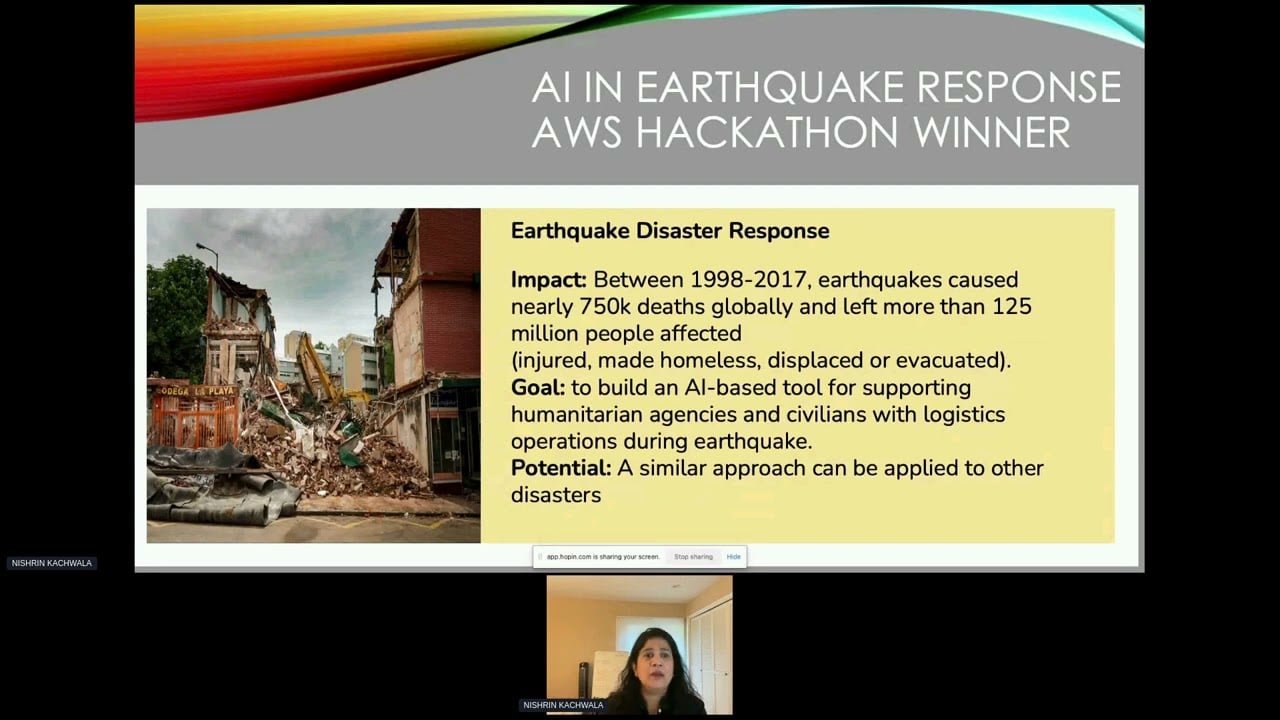
Using transformer models for your own NLP task - building an NLP model End To End, Ana-Maria IstrateThe team trained models on merged earthquake, geolocation and socioeconomic data to predict the affected population, with an XGBoost regressor as the final model. That estimate is combined with United Nations guidelines to calculate food and non-food relief items.
AI for Disaster response, Nishrin KachwalaA candidate generation phase matches the user's intent and filters against the whole inventory, producing about 300 to 400 candidates, which a recommendation model then re-ranks using user preferences and product information. The user's final decision becomes feedback that updates the model.
Recommender systems and women shoppers, Dhanashree BalaramBecause there are many possible ways to fill in the missing information, each leading to a different full observation. A partial digit, for example, could be completed as a seven, a one or a four.
Seeing the unseen: inferring unobserved information from multi-modal data, Adriana Romero Soriano“Almost 80 to 90% of the people who are getting flagged as mules were actually not mules. They were just genuine customers.” Parul Naib, Hunting the Invisible: Learnings from building MuleHunter.ai to Detect Financial Crime at Scale
“But autonomous navigation is more than just self-driving cars. It encompasses a whole variety of systems.” Aishwarya Jadhav, Autonomous AI Navigation Systems
“So for example, if you already own a game like Last of Us part two, and if I still give you a recommendation of that game, there is no way you are going to buy that again.” Gaganjot Kaur Kang, How we built a Personalized Ecosystem to Create Pure Joy for 100+ Million PlayStation Users
Retail recommenders can predict a shopper's size changes she may not want known
When AI fills in what it cannot see, each guess could mean a different diagnosis
A forecast nobody trusts creates no value, however good the model
Zero fraud is a failure if it blocks every other good customer
When crash witnesses panic, a leaner AI model can pinpoint the scene
Why reading every word at once made transformers beat recurrent networks
One lost packet in a thousand: why 5G reliability needs machine learning
Not every network alarm is an anomaly, and Orange's models must tell which
A model built in three weeks can still take 11 months to deploy
If two human labelers disagree, don't expect your model to beat them
Why RNNs forget long sentences, and how attention stopped the forgetting
Why a child who avoids a hot stove is doing machine learning
A burned hand at a candle explains machine learning better than jargon
AI won't take your job, but it will change the role you play
How a data flywheel cut document turnaround from 90 minutes to 10
Deep learning is not replacing machine learning, it lives inside it
The next wave of AI runs on your device, offline, in under 3 GB of RAM
A few hundred megabytes of model can be the death knell of a mobile app
You can add sentiment analysis to an app without training a single model
Most text classifiers don't need to be trained from scratch
A Bolivian founder teaches a neural network to tell tigers from pandas
Shipping on-device AI to millions of devices meant three choices with no undo
An AI assistant booked the wrong island and hallucinated the reviews
Machine learning is shaping daily life with too few women building it