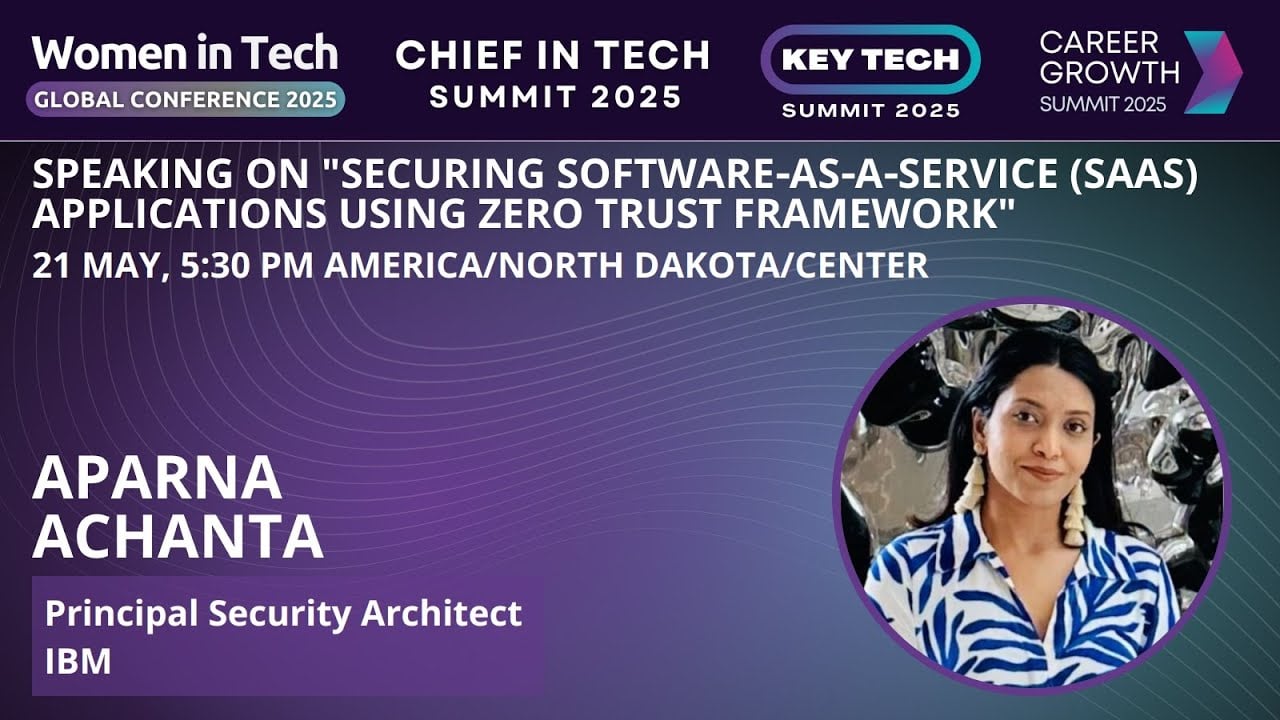
Securing software-as-a-service (SaaS) applications using Zero Trust Framework
Aparna Achanta37:352025
Преминаването през firewall не бива да отключва всички останали приложения в мрежата
При периметровата сигурност един вход, преминал през firewall, може да достигне до всяко друго приложение в мрежата, и точно така нападателите се придвижват странично в организацията. Aparna Achanta, Principal Security Architect в IBM, която е внедрявала Zero Trust за FDA и Министерството по въпросите на ветераните, твърди, че всяка SaaS заявка трябва да се проверява отново на всеки слой. Как екипите да постигнат това, без да нарушат наследените системи, да раздразнят потребителите или да превишат бюджета?
Вижте контролите за достъп, тестване и AI мониторинг, с които тя прилага Zero Trust към SaaS приложения
Aparna Achanta, Principal Security Architect в IBM, обяснява как принципът на Zero Trust за липса на присъщо доверие се прилага към SaaS приложенията и как организациите могат да се подготвят за него. Тя разглежда управлението на идентичността и достъпа, сигурната архитектура, тестването, защитата на данните и непрекъснатия мониторинг с помощта на AI, след което съпоставя предизвикателствата при внедряването с резултатите, отчетени от организациите, и твърди, че мисленето в духа на Zero Trust трябва да ръководи всеки член на екипа и всяко внедряване.
“Да кажем, че дори да са влезли в системата и дори да имат достъп до едно приложение, това не означава, че имат достъп до другите приложения. Така ще се предотврати страничното придвижване на атаките.”
“Ако не актуализирате своя SaaS инструмент или SaaS платформа, нападателите могат да се възползват от уязвимостите на платформата, за да проникнат във вашата организация.”
What you will learn
Обяснете трите парадигми на Zero Trust: проверка на всяка заявка на всеки слой, прилагане на минимални привилегии и допускане, че пробив вече е настъпил.
Планирайте оценка на готовността на SaaS, която обхваща инвентаризация, използване, ниво на риск, проверка на доставчиците, списък с одобрени инструменти и откриване на неразрешени инструменти.
Прилагайте контроли за идентичност и достъп като SSO с MFA, достъп на базата на роли и атрибути, достъп just-in-time и автоматизирани прегледи на достъпа.
Вградете Zero Trust в жизнения цикъл на разработка на SaaS чрез архитектурни прегледи, сканиране на кода в CI/CD, тестове за проникване, навременни актуализации, минимизиране на данните, DLP и учения за реакция при инциденти.
Използвайте SIEM, UEBA и API мониторинг с AI за непрекъснато откриване на заплахи, като предвиждате предизвикателствата, свързани с интеграцията, потребителите и разходите.
Details
Level
Intermediate
Format
Talk
Technical depth
Practitioner
For
Early career, Mid-career, Senior individual contributor
Length
37:35
Published
July 2025
Questions this talk answers
Какво е Zero Trust и кои са основните му парадигми?
Това е рамка за сигурност, основана на принципа за липса на присъщо доверие. Всяка заявка за достъп се третира като идваща от ненадеждна мрежа и се удостоверява на всеки слой, прилагат се минимални привилегии, а екипите допускат, че вече е настъпил пробив.
С какво Zero Trust се различава от периметровата сигурност?
При периметровия модел потребител, преминал през firewall, може да достигне до други приложения в мрежата. Zero Trust проверява потребителя отново на всеки слой на приложенията, което не позволява на нападателите да се придвижват странично.
Как една организация трябва да подготви своите SaaS приложения за Zero Trust?
Инвентаризирайте съществуващите SaaS приложения и оценете тяхното използване и риск, избирайте доставчици с вградени контроли като криптиране и резервни копия и поддържайте списък с одобрени инструменти с ясни политики. Инструментите за мониторинг на мрежата и откриване в облака помагат да се установи неразрешеното използване на SaaS.
Кои практики вграждат Zero Trust в разработката на SaaS?
SSO с MFA, достъп на базата на роли и атрибути с минимални привилегии, достъп just-in-time и автоматизирани прегледи на достъпа, както и архитектурни прегледи и прегледи за сигурност, сканиране на кода в CI/CD, тестове за проникване, навременни актуализации от доставчиците, минимизиране и маскиране на данни, DLP и тествани планове за реакция при инциденти.
Какво затруднява внедряването на Zero Trust и струва ли си?
Основните пречки са интеграцията с наследените системи, недоволството на потребителите и разходите. Според данните, цитирани от лектора, организациите са отчели спад на разходите за сигурност с около 31%, а при по-строги политики разходите при пробив са с около 20,5% по-ниски.
Защо Zero Trust спира страничното придвижване (70 s)
Остарелите SaaS платформи привличат нападатели (81 s)
Направете Zero Trust начин на мислене за всички (81 s)
Today I plan to focus on securing SaaS apps using the Zero Trust framework. My name is Aparna. I am a security leader and I've been working in federal consulting for close to 11 years now. I've worked with US federal agencies and I hope from today's talk you can learn more about Zero Trust, you can learn how to implement Zero Trust in your organization and I will also go through how you can prepare for Zero Trust implementation, how it can be enforced in all phases of the SaaS development life cycle. I will also discuss some challenges and after that I will talk about some of the benefits of Zero Trust and I also have some recommendations for smooth implementation of Zero Trust and then we'll go about seeing some of the results that organizations
have seen as a result of this security framework. In conclusion, I will also talk about some of the takeaways from today's talk. Without further ado, let's get started. Some of you might be familiar with what Zero Trust is, but you know, for those of you who are new to this concept, you know, it is the buzzword that we hear these days. It is a security framework based on the principle of no inherent trust.
So it has basically three paradigms. One being in Zero Trust, all access requests are treated as coming from a non-trusted network and at every application layer, at every stage, all users and devices are authenticated. And the second paradigm is the principle of least privilege. So zero trust enforces the principle of least privilege. And by that, what I mean is only the bare minimum one of the parameters that you want to see the data that you need.
So an example for this would be if you're an account manager for, say, region one, you would only be seeing the data for your region. And the third paradigm is assume breach. So since Zero Trust fundamentally is based on the principle of no inherent trust. It operates under the assumption that breach has occurred. And it also dives into the principles of proactive containment so that the attack is not spread further. So we will further discuss this security framework more in detail so that you have an idea as to how you can translate this framework into your application.
So I'd like to highlight the CSA's Zero Trust model. So as for the CSA's Zero Trust model, there are five pillars, identity devices, networks, applications, and data. And there are three cross-cutting pillars across the five pillars, which are visibility, automation, and also governance. So, you know, when any organization wants to implement the security framework, their maturity level can usually go from being traditional, where they use manual, you know, like manual processes. And it can go all the way to be optimal if you're using AI power tools, for example, for continuous monitoring.
So the fundamental difference between Zero Trust security model and a traditional perimeter-based security model is in the traditional network, let's say a user is able to log in through the firewall, and they have access to the network. They can access other applications within the network. But in Zero Trust framework, even though they are able to pass the network security and they're able to log in, at each application layer, they have to again further verify who the user is. So let's say even though they have logged in, and even though they have access to one application, it doesn't mean that they have access to the other applications. So this will prevent the lateral movement of the attacks.
So, you know, I'd like to start off with how organizations can prepare for Zero Trust. So, you know, many organizations today, they might have thousands of SaaS applications, and, you know, they might not have Zero Trust in their organization. So, to begin with, you know, an organization has to define, you know, like, how many SaaS applications are being used currently, right? So they need to take inventory of all the existing SaaS applications, they need to check the usage of each of the SaaS applications, and they need to assess the risk level for each of the SaaS applications, and assess and see how Zero Trust principles can be applied to them.
For new applications, organizations oftentimes to review the vendors for SaaS platforms. So, when they are doing the assessment, organizations need to ensure that they are selecting vendors who who already have Zero Trust principles within their tools. So, for example, are you selecting a vendor who have robust data backup policies? Are you selecting a vendor who already have the encryption algorithms within them? So they need to assess, you know, the security posture of a SaaS tool? And based on that, decide if they are a right fit. Also, organizations can maintain an inventory of all the approved SaaS tools that aligns that align with the principles of Zero Trust. And this will prevent the employees from installing tools that are not approved.
Also, organizations need to establish clear policies for all the SaaS tools that they approve. They need to, you know, they need to, you know, send clear guidelines regarding the approved SaaS tools and applications, and also notify their employees about using unauthorized SaaS applications. So in today's day and age with AI, we often see that many employees in an organization tend to use use open source AI tools that are not approved within an organization, but this presents a security risk.
Also, organizations can implement network monitoring, cloud discovery tools, which will help them identify which unauthorized SaaS tools are being used. So after organizations take these steps to prepare for Zero Trust, you know, they need to ensure that all the SaaS applications that are being developed in a given organization, they are the teams are also following the principles of Zero Trust.
So in today's talk, I will focus on four tenets: identity management, access management, secure architecture, and monitoring. And this will help you understand how Zero Trust principles can be really baked into when you are working in a software development team, for example. So let's start off with the identity and the endpoint management. So any SaaS application we use today, they usually have an IAM solution. And yes, I see a question. Yes, it will be available. And so let's say organizations need to select IAM provider, let's say, that already has single sign-on baked into the platform in combination with multifactor authentication. This ensures that even though users are signing in using the single sign-on into the network, at any stage, if they are trying to access an application, they are still enforced multifactor authentication.
Also, organizations need to use strong password policies, and they need to remind the users to change passwords that they set for the SaaS applications frequently. And also, you know, some of these SaaS platforms, they also have built-in capabilities where they can decide if access needs to be given to you to the user based on attributes, like the location of the user.
So when the vendor assessment is being done, it's important to make sure that these criteria are being considered. Also, organizations can implement AI-based tools that assist the risk of the SaaS applications and help them respond in real time. If an identity has a warning sign, like, let's say, a user has too many failed attempts for login. And also, endpoint tools need to be implemented to monitor the endpoints for suspicious activity, and to also assess the security posture of the endpoints.
And it can also help detect and respond to threats in real time. So the next, Jeanette, that I want to focus on is access management, which is crucial because role-based access and also attribute-based access can be enforced by organizations in combination with the principle of least privilege to bolster overall security. When I say role-based access, it means only giving access to the data, only giving access to the business units, only giving access to the reports that the person with that given security role needs.
In addition to this, organizations should also monitor privileged accounts. So make sure that you're only assigning system admin privileges to only a select few users who have taken the training and who are also well-versed in the security best practices. Also, organizations can use automation to grant just-in-time access, which is sort of like a temporary access if somebody reads it and revoke it.
And they can also set up some workflows where they can continuously monitor privileged accounts. Also, organizations can set up automated access reviews to remove unnecessary permissions, accounts that are not active, so let's say somebody has transferred to different departments, all their permissions need to be revoked. So all these pointers will help make sure that robust access management is being maintained.
After this, let's take a look at the architecture practices. When applications, SaaS application development teams, when they are implementing SaaS deployment or when they are preparing for a SaaS deployment, all development teams, they should perform architecture reviews and also security reviews at every stage of the development. And during these reviews, make sure that the SaaS development team is identifying all the external integrations to the SaaS application, review any firewall rules, review any firewall rules, make sure the SaaS tool itself has the encryption algorithms to ensure data in-rest and transit are safe.
If you have any websites associated with the SaaS platform, make sure they have valid certificates to ensure more secure coding practices. all the IDE tools these days, they have AI in them, make sure you're following the secure coding practices. And most SaaS development teams have CI/CD pipelines for the deployments. So make sure that code scanning, it can be static code scanning or also dynamic scanning is being set up on the SaaS application that actually scans all the code that is being written for the SaaS application.
And make sure no code vulnerabilities are being introduced. So when we say secure architecture does not only secure coding, we should also focus on testing to ensure, you know, we are shifting the security left. You know, what SaaS application teams can do is they can use automation testing to make sure they are performing thorough testing on the SaaS application.
also penetration testing in which simulation attacks can be simulated, can also be used on SaaS applications to make sure all vulnerabilities are found. And also what happens with most SaaS tools or SaaS applications is SaaS vendors, they typically push updates a few times a year. It is very important to make sure all the SaaS tools, all the SaaS platforms, they are staying current.
staying current because what happens is sometimes if there are code vulnerabilities or security for flaws or bugs, those are being fixed actively by the vendors and those fixes are part of the releases. So if you don't update your SaaS tool or SaaS platform, attackers can take advantage of the platform vulnerabilities to hack into your organization. So it's very important based on the frequency or based on the cycle of updates of your SaaS tool, make sure they are staying up to date.
And also securing data. Securing data in your SaaS application is a very crucial component. So some ways to secure data is to begin with, make sure that the SaaS tool or the SaaS platform has encryption. And also within your SaaS application, make sure you're only collecting information that is absolutely needed. For example, if you don't need to really collect the date of birth of a person, if it is not being used anywhere, if it's not being used in any process, you know, like there's no need to collect it.
Because if you are collecting it, then you have to make sure that all sensitive data is being masked and all sensitive fields are being protected. If you do have any sensitive data, make sure they are being masked. Auditing has to be enabled to make sure if anybody makes changes on sensitive data, you have to make sure that all sensitive data is being captured in the logs.
Also, DLP policies, they are crucial to enforce that all sensitive data in files or in chatbot messages, for example, or in emails is identified. And sensitive data is being prevented from unauthorized sharing. Also, it's important that organizations have robust incident response plans, and they are testing the tabletop exercises. As part of the incident response plan, it's also important to identify the roles and responsibilities as to who will be performing the tabletop exercises, who will be performing the simulation attacks, you know, who are you testing the data backup and the rollback procedures.
So it's really important to have an up-to-date incident response plan. And as we onboard more SaaS applications, the complexity of these tabletop exercises and the simulation attacks also increases. So it's important for whoever is performing these exercises to also be trained to perform these exercises. So the next topic I want to focus on is continuous monitoring and threat detection.
So the next topic I want to focus on is continuous monitoring and the data to be able to do this. So for the next topic I want to focus on is continuous monitoring and data to be able to be able to do this. So we want to focus on is continuous monitoring and data to be able to do this.
So we take the help of our friend, AI Powered Tool, where, you know, implementing AI Powered Solutions, SIEM tools, they can aggregate the logs from all your SaaS applications. And they can provide dashboards, you know, reports, dashboards, alerts, if they find any suspicious behavior, if they have any threat detection and predictive AI can also basically, you know, like analyze all the backup data for your SaaS tool or your SaaS application.
And it can predict suspicious activities across your SaaS applications. So APIs are, you know, a big pillar in today's day and age, especially for SaaS applications. So even for API monitoring, AI Powered Tools can be used where they ensure the API calls, the response times of the APIs, all of them are conforming to the expected patterns. Any anomalies in the API traffic can be flagged and investigated using UEBA tools. Also regular training of AI models. If you're using a SaaS platform that already has AI intelligence in it, or if you have your homegrown AI models that you're integrating with your SaaS applications, regular training of AI models with current threat intelligence. Also helps to enforce fundamental policies.
And it will help your organization to stay strong against the emerging threats. Also, real-time monitoring and logging of user sessions, API activities, session logins, user logins, sessions, session response times, all this is crucial. And really, if you use any AI driven tool, they will be able to, you know, track all this unexpected behavior. And it will help you better enforce our policies of zero trust. So now I would like to, you know, present some of the challenges in adopting zero trust.
One of the main challenges is integration. Many organizations usually have existing SaaS applications and infrastructure and integrating policies of zero trust, oftentimes requires an upgrade or an update in maybe their process, maybe investing in more infrastructure or more tools or in training. And also, sometimes, legacy systems and legacy applications, it may be hard even for them to integrate.
Also, users, right? Like, if there are any existing users, and if you would like to enforce, like, let's say, policy of lease privilege, it can mean maybe taking away permissions that they already have, it can mean change in the user experience, it can mean more, more steps in authentication, and sometimes there is frustration from users. Also, one big challenge for organizations is the cost and the resource constraint. You know, oftentimes, they need to retrain staff, invest in new security tools, new monitoring tools, and also train the developers and users.
But if organizations are able to, you know, cross all those hurdles, cross all those challenges, the benefits that they get in implementing this security platform are huge. First and foremost, zero trust can help in trying to mitigate SaaS specific threats like account takeovers, insider threats, breaches. Also, it can really be a great companion in ensuring an organization is meeting all the compliance standards. Let's say if you're a healthcare organization and you're looking to meet the HIPAA compliance or a federal organization is looking to meet the FISMA compliance. It can really help companies to better observe all these regulations and implement strict access controls and also help with the protection of sensitive data. It can reduce the downtime in case of a breach. It can help with the recovery efforts. And it can also, you know,
reduce the impact of a breach. Another huge benefit is improved oversight. So continuous monitoring helps give more transparency into the SaaS applications in general, into the user behavior, the APIs. It allows companies to detect and respond to threats more effectively. And it also helps build a resilience and trust. And in general, it fortifies the security posture of all of your SaaS applications.
So some of the recommendations for smooth implementation of zero trust in SaaS applications. I think organizations can start with the security gap assessment to analyze your current security posture. And then define clear access control policies and prioritize security goals that really align with your vision. And then select tools that have zero trust inbuilt in their platforms and also make sure, just as an organization or just as a team, you are establishing a security-first culture through continuous training, continuous training, awareness sessions, not only for the end users, but for your security team, for your software developers, for your project managers.
So it has to be a holistic approach. Now let's look at some of the results that organizations have realized as a result of implementing the security framework. Organizations have seen their security spend decrease by about 31%. Organizations with more evolved zero trust laws to lost about one and a half million less than the ones that are still early in their journey.
Organizations that enforce stricter zero trust policies have seen about 20.5% lower cost when the breach happens and they have saved about a million dollars. And at my organization, I have implemented zero trust frameworks for SaaS platforms, particularly within my U.S. federal clients and also for the healthcare industry. And it has really helped us meet security standards like FedRAMP and HIPAA, but also ensure sensitive data is being protected.
In conclusion, I would say that zero trust thinking, zero trust frame of mindset, that needs to be adapted in all decisions you make as a SaaS application team. So every developer, every end user, every product owner or project manager or business analyst, whichever phase of SaaS application development you are in, try to think, try to have zero trust at the back of your mind, Because I think that will really help fortify each phase of the application development.
So it's not just the security team or the developers. I think all team members, everybody in the organization, if they start thinking on, okay, are we building this SaaS application, right? Are we embracing principles of zero trust? I think that just becomes second nature after a while, and that will automatically ensure all your applications are secure. By investing in zero trust, it not only decreases the threat mitigation costs, data breaches, ransomware attacks, But it really builds resilience long term, and especially with the evolving cybersecurity threats with, you know, like GenEI and all of that.
I think it really helps teams to be more prepared, even in case of a breach, and it really helps to safeguard sensitive data. So this is my talk for the day and really my call for action is embed zero trust thinking into every developer, every decision, every SaaS deployment. Thank you all for joining. I hope this was a really useful talk and you're able to take away something.
I see a question from Andrea. which tools would you recommend initially open source to see if it proves viable in highly regulated environments, specifically referring to log ingestion, indexing as an attack surface? So some of the tools I've used, Andrea, I think Microsoft Defender, Sentinel, Azure Monitor, Azure App and Sites, Dynatrace, Splunk, all of these are good with log ingestion.
They also have inbuilt AI, like even predictive AI, which actually sends you, you know, like alerts, it shows on dashboards. So I think all of the all of these are great tools. Any other questions from people? All right, all. Thank you so much for joining today. And I hope you have a great evening and, you know, please connect with me on my social media.
And if you have any questions in any stage of your zero trust journey or, you know, like if you just chat with me, even sometimes casually. So, yeah, I would love to connect. Yeah, thank you all. Have a great evening. Bye.
Transcribed automatically; names checked against the speaker record. Select a time to jump there.
Article based on this talk
Как SaaS екипите могат да вградят Zero Trust във всеки етап на разработката?
Архитектът по сигурност в IBM Aparna Achanta прилага принципите на Zero Trust към подготовката на SaaS, идентичността, достъпа, архитектурата, защитата на данните и мониторинга.
Накратко
Aparna Achanta твърди, че SaaS приложенията са най-сигурни, когато нищо не се приема за надеждно по подразбиране: всяка заявка се проверява, всеки потребител получава само достъпа, от който се нуждае, а екипите действат така, сякаш пробив вече е настъпил. Principal Security Architect в IBM показва как организациите могат да подготвят своята SaaS среда за Zero Trust и след това да го вградят в идентичността, достъпа, архитектурата, тестването, защитата на данните и мониторинга. Заключителното ѝ послание е, че Zero Trust работи най-добре като начин на мислене, споделен от целия екип, а не само от специалистите по сигурност.
Основни изводи
Научете за рисковете и предизвикателствата, които носят SaaS приложенията.
Научете за стратегии за внедряване на Zero Trust във всеки етап от жизнения цикъл на разработка на софтуер.
Научете за резултатите, които организациите са постигнали чрез внедряване на Zero Trust.
Какво всъщност означава Zero Trust
Опирайки се на близо 11 години опит като консултант на федералното правителство на САЩ, Achanta започва с определение: „Това е рамка за сигурност, основана на принципа за липса на присъщо доверие.“ (1:25) Тя описва три парадигми: всяка заявка за достъп се третира като идваща от ненадеждна мрежа, а потребителите и устройствата се удостоверяват на всеки слой; прилагат се минимални привилегии (регионален акаунт мениджър вижда само данните за своя регион); и се допуска, че пробив вече е настъпил, с проактивно ограничаване, за да не се разпространи атаката.
Тя представя модела Zero Trust на CSA с пет стълба (идентичност, устройства, мрежи, приложения и данни) и три хоризонтални способности (видимост, автоматизация и управление). След това го съпоставя с периметровата сигурност, при която потребител, преминал през firewall, може да достигне до други приложения в мрежата. „Да кажем, че дори да са влезли в системата и дори да имат достъп до едно приложение, това не означава, че имат достъп до другите приложения. Така ще се предотврати страничното придвижване на атаките.“ (5:20)
Първо подготовка на организацията
Тъй като много организации вече използват голям брой SaaS приложения, Achanta започва с основите: инвентаризирайте всяко съществуващо приложение, проверете използването му, оценете риска и решете как да приложите принципите на Zero Trust. При преглед на доставчици за нови инструменти трябва да се предпочитат платформи с вече вградени контроли като криптиране и надеждни политики за резервни копия. Списък с одобрени инструменти, ясни политики и насоки за служителите намаляват използването на неодобрени инструменти, включително AI инструменти с отворен код. „Организациите могат също да внедрят мониторинг на мрежата и инструменти за откриване в облака, които ще им помогнат да установят кои неразрешени SaaS инструменти се използват.“ (9:40)
Идентичността и достъпът като първа линия
По отношение на идентичността тя препоръчва IAM доставчик, който съчетава единен вход (SSO) с многофакторно удостоверяване, подкрепени от строги политики за пароли, проверки на базата на атрибути като местоположението на потребителя, инструменти с AI, които реагират на предупредителни сигнали като многократни неуспешни опити за вход, и мониторинг на крайните устройства. По отношение на достъпа контролите на базата на роли и атрибути работят заедно с минималните привилегии, така че хората да виждат само данните, бизнес звената и отчетите, необходими за тяхната роля.
Привилегированите акаунти изискват особено внимание: „Уверете се, че давате права на системен администратор само на малък брой потребители, които са преминали обучението и добре познават най-добрите практики за сигурност.“ (14:04) Автоматизацията може да предоставя и отнема достъп just-in-time и да извършва прегледи на достъпа, които премахват неактивни акаунти и правата на хора, сменили отдела си.
Сигурност в архитектурата, тестването и данните
Achanta призовава екипите за разработка на SaaS да провеждат архитектурни прегледи и прегледи за сигурност на всеки етап, обхващащи външните интеграции, правилата на firewall, криптирането на данните в покой и при пренос, както и сертификатите на уебсайтовете. CI/CD конвейерите трябва да включват статично или динамично сканиране на кода, а автоматизираното тестване и тестовете за проникване помагат сигурността да се измести наляво. Навременното прилагане на версиите от доставчиците също е важно, защото те съдържат корекции на известни уязвимости: „Ако не актуализирате своя SaaS инструмент или SaaS платформа, нападателите могат да се възползват от уязвимостите на платформата, за да проникнат във вашата организация.“ (18:42)
По отношение на данните минимизирането е на първо място: „А в рамките на вашето SaaS приложение се уверете, че събирате само информацията, която е абсолютно необходима.“ (19:33) Чувствителните полета трябва да се маскират и одитират, DLP политиките трябва да спират изтичането на чувствителни данни чрез файлове, съобщения в чатботове или имейл, а плановете за реакция при инциденти се нуждаят от ясни роли, симулационни учения и тествани процедури за резервни копия и връщане към предишно състояние.
Мониторинг, компромиси и резултати
За непрекъснатия мониторинг тя описва SIEM инструменти с AI, които събират логове от всяко SaaS приложение в табла и сигнали, предиктивен AI, който отбелязва подозрителна активност, и UEBA инструменти, които разследват аномалии в API трафика, като AI моделите се преобучават редовно с актуално разузнаване за заплахи.
Тя назовава пречките открито: интеграцията със съществуващите и наследените системи, недоволството на потребителите, когато правата им се стесняват или стъпките за удостоверяване се увеличават, и разходите за нови инструменти и обучение. „Но ако организациите успеят да преодолеят всички тези пречки, всички тези предизвикателства, ползите от внедряването на тази платформа за сигурност са огромни.“ (28:16) Сред изброените ползи са защитата от превземане на акаунти и вътрешни заплахи, подкрепата за стандарти за съответствие като HIPAA и FISMA, намаленото въздействие от пробиви и по-добрият надзор. Според данните, цитирани от лектора, организациите са отчели спад на разходите за сигурност с около 31%, а тези с по-строги политики са имали с около 20,5% по-ниски разходи при пробив. По думите ѝ при нейните собствени клиенти от федералния сектор и здравеопазването Zero Trust е помогнал за покриване на стандарти като FedRAMP и HIPAA.
Нейните препоръки: започнете с оценка на пропуските в сигурността, определете ясни политики за контрол на достъпа, избирайте инструменти с вграден Zero Trust и изградете култура с приоритет на сигурността чрез обучение за всички, от крайните потребители до проектните мениджъри. Тя завършва с призив за действие: „Това е моята лекция за днес и моят призив за действие е: вградете мисленето Zero Trust във всеки разработчик, всяко решение, всяко SaaS внедряване.“ (35:04) В сесията с въпроси и отговори тя посочва Microsoft Defender, Sentinel, Azure Monitor, Azure Application Insights, Dynatrace и Splunk като инструменти, които е използвала за събиране на логове.
Гледайте лекцията
Защита на SaaS (software-as-a-service) приложения с помощта на рамката Zero Trust, Aparna Achanta (38 минути): https://www.womentech.net/video/securing-software-service-saas-applications-using-zero-trust-framework-aparna-achanta
За лектора
Aparna Achanta е Principal Security Architect в IBM, където в рамките на IBM Consulting е внедрявала рамки като Zero Trust и Security by Design за федерални агенции на САЩ, сред които Министерството по въпросите на ветераните, Администрацията по храните и лекарствата (FDA) и Министерството на транспорта. Тя е член на Forbes Technology Council, член на консултативния съвет на Center for Excellence in Government Cybersecurity Risk Management and Resilience към George Mason University, член основател и лектор в WomenTech Network, както и член на изпълнителния съвет на Women in Cybersecurity (WiCyS) Austin Chapter.
Въпроси, на които отговаря лекцията
Какво е Zero Trust и кои са основните му парадигми?
С какво Zero Trust се различава от периметровата сигурност?
Как една организация трябва да подготви своите SaaS приложения за Zero Trust?
Кои практики вграждат Zero Trust в разработката на SaaS?
Какво затруднява внедряването на Zero Trust и струва ли си?
Изготвено с AI въз основа на транскрипцията на лекцията. Предстои редакторски преглед.
Frameworks and ideas mentioned
Zero Trust
CSA Zero Trust model
Principle of least privilege
Assume breach
Role-based access control
Attribute-based access control
Just-in-time access
Shift left
HIPAA
FISMA
FedRAMP
Resources mentioned
Microsoft Defender
Microsoft Sentinel
Azure Monitor
Azure Application Insights
Dynatrace
Splunk
Cite this talk
Aparna Achanta. "Securing software-as-a-service (SaaS) applications using Zero Trust Framework." WomenTech Network, 2025. https://www.womentech.net/video/securing-software-service-saas-applications-using-zero-trust-framework-aparna-achanta