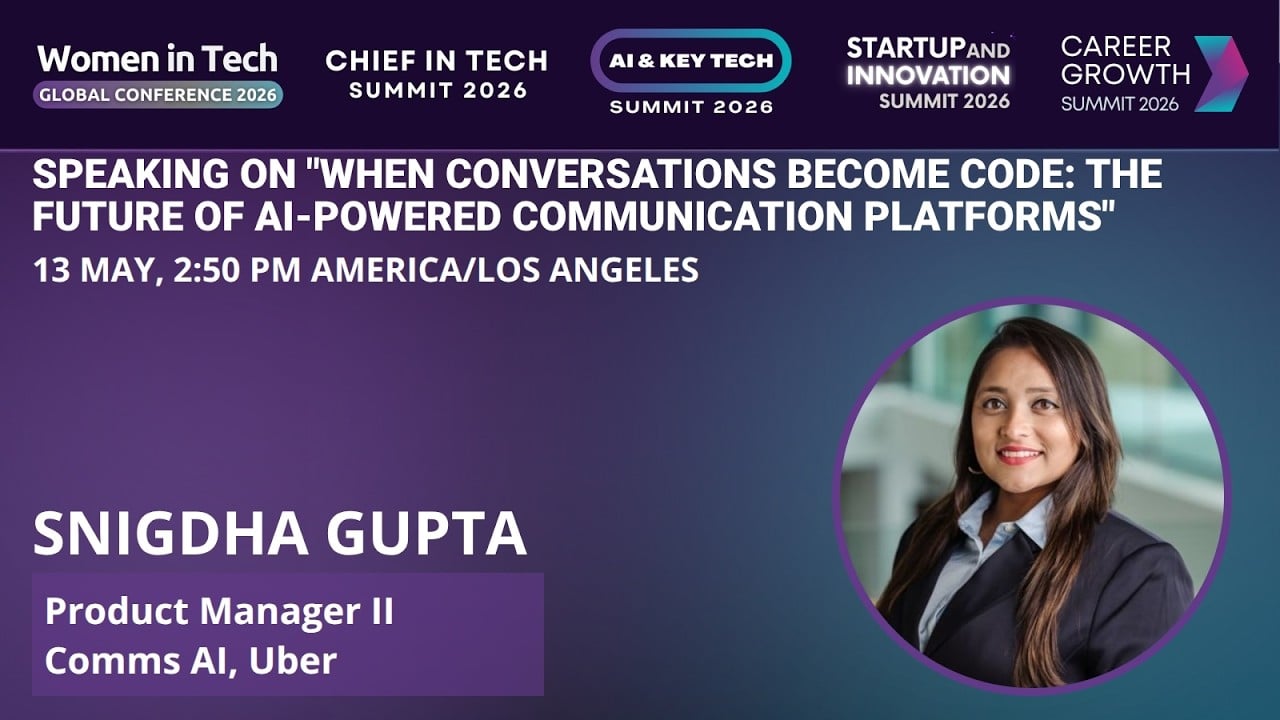
When Conversations Become Code: The Future of AI-Powered Communication Platforms
Snigdha Gupta24:422026
Most companies sit on a goldmine of conversations and do nothing with it
A customer who simply opens a support ticket at Amazon already costs the company money, yet every message in that ticket carries intent and sentiment most firms never use. Snigdha Gupta, a product manager on Uber's communications AI platform, has built such systems across fintech, mobility and media. Her question: how do you turn chats, emails and voice calls into actions you can trust when customers forgive human mistakes but not AI ones?
Get a five-step blueprint for AI communication systems that listen before they act
Snigdha Gupta, a product manager on Uber's Comms AI team, explains how chats, emails and voice calls can be turned into actionable signals through intent detection, agentic LLM orchestration and human-in-the-loop review. She argues that the harder and more valuable problem is building systems that listen, prioritising precision, context and empathy, and offers a five-step blueprint (listen, learn, act, measure, protect) for AI-native communication platforms.
“I think every message carries intent. Every reply carries a sentiment.”
“So listening means understanding intent, not just words, and detecting emotion, not just sentiment scores, and knowing when to act and how to act, and when to step back and put a human in the moment.”
What you will learn
Map an AI communication platform into three parts: intent detection, agentic LLM orchestration with guardrails, and human-in-the-loop review.
Prioritise precision over recall when AI actions such as refunds or account suspensions carry legal or financial risk.
Enrich conversations with context (hydration) such as trip IDs, billing history and prior chats so issues reach the right team.
Decide when to automate fully, augment a human agent or route to a person based on volume, risk, ambiguity and emotion.
Apply the LLAMP blueprint: listen, learn, act, measure and protect, with human oversight by design.
Key takeaways from the speaker
Learn how Big Tech leverages conversational signals for product intelligence and monetization.
Understand the architecture of AI-native communication systems (intent detection, orchestration, feedback loops).
Explore how to balance automation and empathy in customer experiences.
Gain a practical framework to build scalable, LLM-driven omnichannel platforms.
Details
Level
Intermediate
Format
Talk
Technical depth
Introductory technical
For
Mid-career, Senior individual contributor
Length
24:42
Published
August 2026
Questions this talk answers
What are the core building blocks of an AI-native communication platform?
Intent detection that classifies and buckets issues across text and voice channels, agentic LLM workflows that route, retrieve, draft and act within guardrails, and a human-in-the-loop layer that validates actions and builds a golden dataset.
Why should these systems favour precision over recall?
Missing a refund ticket is acceptable, but giving refunds to the wrong person or suspending a user on a low-confidence detection can lead to legal complications.
How should teams evaluate intent detection over time?
Run recurring weekly or monthly reviews on a random sample, checking precision (how many detected intents were correct) and recall (how many were missed), aiming eventually for both to be high.
When should a conversation be automated, augmented or handed to a human?
High-volume, low-risk, deterministic cases can be fully automated; AI can draft suggestions for agents to approve; high-emotion, ambiguous or high-stakes cases go to a human, and sensitive identity or relational moments are co-created.
What does building LLM native rather than LLM bolted mean?
Making the system scalable, omnichannel and platform-like, with microservices for orchestration that can be plugged in and improved per channel, such as emotion detection for chat or barge-in handling for voice.
About this talk
As products become increasingly conversational, every interaction, be it an email, chat, or voice call, becomes an opportunity for intelligence. In this talk, I’ll share how teams at the intersection of AI, product, and customer experience can design scalable communication platforms powered by intent detection, agentic workflows, and human-in-the-loop feedback (HITL).
Drawing from real-world implementations across multiple domain ecosystems, we’ll explore how to move from reactive support systems to proactive, personalized engagement, while balancing automation with empathy. AI Communication Platforms is where conversations become code, and code becomes connection.
Attendees will walk away with a framework for building AI-native communication systems that don’t just talk to users, but truly listen to them.
Intended audience:
Product Managers, AI/ML Practitioners, Platform Engineers, and UX Leaders interested in AI-driven customer experiences and agentic communication platforms.
When to automate, augment or hand to a human (53 s)
I'll get started here with some introduction from my end. So I'm Snigdha. You can also call me Sniggy. I am taking this session from my office's workstation. So it is the middle of the day. I'm based on the Pacific coast. I am in sunny Wales and I work at Uber. I was one of the few people who decided really late in their careers to do a career pivot. So I did transition from software to product. I do have a master's in computer science as well as Carnegie Mellon. And I'm a product manager at Uber, specifically in the comms platform team, where I extensively work a lot with communications. And I'm deeply excited about this journey where a lot is changing in the market, where we are trying to find insights
from conversations which were usually buried in support chats, voice calls, IVRs, etc. So today we're going to talk about how conversations can actually become code and signals for you, how you can leverage any insight from these conversations, and how do you really build these systems, both as a software developer, but also as a product manager. So without further ado, I'll move on.
I'm unable to see any questions, but I will pause in between if you guys sort of have any questions there. I think one thing I do want to get started is how the future of communications is actually changing. Every interaction has become a signal. And you can think about the last time you reached out to a company, and maybe it was an email or a chat or a voice call. And from your side, it felt like it's a request.
So everyone hates support calls. And I personally do not like spending hours on getting some sort of resolution. But sometimes we have to, right? And then think about what really happens on the platform side, right? Think about what really happens with each message that you've sent or an email that you've sent, where you need some resolution, but what's really happening on the other side? I think every message carries intent. Every reply carries a sentiment. And right now, most companies are sitting on a goldmine of conversational data. And they're doing almost nothing intelligent with it right now. We are seeing this change at big tech companies, companies like Google, Microsoft, Uber, Amazon. They're all trying to work with intelligence, specifically with conversations. But I think all of us can sort of use some of these
insights at some place or the other, wherever you're working, and bring these ideas to your leadership, to your teams, and you know, and bring in the innovative solution. So let's, let's go to, you know, thinking about what are we going to cover today. So firstly, we will talk about the shift, then we'll talk a little about how do you really build these? What are the things you really need to balance? And how you should think about the AI native frameworks? And finally, we'll end with some takeaways.
So quickly, to talk about, you know, the shift. Not long ago, I would say the communication platforms look like, look, look like, you know, where tickets are routed by keyword matching, there is IVRs, there is templatic responses, are you getting copy pasted information by agents, there's some really boring AI chats that you see, and you kept, you're basically stuck in a loop with them. So you do not, you don't get your resolution. And then there's a huge cost on the platform side also with each of these tickets being raised. So I think what a lot of you folks would not know, but let's say you ordered something on Amazon, and you'd never got the package, and you've now raised a ticket. That ticket actually costs Amazon a lot. Not just like, in terms of getting it resolved, but even just initiating that
a ticket is a cost to Amazon. The way to see this shift here is that we are moving into a, you know, in a more proactive or a, you know, proactive intelligence mode. Initially, once the issue is raised, you would sort of look at the complaint that the customer has made, and then take the action. So that was more of a reactive support. But what you're now looking at is more of proactive intelligence, where you can detect the intent in real time, or in near real time. There is LLM orchestration across channels. So you if I've raised a ticket on email, as well as on a chat, you can actually get both the context. Even with voice calls, you can get that context. And then finally, you know, you can get
personalized and context aware replies. And there's a lot around the feedback loops compounding to learning, where you can detect patterns, insights, you could do you could do some sort of interventions. You could also understand what are the major gaps in all the support tickets or all sort of the communications across your channels. And this can also be really well leveraged to marketing campaigns as well.
Given that you know what sort of content really works with your with your users, and you can look into the conversations there and get these insights. Let's look into the architecture here. So if you have to think of one way, I would say there are three major parts to it. When you are building a system that can detect insights from a conversation, this can be text, this could be voice. Currently, these are the two major modes of communications right now. When I say text, it could be on chat or email. And when I say voice, it's usually a voice call. But it could also be audio recordings, which are priorly done and are not in real time. So the first aspect of this is to basically get the intent. You want to first classify
what the intent is, then second extract that value, and then disambiguate the user across those channels, you want to ensure that what is the bucket of categorization, or issue categorization, and then direct that user into that particular channel. So how you're doing this is, let's say I raise a complaint at Amazon. I recently didn't get a package that I had ordered, I have initiated that, hey, I did not get my refund, even after automatically asking it on Amazon. You can now detect that there is a successive, there is an issue resolution issue, which means that the user had already asked for a resolution, we tried to provide them as a company, but we weren't able to do that. So now you've bucketed that into some sort of a category. And now you can direct that to the respective team. Now how this leans into agentic
orchestration is that you can design LLM workflows that route, retrieve and draft and then also act with specific guardrails, guardrails, of course, from the designated team. So think of an example, like, you know, I'm from Uber, we work with a lot of automatic vehicles or AVs. Think of it in this way that what happens when a user tries to, you know, find a ride, or there's sort of a pickup confusion. When the user is saying that, hey, I lost my phone, can we can we figure out a way to understand that intent, categorize it correctly, and then let the lost and found team know that so and so customer is going undergoing so and so problem, and then initiate a resolution from our end rather than letting the user wait on it to happen.
And then finally, there's a human in the loop portion to it. Now, because we are working with such large use cases and users, you cannot entirely rely on AI no matter how much we all love and hate AI. The reason because of this is that in certain use cases, the human, the error with AI can really lead to legal complications. So you have to ensure that even though your recall is not high, your precision is, which means that you want to ensure that there are humans that are validating the actions done by the AI system here, or the agentic orchestration done here. And you are creating some sort of a golden data data set to make sure that the resolution that the AI is doing is in the correct workflow system.
And it's taking the right measures to make the make the resolution for that particular support ticket or conversation that the user has done. I'll move on to the next one here to quickly, you know, give you an example. So let's say it says, you know, my order was never delivered and I was charged twice. So in this case, this could be in that particular event, there is maybe a duplicate charge.
There's a frustrated, urgent sentiment. There is some sort of amount which which you might want to know that how many times have you made a refund issue. And then finally, you are letting the team of refunds and paybacks know about this issue, but then also get the help of human in the loop to help prioritize this particular issue. The common things that you would want to know here is number one is multi intent by default. So you want to focus on real conversations where it's multimodality, which means irrespective of emails, chats and voice calls. Then you also want to focus on the confidence over certainty. There needs to be high confidence because these are AI generated and you want to ensure that your AI is working more correctly than negatively. If you miss out a refund ticket,
that's fine. But if you are giving refunds to the wrong person or detecting it in the wrong scenario, that's not really the good thing to do. So or if you are, you know, taking sort of severe action, for example, suspension or blocking the user for certain activity. Those sorts of those sorts of things cannot be you cannot work with those if the confidence level is too low. So definitely focus on how can you calculate the confidence of detecting that particular intent, whether it is through AI or through human in the loops golden data set. And then finally, we have context over content, where every event state billing history or any prior chart reshapes the meaning. So if you can add more content, metadata, dynamic configurations,
additional information from other systems that which we call it hydration, you can then get much better insights and understanding from that conversation. So for example, if let's say there's a lost and found ticket, if I can add the trip ID, the time, the vehicle that the item was lost in, it becomes easier for you and your system to navigate that particular support ticket to the correct team and proactively take that action.
So obviously, there are some sort of limitations to conversations, you know, when people talk on voice call, they can barge in, they can turn back on what they've said. So I could probably say, you know, I, my order was delayed, I, my order was delayed, and then I would say no, it's not delayed. Actually, it was not delivered. And those are sort of, you know, turn in or barge in in specially invoice, you'll have to get go through those sort of limitations.
Then there's chat brevity as well. There's this email formality, all of those things also need to be tackled by your system, where you need to ensure that your system is a, acceptable to the latency or is able to figure out how you how do you really make a system from end to end, where, if you're doing in near real time, whether real time, or whether you want to do it in historical background.
And then, then, then, let's see how how we really, you know, can work with some guardrails here. So you had a message, you had an intent classifier, you do use some policies and tools to ensure that there are enough guardrails, then there is an LLM drafter. So your LLM sort of drafts what it needs to do. And then finally, the human in the loop review happens. And then you tie that all back up with reply and action. So you do not stop once your human or human annotations have been done. You also have to see what metric calculations do you get at the end of your conversation signal detections, and then use that data to fill it back into your system. So now your system is more advanced and eliminates those sort of ambiguities and places where it was unable to detect the fact or detect the signal or detect the
detect the intent. And then next, we would want to talk about what human in the loop is. So you think about this where you have taken out an intent from a conversation. Now your model or your system has figured that, okay, there was a lost and found item or there was a refund issue. The customer is agitated or the customer is frustrated.
Okay. You want to make sure that you want to make sure that you want to make sure that these predictions or not predictions, but these findings are sort of correct. And that there is the same understanding, like if I as a human would read that conversation, I would get the same understanding as that the model has predicted, you know, outputted it. So you want to make sure that you're doing sort of recurring evaluations.
You could do it on a weekly basis on a monthly basis, depending on your use case. But the idea is that you take a sample subset, and it's always better to take a random sample subset, rather than something specific, and then you check for precision. Accuracy would be sort of misaligned here, but you check mostly for precision, which means that out of all the detected intents from these conversations, how many have you actually detected correctly. And then the recall would be how many have you missed. So depending on your use case, it could be okay to miss a few or you would also want a higher recall. Eventually, the best state scenario would be that you find that you get to a point where both precision and recall are really high.
And then finally, I would want to leave you with this that we talk a lot about like AI systems that can generate responses and draft emails and synthesize answers, I would say that's really remarkable. But the harder and the harder and the harder and the harder and more important problem is to build systems that can listen. So listening means understanding intent, not just words, and detecting emotion, not just sentiment scores, and knowing when to act and how to act, and when to step back and put a human in the moment.
So the idea with making conversations into code is that you are able to take an action even before the user tells you that it needs you, and that you are able to turn that into a dollar impact where you are doing resolutions faster, where you are having better customer experience, which leads to, you know, higher net promoter scores and customer satisfaction scores.
And then lastly, you are building a more automated system that requires less human intervention and more sort of growing itself and its intelligent and knowledge base along with all these metadata and hydrations. So I would take a pause here and see if there are any questions from people in the chat. So I think the last few things that I would want to quickly go over is that when you are trying to build automation, think of it building it with empathy more automation does does answers to the scale, but empathy scales the relationships, the craft on knowing like, you know, where do you need to add AI and where do you need to plug it out sort of really matters.
So you need to you need to you need to think of when to do what. So if there is a high volume, low risk, and it's deterministic, you can automate that fully, like we all know that. But if sort of you're drafting certain suggestions, and then the human approves such like augmenting the agent, so you have a little bit of AI system and then a little bit of the agent, if there's a high emotion involved, and there's a lot of ambiguity or stakes, then definitely that gets routed to the human.
And then finally, if you want to co create on like sensitivity identity or relational moments, then that becomes like a co create system. And next, I want to leave you with a blueprint here for any sort of AI native comms you're doing irrespective of what is the use case or what is the product that you're working with.
Think of it this way that you want to first capture also listen is the sort of the acronym here that you could say lamp with a double L. So you want to first listen, then learn on the closed loop for every interaction. So you do that a couple of times to really find patterns and insights that would be a learning.
Then finally, you do an action or that action could be as small as, you know, responding to the user automatically or taking an action so much so that you actually resolve the entire issue of the user through an agentic process. Then finally, you measure the success rate, the quality metrics, the trust, the resolution rate, and then finally protect any guardrails, privacy and humor and have human oversight by design so that there is no sort of mistakes by AI.
I think one thing you need to keep in mind is that humans can forgive mistakes by a human, but humans do not forgive mistakes by an AI because that can be challenged in the legal code. And you do not want to get get to that point where your company is being, you know, company has a lawsuit. So definitely make sure that you have strong guardrails, you have strong privacy controls and security controls, even more so so that no bad actor can sabotage your system.
Finally, I would say that there are four major ideas that you should take away with you today. Number one is that we are currently in the moment where conversational signals are product fuel. Every tech company is trying to turn these signals into intelligence and monetize on it. Number two, architecture definitely matters. So how you build your system, whether it is intent detection connecting to your agentic workflows or your agentic workflows connecting to your quality metrics, the entire end to end system matters.
So you definitely want to make sure that you have an architecture that can scale and work well with multi users. Number three is empathy is a design choice. When you build with empathy and you think of the user and try to be in their shoes, you are able to see some of the blind spots that you may not have been able to anticipate or even your system might not have been able to anticipate.
And then finally, build a LLM native, not an LLM bolted. What this essentially means is that make it scalable, make it omnichannel, make it a platformative, which means that you can plug and play in different platforms. So if you if you can create microservices for your entire orchestration that helps you improvise or improve some of those specific microservices capable of improving in that particular arena.
So if you have something specific for chat, you can then focus specifically to detect certain emotions, certain narratives, certain intents or signals or facts. Whereas when it comes to voice, you would be able to figure out different sort of languages, barge in, you know, top turns, all of those sorts of things. And that would be it. I would give away one thing.
So I do write a lot of on A.I. and product management. I write everything from how voice is changing. The voice interface is changing to how do you really get hired in this competitive market and how do you use A.I.? My sub stack is called become one percent better PM. You can sign up. It's free. And if you have any further questions, I'm happy to answer those in the chat or on LinkedIn.
And that would be all for today. Thank you, Kat. Thank you for your support. You've been a really great audience. I'll quickly see if there are any questions in the chat. Cool. Thank you, everyone.
Transcribed automatically; names checked against the speaker record. Select a time to jump there.
Article based on this talk
How do you build AI communication systems that listen before they act?
Uber product manager Snigdha Gupta shows how intent detection, agentic workflows and human review turn everyday conversations into trusted action.
In short
Snigdha Gupta argues that every email, chat and voice call a company receives is a signal, and that most organisations are wasting it. Her answer is an AI-native communication platform built on three parts (intent detection, agentic LLM orchestration and human-in-the-loop review), designed to favour precision, context and empathy over raw automation. She closes with a five-step blueprint she calls LLAMP: listen, learn, act, measure and protect.
Key takeaways
Learn how Big Tech leverages conversational signals for product intelligence and monetization.
Understand the architecture of AI-native communication systems (intent detection, orchestration, feedback loops).
Explore how to balance automation and empathy in customer experiences.
Gain a practical framework to build scalable, LLM-driven omnichannel platforms.
Every conversation is a signal
Gupta, who moved from software engineering into product and now works on Uber's communications platform, starts from the customer's side of a support request. To the customer it feels like a simple ask. To the platform, she says, it is something richer: "I think every message carries intent. Every reply carries a sentiment." (1:59)
The problem is that this information usually stays buried in support chats, voice calls and IVR systems. "And right now, most companies are sitting on a goldmine of conversational data. And they're doing almost nothing intelligent with it right now." (1:59) She notes that big tech companies such as Google, Microsoft, Uber and Amazon are all working on conversational intelligence, and encourages viewers to bring the same ideas to their own teams and leadership.
From reactive support to proactive intelligence
Gupta describes the old model plainly: tickets routed by keyword matching, IVRs, templated responses copied and pasted by agents, and chatbots that trap customers in loops. Each ticket also has a cost on the platform side. Using an undelivered Amazon order as her example, she points out that even raising a ticket is expensive: "That ticket actually costs Amazon a lot." (3:35)
The shift is towards detecting what the customer needs before they have to chase it. "But what you're now looking at is more of proactive intelligence, where you can detect the intent in real time, or in near real time." (4:29) LLM orchestration across channels means context from an email, a chat and a voice call can be combined, replies can be personalised, and feedback loops can reveal patterns, gaps in support and even insights for marketing campaigns.
The architecture: intent, orchestration, human in the loop
Gupta breaks the system into three parts. First, intent detection: classify the intent, extract the relevant values, disambiguate the user across channels and bucket the issue so it reaches the right team. Second, agentic orchestration: LLM workflows that route, retrieve, draft and act within guardrails set by the owning team. Her Uber example is a rider who reports a lost phone; the system should recognise the intent, alert the lost and found team and start a resolution rather than leaving the rider to wait.
Third, and non-negotiable at scale, is human review. Because AI errors can lead to legal complications, she says: "So you have to ensure that even though your recall is not high, your precision is, which means that you want to ensure that there are humans that are validating the actions done by the AI system here, or the agentic orchestration done here." (8:40) Those human checks also build a golden dataset that keeps the workflows correct.
Multi-intent, confidence and context
A message such as "my order was never delivered and I was charged twice" carries several intents at once, plus frustration and urgency. Gupta draws three lessons. Systems should assume multiple intents by default across every channel. They should value confidence over certainty, because missing a refund ticket is tolerable while refunding the wrong person, or suspending a user, is not: "So definitely focus on how can you calculate the confidence of detecting that particular intent, whether it is through AI or through human in the loops golden data set." (11:02)
And context beats content. Adding metadata from other systems, which her team calls hydration, changes what a message means: "So for example, if let's say there's a lost and found ticket, if I can add the trip ID, the time, the vehicle that the item was lost in, it becomes easier for you and your system to navigate that particular support ticket to the correct team and proactively take that action." (12:03) She also flags channel quirks, from callers who barge in and correct themselves to terse chats and formal emails.
Measuring what the model understood
The pipeline Gupta sketches runs from message to intent classifier, through policies and tools that act as guardrails, to an LLM drafter, human review, and finally the reply and action, with metrics fed back into the system. Evaluation should be recurring, weekly or monthly depending on the use case, on a random sample. Precision asks how many detected intents were correct; recall asks how many were missed. "Eventually, the best state scenario would be that you find that you get to a point where both precision and recall are really high." (15:38)
Listening, empathy and the LLAMP blueprint
Generating replies is remarkable, Gupta says, but the harder problem is listening: "So listening means understanding intent, not just words, and detecting emotion, not just sentiment scores, and knowing when to act and how to act, and when to step back and put a human in the moment." (16:31) She offers a simple rule for where AI belongs: "So if there is a high volume, low risk, and it's deterministic, you can automate that fully, like we all know that." (18:40) Cases needing drafts and approval augment the agent, high-emotion or high-stakes cases go to a human, and sensitive identity or relational moments are co-created.
Her blueprint, LLAMP, asks teams to listen, learn from closed loops, act, measure quality, trust and resolution rates, and protect with guardrails, privacy and human oversight. The stakes are real: "I think one thing you need to keep in mind is that humans can forgive mistakes by a human, but humans do not forgive mistakes by an AI because that can be challenged in the legal code." (20:33) Her final advice is to build "LLM native, not an LLM bolted": scalable, omnichannel microservices that can each improve in their own channel.
Watch the talk
Watch "When Conversations Become Code: The Future of AI-Powered Communication Platforms" by Snigdha Gupta (25 minutes): https://www.womentech.net/video/when-conversations-become-code-future-ai-powered-communication-platforms
About the speaker
Snigdha Gupta is Product Manager II, Comms AI at Uber, with deep experience building AI-powered communication platforms across fintech, mobility and media, and previous roles at Amazon, Autodesk and ServiceLink. She holds a Tech MBA in Product Management from Carnegie Mellon University and an MS in Computer Science (AI/ML) from the University at Buffalo, writes "Become 1% Better PM" on Substack and mentors aspiring product managers.
Questions this talk answers
What are the core building blocks of an AI-native communication platform?
Why should these systems favour precision over recall?
How should teams evaluate intent detection over time?
When should a conversation be automated, augmented or handed to a human?
What does building LLM native rather than LLM bolted mean?
Drafted with AI from the talk transcript. Editor review pending.
Snigdha Gupta. "When Conversations Become Code: The Future of AI-Powered Communication Platforms." WomenTech Network, 2026. https://www.womentech.net/video/when-conversations-become-code-future-ai-powered-communication-platforms