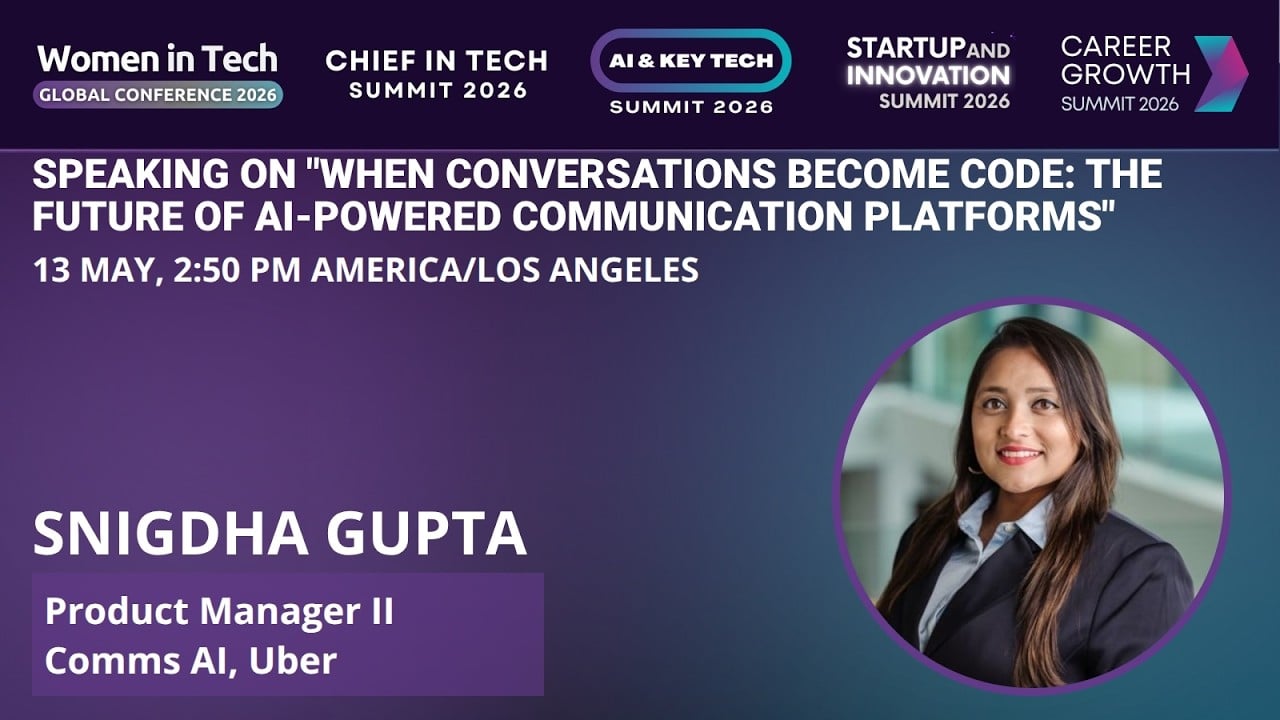
When Conversations Become Code: The Future of AI-Powered Communication Platforms
 Snigdha Gupta
Product Manager II Comms AI,, Uber
Most companies sit on a goldmine of conversations and do nothing with it
On its own, a language model rarely makes a dependable product. The real work is grounding it, tuning it, measuring it and keeping its costs in check. Engineers, architects and product leaders show developers and data teams how to ground answers in company data with retrieval, choose between supervised, preference and reinforcement fine-tuning, evaluate each component against gold datasets, design reliable chatbots and agents, and cut token costs or call models from SQL and serverless services.
23 talks 22 speakers 10 hours 2023 to 2026
Search the whole library
Snigdha Gupta
Product Manager II Comms AI,, Uber
Most companies sit on a goldmine of conversations and do nothing with it
 Christine Sarros
Senior Vice President, Enterprise Engineering, Oracle
Oracle's old help bot passed over 90% of requests on as tickets
 Jetashree Ravi
Tech Lead Manager, Fireworks AI
Reliable agents need a verifiable task more than 100K labeled examples
 Sowmya Podila
Senior Applied AI Scientist, Fortune 50 Retail
Many users ask your LLM the same question, and you pay for every answer
 Charu Maheshwari
Product finance & strategy, Anthropic
A cheap AI model can cost more than a strong one that gets it right once
 Dhivya Nagasubramanian
Lead AI Solutions Architect, Fortune 500 Company
Ignoring unstructured data is a bigger risk than taming its complexity
Intent detection that classifies and buckets issues across text and voice channels, agentic LLM workflows that route, retrieve, draft and act within guardrails, and a human-in-the-loop layer that validates actions and builds a golden dataset.
When Conversations Become Code: The Future of AI-Powered Communication Platforms, Snigdha GuptaBusinesses do not make critical decisions from the general internet corpus; they need models fine-tuned or adapted to their own specific data that deliver secure, fast and relevant outputs.
AI and the Enterprise: Considerations for secure and responsible deployments of native, 3rd party and integrated models, Christine SarrosSupervised fine-tuning learns from high-quality input and output examples with a clear gold standard, DPO learns from preferred versus non-preferred output pairs (for voice, style or safety), and RFT learns from an evaluator that scores the model on a real task.
Make RFT Boring (In a Good Way): Predictable, Practical Tuning, Jetashree RaviMany users ask similar questions about the same documents, so recomputing answers wastes compute. Caching returns stored answers, cutting latency and cost without reducing the data sent to the model, so accuracy stays intact.
Cutting LLM Inference Costs by 50–90%: Introduction to Caching in AI systems, Sowmya PodilaInput tokens are processed in parallel almost at once, while output tokens are generated one at a time, so they need far more computation. The speaker cited output as typically three to six times as expensive.
Pricing Intelligence: What AI economics means for leaders building and buying AI, Charu MaheshwariStructured data is numerical and categorical data stored in relational databases, such as sales figures and customer records. Unstructured data has no predefined format and includes scanned documents, PDFs, audio, video, emails, surveys and social media posts.
Harnessing the Potential of Unstructured Data to Drive Enterprise Success, Dhivya NagasubramanianLLMs can hallucinate confidently and answer inconsistently, which erodes user trust. They also lack actionability, because taking actions requires sharing user context with the model, which raises data privacy concerns.
Building an AI Chatbot: Better Responses and Actionability with LLM and Predefined Logic Trees, Riddhima SejpalThey tend to reply with long, wordy lists, while a good agent should take deterministic actions such as acknowledging and probing and understand preferences implicitly rather than filling a form.
Building and evaluating robust conversational interfaces using LLMs, Janvi Palan Kaoutar El MaghraouiPrincipal Research Scientist, IBM2 talksSnigdha GuptaProduct Manager II Comms AI,, Uber1 talkChristine SarrosSenior Vice President, Enterprise Engineering, Oracle1 talkJetashree RaviTech Lead Manager, Fireworks AI1 talkSowmya PodilaSenior Applied AI Scientist, Fortune 50 Retail1 talkCharu MaheshwariProduct finance & strategy, Anthropic1 talkDhivya NagasubramanianLead AI Solutions Architect, Fortune 500 Company1 talk
 Riddhima SejpalSenior Staff Software Engineer, Instacart Inc.1 talk
 Janvi PalanPreviously at Samsung Research America1 talk
 Kamal shree SoundirapandianDeveloper Advocate, Microsoft1 talk
 Pooja KelgaonkarSenior Data Architect, Rackspace Technology1 talk
 Savita MittalSenior Cloud Solutions Architect, MICROSOFT1 talk
“I think every message carries intent. Every reply carries a sentiment.” Snigdha Gupta, When Conversations Become Code: The Future of AI-Powered Communication Platforms
“Most businesses are not trying to write term papers about philosophers.” Christine Sarros, AI and the Enterprise: Considerations for secure and responsible deployments of native, 3rd party and integrated models
“And throughout the presentation, we will be laser focused on the middle one because to be quite honest, not only does it help and improve the model performance, it's also quite misunderstood today.” Jetashree Ravi, Make RFT Boring (In a Good Way): Predictable, Practical Tuning
Riddhima Sejpal
Senior Staff Software Engineer, Instacart Inc.
Instacart's support chatbot got better by letting the LLM do less
Janvi Palan
Previously at Samsung Research America
A sales chatbot that asks question after question is just a form
Kaoutar El Maghraoui
Principal Research Scientist, IBM
IBM removed two thirds of the data it collected before training Granite
Kamal shree Soundirapandian
Developer Advocate, Microsoft
Most teams skip the last three steps of adding AI to their apps
Pooja Kelgaonkar
Senior Data Architect, Rackspace Technology
Run large language models on your warehouse data with plain SQL
Savita Mittal
Senior Cloud Solutions Architect, MICROSOFT
The best use of Azure OpenAI may not be a chatbot at all
Kaoutar El Maghraoui
Principal Research Scientist, IBM
IBM removed two thirds of its collected data to build a model it could trust
 Namrata Sherkhane
Senior Cloud Solution Architect, Microsoft
Generative AI can answer employee questions straight from your policy documents
 Deirdre Meehan
Staff Engineer, UnlikelyAI
An AI assistant booked the wrong island and hallucinated the reviews
 Shubhangi Tandon +1
Mananger, Applied Research 2, eBay inc
Averaging similarity labels erases the shoppers visual search must serve
 Nandita Giri
Senior Software Engineer
A hallucinated fact in step two can poison every step that follows
 Shirsha Ray Chaudhuri
Director, Research Engineering ,, TR Labs at Thomson Reuters
Standard APM missed per-user tokens, user feedback and prompts in GenAI
 Manasi Sharma
Principal engineering manager, Microsoft
Less than half of enterprise decisions have enough data behind them
 Nivedita Kumari
Data Analytics Customer Engineer, Google
71% of organizations plan generative AI in their databases, 14% manage it
 Sowjanya Pandruju
Cloud Native Applications Architect, Amazon Web Services (AWS)
Gen AI workloads are unpredictable, so stop planning servers for them
 Harsha Upadhyay
Founder, allaboutdata.net
AI agents can act on their own, but only on data that is ready for them
 Jayeeta Putatunda
Senior Data Scientist, Fitch Ratings
Fintech can skip building NLP from scratch, but not the human in the loop