Data Science, Artificial Intelligence and Machine Learning
Sandhya Krishnan20:412021
L'IA ne prendra pas votre emploi, mais elle changera votre rôle
Chaque tweet, chaque publication Facebook et chaque recherche sur mobile laisse une empreinte numérique, et le graphique présenté par l'intervenante montre des volumes de données en croissance exponentielle depuis 2015. Si vous avez l'impression que le débat sur l'IA vous a dépassé, le jargon à lui seul peut vous tenir à l'écart. Sandhya Krishnan, passionnée de données forte de dix ans d'expérience en informatique (développement, test et support de production), cartographie l'ensemble du domaine : comment des données brutes et bruitées deviennent-elles une prédiction exploitable par une entreprise ?
Obtenez une carte claire de l'analytique, des types d'IA et des étapes de construction d'un modèle de machine learning
Sandhya Krishnan propose un tour d'horizon accessible aux débutants de la data science, de l'intelligence artificielle, du machine learning et du deep learning, des quatre types d'analytique aux façons de classer les systèmes d'IA. Elle présente l'apprentissage supervisé, non supervisé et par renforcement, les étapes concrètes de construction d'un modèle de machine learning et des applications du quotidien, des recommandations de Netflix à la détection de fraude.
“L'emploi humain ne va pas disparaître de toute façon. Mais il va changer de rôle.”
“Donc les deux premières sont une méthode réactive : quelque chose s'est produit, puis on travaille dessus. Alors que les deux dernières sont une approche proactive.”
What you will learn
Distinguer l'analytique descriptive, diagnostique, prédictive et prescriptive, et associer chacune à une question métier.
Classer les systèmes d'IA par capacité (étroite, générale, super) et par fonctionnalité (réactive, mémoire limitée, théorie de l'esprit, conscience de soi).
Choisir entre apprentissage supervisé, non supervisé et par renforcement selon l'existence de données étiquetées.
Préparer les données pour un modèle en traitant les valeurs manquantes, les incohérences, les doublons et les variables catégorielles.
Reconnaître le machine learning à l'œuvre dans les recommandations, l'identification sur les photos, les assistants virtuels et la détection de fraude.
Details
Level
Beginner
Format
Talk
Technical depth
Introductory technical
For
Student, Early career, Career changer
Length
20:41
Published
June 2021
Questions this talk answers
Quelle est la différence entre business intelligence et business analytics ?
La business intelligence couvre principalement l'analyse descriptive et diagnostique de ce qui s'est déjà produit, tandis que la business analytics y ajoute l'analyse prédictive et prescriptive. La business analytics est le cadre le plus large, dont la business intelligence est un sous-ensemble.
L'IA va-t-elle prendre les emplois des gens ?
Selon Krishnan, les emplois humains ne disparaîtront pas, mais les rôles changeront. Les personnes deviendront plus créatives et spécialisées à mesure que l'IA automatisera les tâches fastidieuses.
Comment les systèmes d'IA sont-ils classés ?
Par capacité, en intelligence étroite, générale et super intelligence, et par fonctionnalité, en machines réactives, mémoire limitée, théorie de l'esprit et conscience de soi.
Quels sont les principaux types de machine learning ?
L'apprentissage supervisé s'entraîne sur des données étiquetées, l'apprentissage non supervisé découvre des schémas cachés et des groupes dans des données non étiquetées, et l'apprentissage par renforcement apprend en agissant sur un environnement et en se corrigeant au fil du temps.
Quelles sont les étapes de construction d'un modèle de machine learning ?
Collecter les données, les nettoyer (valeurs manquantes, incohérentes et en double, encodage des variables catégorielles), choisir un modèle à l'aide de nuages de points, séparer les jeux d'entraînement et de test, appliquer une mise à l'échelle des variables, puis prédire.
Les quatre types d'analytique en une minute (63 s)
L'IA va-t-elle prendre votre emploi ? (69 s)
Apprentissage supervisé ou non supervisé, simplement expliqué (67 s)
I am having around 10 years of experience in IT. Today, I will be dealing with session Data Science, Artificial Intelligence, Machine Learning and Deep Learning. First, we will go through Data Science. As you all know, data is the new oil in digital economy. There are different types of data. It can be categorical or qualitative numeric. But we can classify them into broader way. There is open data and closed data. Open data are those data which anyone can access without any restrictions like survey results, research data and customer studies which are published. Whereas closed data, it will have a restriction and we should have some permission to access those data like sensitive and important record.
Speaker 2: This is a graph where data is plotted with data volume in terabyte, zerabyte and years. And you can see from 2015, there is a massive increase or exponential increase in data. These data can be collected from Twitter or Facebook or whatever you search in from your mobile. So whatever we do in this digital era, we are living a digital footprint.
Speaker 2: And these are raw data. These raw data are inconsistent in nature, incomplete, does not have any certain or particular behavior or trends. And most likely it will have noise. That is error. So these data can be refined and distilled. And after that, if you put some statistical advanced tool in that, then we can get valuable insights.
Speaker 2: And this valuable insights we can convert into information and which in turn can be converted to knowledge. And this knowledge can be used to solve both technical and productivity problem of analytic business business. And these are mainly done by two that is business intelligence and business analytics. Speaker 2: Business intelligence is used to deliver relevant and reliable information to right people in the right format at right time. Here it is very important that we are delivering the information at the right time. So BIE is used to make better decisions faster. Whereas business intelligence, it is having artificial intelligence, statistical and operation research technique, information technology and management strategies.
Speaker 2: And by using these knowledge, we are making some valuable insights. And by using these knowledge, we are making some valuable insights. This can be done by correlation analysis, regression analysis, Speaker 2: Regression analysis, text mining, and many much thing like that. Mainly business intelligence deal with descriptive and diagnostic analysis. Whereas business analytics lead with prospective and predictive analytics.
Speaker 2: So in a nutshell, we can explain these four analytics. That is description analytics is what happened. Diagnostic is why did it happen. And predictive is what will happen. And predictive is what will happen. Speaker 2: And prescriptive is what should I do. So you can see the first two that is descriptive and diagnostic is that something already happened. And then we are analyzing the data where are the later two it is forecasting the future. So the first two is an reactive method something happened, then we are working on that. Whereas later two is proactive approach.
Speaker 2: So we can say that when we put some prediction into business intelligence, we get business analytics. That is business analytics is a bigger umbrella and business intelligence is a subset to that. Speaker 2: Descriptive we can use for revenue of company or sales report and the diagnostic we can use for employee performance analysis by HR department.
Speaker 1: Descriptive we can use for forecasting weather predict predict weather and the eyes of a company customer churn. We can see the likelihood of that. Prescriptive analysis always deals with when a word optimization come. Speaker 2: That is optimization of bed capacity and overtime shift in a hospital price and promotion optimization for retail. Speaker 2: Then we can see artificial intelligence. Artificial intelligence is the science and engineering of making intelligent machine. Any technique which enables computer to mimic human intelligence such as decision making, text processing, visual representation, sort of visual perception. AI is a broader field for a big umbrella, which contains several subfields such as machine learning, robotics, computer vision, etc.
Speaker 2: So we have data science where we deal with data and if we use data science to make intelligent decisions, then we are using artificial intelligence. So we can see that the Venn diagram, the intersection. Speaker 2: AI is now being used in almost every sector like transportation, health care, banking, retail, entertainment, e-commerce. And we already all have an hype that if artificial intelligence come, then our job will be at risk. But actually it is not like that. Human job won't go anyway. But they will change role.
Speaker 2: We all will be more creative and specialized as AI is integrated into workday. Better data lead to better maps, which lead to better prediction. So people using AI can automate the tedious work and track action to the inside. Speaker 2: Artificial intelligence can be classified based on capabilities and functionalities. When we classify it based on capabilities, we have narrow intelligence, general intelligence and super intelligence.
Speaker 2: Narrow intelligence is also known as weak intelligence, and it is only specific to one area and it cannot work beyond that. It is having little limitation and it is widely used for natural language processing. IBM Watson and Siri is best example. And we are also having many other like image recognition system, recommendation system, spam filtering. The natural. When we come when human communicate with each other with the help of Speaker 2: text or by verbal communication we are using natural language.
Speaker 2: The natural. When we come when human communicate with each other with the help of text or by verbal communication, we are using natural language. Speaker 2: The same frontal is used here natural language processing or NLP refers to branch of artificial intelligence that give the machine ability to read, understand and derive meaning from human language.
Speaker 2: Robots such as Sophia or human assistance used used. Speaker 2: Uses natural language in process to sound like human and understand and understand. Speaker 3: The same frontal is used here natural language processing or NLP refers to branch of artificial intelligence that give the machine ability to read, understand and derive meaning from human language. Speaker 3: Robots such as Sophia or human assistance used uses natural language in process to sound like human and understand what we are seeing.
Speaker 3: Then comes general intelligence. It is a strong one. Speaker 3: It can understand and learn any individual intellectual task that a human being can. Speaker 3: And we are not completely developed into it, but we are in the phase of development. Speaker 4: Fijisto has built K computer, which is one of the fastest supercomputer in the world.
Speaker 4: It is a significant attempt towards strong intelligence and it take around 40 minutes to stimulate a single second of neural activity. Speaker 4: Then last come artificial super intelligence. It is only hypothetical. Speaker 5: It should be above human activity in all sense that it should surpass human intelligence and can perform any task better than human.
Speaker 5: It should be smarter than human in every way. Speaker 5: And when we classify intelligent artificial intelligence based on functionality, it can be divided into reactive machine limited theory mind and self awareness. Speaker 5: Reactive machine is like the primary form of artificial intelligence. Speaker 5: It does not store any memory. It does not have any cache. It works on present data.
Speaker 5: Best example is IBM Deep Blue that defeated just Grandmaster Gary Kasparova. Speaker 5: And then comes limited theory. Limit theory is like it has limited memory access, but it is very short term short lived and they can use this past data for specific period by they work on past data and it works only for short period.
Speaker 6: This is best example is like self-driving car. They are included with vehicle devices, which went to change lane, avoid cutting off another driver or hit a nearby vehicle. Speaker 6: Then theory of mind. It is also like not completely developed. Speaker 6: Kismet and can mimic human emotion and recognize them is one of the real world example of this, but it cannot follow grace or convey attention to human.
Speaker 6: Theory of mind. The example is Robert Sophia. She has an combined computer algorithm, which allow in her eye, which allow her to see. Speaker 6: She can sustain eye contact, recognize individuals and follow face. Speaker 6: Self-awareness. It also is an hypothetical one. Speaker 6: It all at such system understand the internal tried state and condition and preserves human emotion.
Speaker 6: These machines will be smarter than human mind. Speaker 6: Then these are the famous quotes of great personality. Speaker 6: Elon Musk says that AI does not have to be able to destroy human. Speaker 6: If AI has a goal and humanity just happens in the way, it will destroy human as a matter of course without even thinking about it.
Speaker 6: No hard feelings. Speaker 6: Whereas Mark Cuban says that artificial intelligence, deep learning and machine learning, whatever you are doing. Speaker 6: If you don't understand it, learn it because otherwise you are going to be a dinosaur within three years. Speaker 6: And father of deep deep learning. Speaker 6: Jeffrey Hinton says that in deep learning, the algorithm which we are using, it is of 1980s and 1990s.
Speaker 6: People were very optimistic about them, but in turn out they did not work too well. Speaker 6: And he has worked lots of lots and lots of work in deep learning and he had published many articles in the same. Speaker 6: We'll learn machine learning. Speaker 6: Machine learning provides AI the ability to learn without explicit programming.
Speaker 6: Here we make machine to work. Speaker 6: Machine will program. Speaker 6: Machine learning is achieved by algorithm that discovers pattern and generate insights from data they are exposed to. Speaker 6: Machine learning access vast amount of data both structured and unstructured and learn it from to predict the future. Speaker 6: When we mark artificial intelligence, machine learning and deep learning by an Venn diagram, we can see that artificial intelligence is a broader umbrella Speaker 6: And machine learning is a way of achieving artificial intelligence.
Speaker 6: Likewise, deep learning is a way of achieving machine learning. Speaker 6: Artificial intelligence. Speaker 6: We know that anything that imitate human behavior and application of AI that allows a system to automatically learn and improve from experience and deep learning limit our neural network of the human brain. Speaker 6: Machine learning algorithm can be classified into supervised learning unsupervised learning and reinforcement learning.
Speaker 6: Supervised learning is like making a child learn. Speaker 6: We want to want them to identify some cat or a dog. Speaker 6: We have to show them your pics. Speaker 6: The same as work for supervised learning. Speaker 6: The data is already labeled. Speaker 6: So we know that what our target is. Speaker 6: It required at least an input and output variable be given to the model for it to be trained.
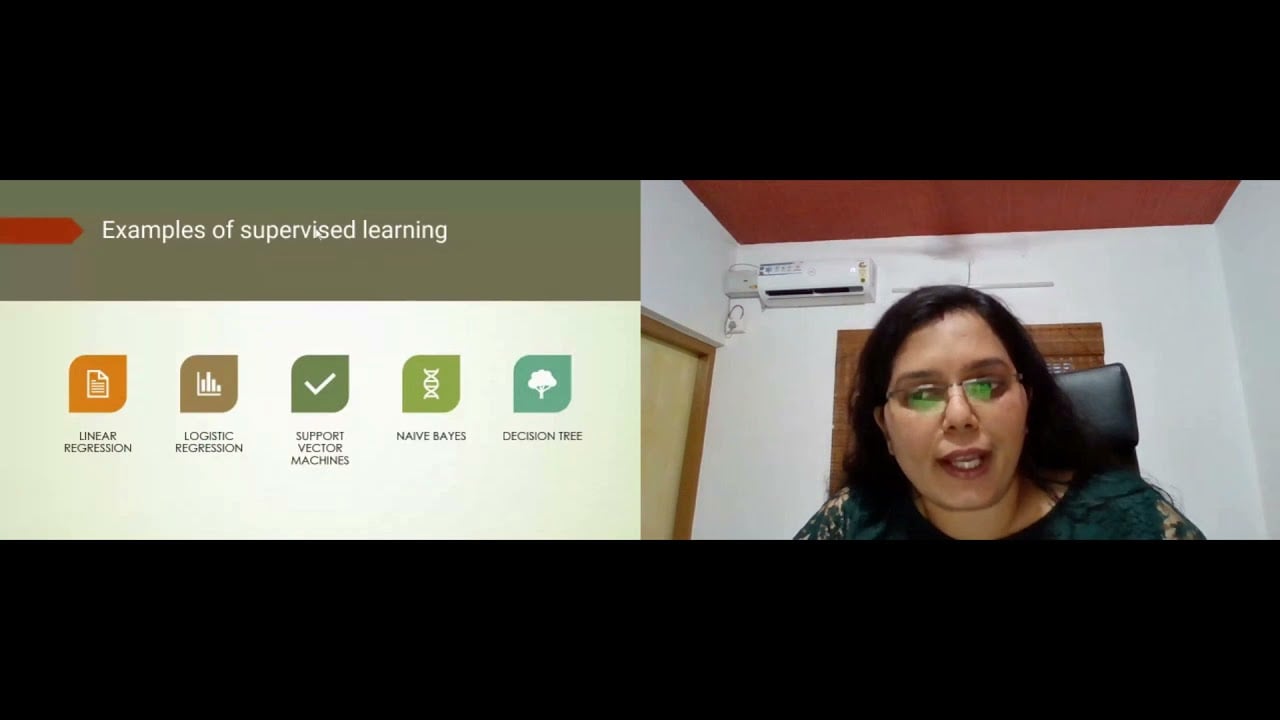
Speaker 6: It is somewhat like this. Speaker 6: We have input data and annotations that we feed to the machine. Speaker 6: So when we put an input to the machine, it will predict that what the input is. Speaker 6: Example of supervised learning is linear regression, logistic regression, support vector machine, NAV base and decision tree. Speaker 6: Unsupervised learning, it is like we don't have labeled data.
Speaker 6: And we make the machine to understand the design pattern. Speaker 6: The system can identify hidden features from input data provided. Speaker 6: Once the data is more readable, the pattern and similarity become more evident. Speaker 6: It will be like we will be putting lots of input without any annotations and the model will learn.
Speaker 6: And then it can divide and classify into the specific group. Speaker 6: Example of unsupervised learning is K-Mean clustering. Speaker 6: Hierarchical clustering and anomaly detection. Speaker 6: Reinforcement learning. Speaker 6: Here it is a combination of supervised and unsupervised learning. Speaker 6: Here minimum data, training data are available. Speaker 6: At that time we use reinforcement learning and also we don't have much idea of the environment.
Speaker 6: And it learned the environment by interacting with it. Speaker 6: Algorithm act on the environment. Speaker 6: For example, make a trade in financial portfolio. Speaker 6: Algorithm optimizes for best series of action by correcting itself over time. Speaker 6: And when we have to design a machine learning algorithm, we have to first collect the data, data processing, choose the model, train the model, test the model, Speaker 6: Feature scale and predictions.
Speaker 6: We will learn one by one. Speaker 6: First one is data collection. Speaker 6: There are five common methods by which we can collect data. Speaker 6: That is close survey and cues. Speaker 6: Other is open ended survey and questionaries, bar one to one interview, focus group or direct observation. Speaker 6: Once we have collected data, we have to check identifying and handling missing data.
Speaker 6: That is if any numerical value is missing, then we can go for mean of the all value and put it in the column. Speaker 6: Then inconsistence value. Speaker 6: For example, we are having someone is entering the data in computer that time. Speaker 6: They may have made a mistake like address and pin number are not matching.
Speaker 6: In such cases, it becomes inconsistent values. Speaker 6: So we have to treat that manually. Speaker 6: Then comes duplicate value. Speaker 6: There is a chance that two people under the same value. Speaker 6: If duplicate value is there, we have to delete one value that encoding categorical data. Speaker 6: For example, we are taking a population of three main three country.
Speaker 6: For example, India, US and UK. Speaker 6: In that case, we cannot feed the system categorical value. Speaker 6: We have to make better like we have to put India as 100, US as 010 and UK as 001. Speaker 6: Then next is choose the model for choosing the model. Speaker 6: We can we can have a first have a scatter plot of the independent variable each independent variable and dependent variable.
Speaker 6: When we have a scatter plot, we can see the relation between two. Speaker 6: If they are linear related or they are scattered and then we can go based on scatter plot. Speaker 6: We can decide which model we have to take that we have already learned supervised and unsupervised learning many like in a regression logistics.
Speaker 6: So we can choose from one of the model then resampling method. Speaker 7: It is an advanced like Monte Carlo stimulations can be used for this. Speaker 7: Then after that, we have to split the test. Speaker 7: We have having a test data. Say we are having 1000 test data in that we have to split into training set and a set training set.
Speaker 7: We have to divide into 80% test to 20% then training set. Speaker 7: We have to evaluate. Speaker 7: We have to train the system with training set and test set is used for evaluation. Speaker 7: And evaluation of model is done to check the performance of system. Speaker 8: Then come feature scaling for all the algorithm.
We don't go for feature scaling, feature scaling are used such so that all your features that is variable are scaled to make sure that all take same scale. Speaker 8: It is done to prevent that one feature does not dominate the other. Speaker 8: For example, if you are having multiple linear regression, it can be represented by this equation.
Speaker 8: So by using normalization or standardization, we can go for feature scaling. Speaker 8: Then prediction once our model is there, we have trained test and we have feature scale. Speaker 8: Then we can go for prediction, predicting the future value. Speaker 8: This can be done by putting system and live examples of machine learning is automatic tagging of friend in Facebook.
Speaker 8: When we put a photo, we automatically, we know that we get a tag. Speaker 9: This person is name is this. So like it is by using deep face algorithm, then Uber, Uber, calculate shortest distance and the demand. This are surprising everything is calculated, basing on machine learning application. Speaker 9: Then virtual personal assistants, such as Siri, Alexa, Google, Cortana, everything are using ML ML is used for speech recognition, speech to text conversion, match to language processing, text to speech conversion.
Speaker 9: Then Google Translate use neural machine translation and NLP for translation. Speaker 9: Then Netflix, we know that when you log into Netflix, it gives us the recommendation. It is done by collecting the data we do that is searching, browsing, start, stop, rewind, by collecting all of this data, they recommend the film for us. Speaker 9: Then next is fraud detection.
Speaker 9: When we use credit card or debit card, whenever a customer carries out a transaction. Speaker 9: ML model, thoroughly scan x-ray their profile searching for suspicious activity. Speaker 9: Then keynote sports. Here we don't have joystick, but by seeing our actions and movement, ML play with us. Speaker 9: Then it is virtual reality set. As we move, the picture also move.
Speaker 9: Then robot dog. Speaker 9: It is used for making kids learn walking and also it is appears in fiction. Then other example are audible recommendation, Amazon recommendation, Facebook ad recommendation. We use ML for mass exploration program. Then in drugs, we use behavior modeling. Speaker 9: Then in leap learning. Speaker 9: The major difference between ML and a deal is that ML uses our mimic our neural network.
But whereas ML works only on structured data. This is the example of neural network and provides a ability to mimic human brain. Speaker 9: It is like input layer. Speaker 9: We feed and the hidden layer identifies the pattern and get the output. It is a retina by scanning retina. They identify ML. Sorry. DL identifies if the patient is diabetic or not.
Speaker 9: Then it is calculated by when we provide an input. It provide a weightage for each one. Then it goes to an activation function. Activation function identifies the input and provide a bias. It determines whether it the input should be filtered or not. Once I put it according to the activation, the value enters. And once it entered, output layer predict the value.
These are the other applications DLR used. Thank you. You can write down my email ID. If there is any doubt or anything which I can have, please let me know. I will try to contact soon. Speaker 9: Thank you. Speaker 9: Thank you everyone.
Transcribed automatically; names checked against the speaker record. Select a time to jump there.
Article based on this talk
Comment des données brutes deviennent-elles une prédiction de l'IA ?
Sandhya Krishnan retrace, en termes simples, le chemin des données bruitées vers l'analytique, l'intelligence artificielle, le machine learning et le deep learning.
En bref
Les données brutes sont bruitées et incomplètes, mais une fois nettoyées et analysées, elles deviennent des insights, puis de la connaissance, puis le carburant de l'intelligence artificielle. Sandhya Krishnan, passionnée de données forte de dix ans d'expérience en informatique, présente les quatre types d'analytique, les façons de classer l'IA, les trois familles de machine learning et les étapes concrètes de construction d'un modèle. Son message pour celles et ceux que l'IA inquiète est rassurant : les emplois ne disparaîtront pas, mais les rôles changeront.
Points clés
Les différents types d'IA et les usages en temps réel du ML.
Des données brutes aux décisions
Krishnan ouvre avec la prémisse qui structure toute son intervention.
« Comme vous le savez tous, les données sont le nouveau pétrole de l'économie numérique. » (0:00)
Elle distingue les données ouvertes, comme les résultats d'enquêtes publiés et les données de recherche accessibles à tous, des données fermées, qui nécessitent une autorisation car elles contiennent des informations sensibles. Un graphique de ses diapositives montre des volumes de données en hausse exponentielle depuis 2015, collectées sur des plateformes comme Twitter et Facebook et à partir de tout ce que les gens recherchent sur leur téléphone. Selon ses mots, toute personne vivant à l'ère numérique laisse une empreinte numérique.
Ces données brutes, explique-t-elle, sont incohérentes, incomplètes et pleines de bruit. Affinées et traitées avec des outils statistiques, elles produisent des insights qui deviennent de l'information, puis de la connaissance. Deux disciplines assurent ce travail. La business intelligence fournit une information fiable aux bonnes personnes au bon moment et couvre surtout l'analytique descriptive (ce qui s'est passé) et l'analytique diagnostique (pourquoi cela s'est passé). La business analytics y ajoute l'analytique prédictive (ce qui va se passer) et l'analytique prescriptive (ce que je dois faire).
« Donc les deux premières sont une méthode réactive : quelque chose s'est produit, puis on travaille dessus. Alors que les deux dernières sont une approche proactive. » (3:07)
Ses exemples rendent la distinction concrète : rapports de ventes pour le descriptif, analyse de la performance RH pour le diagnostic, météo et attrition client pour la prédiction, capacité en lits d'hôpital ou tarification dans la distribution pour l'optimisation prescriptive.
Ce qu'est l'IA, et ce qu'elle n'est pas
Krishnan définit l'intelligence artificielle comme toute technique permettant aux ordinateurs d'imiter l'intelligence humaine, par exemple la prise de décision, le traitement de texte et la perception visuelle. L'IA est un vaste ensemble qui englobe le machine learning, la robotique et la vision par ordinateur, et lorsque la data science sert à prendre des décisions intelligentes, les deux se recoupent. Elle aborde directement la crainte la plus répandue.
« L'emploi humain ne va pas disparaître de toute façon. Mais il va changer de rôle. » (5:03)
Elle propose ensuite deux façons de classer l'IA. Par capacité, on trouve l'intelligence étroite, propre à un domaine (Siri, IBM Watson, filtres anti-spam, systèmes de recommandation) ; l'intelligence générale, encore en développement, pour laquelle elle cite le K computer de Fujitsu, une tentative qui a mis environ 40 minutes à simuler une seule seconde d'activité neuronale ; et la super intelligence, qui reste hypothétique. Par fonctionnalité, on trouve les machines réactives sans mémoire, comme IBM Deep Blue, qui a battu Garry Kasparov ; les systèmes à mémoire limitée, comme les voitures autonomes ; la théorie de l'esprit, illustrée par Kismet et le robot Sophia ; et la conscience de soi, là encore hypothétique. Elle conclut cette partie avec des citations qu'elle attribue à Elon Musk, Mark Cuban et Geoffrey Hinton sur les risques de l'IA et la nécessité de l'apprendre.
Comment les machines apprennent
Dans la présentation de Krishnan, le machine learning est un moyen de parvenir à l'IA, et le deep learning un moyen de parvenir au machine learning.
« Le machine learning donne à l'IA la capacité d'apprendre sans programmation explicite. » (10:41)
Elle décrit trois types. L'apprentissage supervisé fonctionne sur des données étiquetées, avec des exemples comme la régression linéaire, la régression logistique, les machines à vecteurs de support, Naive Bayes et les arbres de décision.
« L'apprentissage supervisé, c'est comme faire apprendre un enfant. » (12:02)
De même qu'un enfant apprend à reconnaître un chat en voyant des images, un modèle supervisé apprend à partir d'entrées associées à des sorties connues. L'apprentissage non supervisé n'a pas d'étiquettes : le modèle découvre des schémas cachés et regroupe les données, au moyen de méthodes comme le clustering K-means, le clustering hiérarchique et la détection d'anomalies. L'apprentissage par renforcement s'applique lorsque les données d'entraînement sont rares et l'environnement inconnu ; l'algorithme agit, par exemple en effectuant une transaction dans un portefeuille, et se corrige au fil du temps.
Construire un modèle, étape par étape
Krishnan présente un processus pratique. La collecte de données peut s'appuyer sur des questionnaires fermés ou ouverts, des entretiens individuels, des groupes de discussion ou l'observation directe. Vient ensuite le nettoyage : remplacer les valeurs numériques manquantes par la moyenne de la colonne, corriger les entrées incohérentes comme une adresse qui ne correspond pas à son code postal, supprimer les doublons et encoder les données catégorielles, par exemple en transformant Inde, États-Unis et Royaume-Uni en colonnes binaires distinctes.
Pour choisir un modèle, elle recommande de représenter chaque variable indépendante par rapport à la variable dépendante.
« Avec un nuage de points, on peut voir la relation entre les deux. » (15:37)
Les données sont ensuite séparées, généralement 80 % pour l'entraînement et 20 % pour le test, et le modèle est évalué sur le jeu mis de côté. La mise à l'échelle des variables, par normalisation ou standardisation, empêche une variable de dominer les autres avant que le modèle ne passe à la prédiction.
Le machine learning au quotidien, et le deep learning
La dernière partie ancre les concepts dans des produits familiers : l'identification automatique des amis sur Facebook grâce à DeepFace, les calculs d'itinéraires et de demande d'Uber, les assistants virtuels comme Siri, Alexa et Cortana, la traduction automatique neuronale de Google Translate, les recommandations de Netflix fondées sur les recherches, la navigation et les retours en arrière, et la détection de fraude qui analyse chaque transaction par carte pour repérer toute activité suspecte.
Le deep learning, explique-t-elle, imite le réseau de neurones du cerveau humain. Les entrées reçoivent des poids, traversent des couches cachées et une fonction d'activation, puis la couche de sortie prédit une valeur. Son exemple : un système de deep learning qui analyse la rétine pour déterminer si un patient est diabétique.
Regarder l'intervention
« Data Science, Artificial Intelligence and Machine Learning » par Sandhya Krishnan, 21 minutes : https://www.womentech.net/video/data-science-artificial-intelligence-and-machine-learning
À propos de l'intervenante
Sandhya Krishnan est passionnée de données et professionnelle du logiciel très organisée et attentive aux détails, maîtrisant Java, UNIX, Selenium, VB script et Python, avec 10 ans d'expérience en informatique couvrant le développement, le test et le support de production. Elle fait partie des contributrices des e-books Testing_Stories et #21stskills4testers.
Questions auxquelles répond cette intervention
Quelle est la différence entre business intelligence et business analytics ?
L'IA va-t-elle prendre les emplois des gens ?
Comment les systèmes d'IA sont-ils classés ?
Quels sont les principaux types de machine learning ?
Quelles sont les étapes de construction d'un modèle de machine learning ?
Rédigé avec l'IA à partir de la transcription de l'intervention. Relecture éditoriale en attente.
Frameworks and ideas mentioned
Descriptive, diagnostic, predictive and prescriptive analytics
Narrow, general and super intelligence
Reactive machines, limited memory, theory of mind and self-awareness
Supervised, unsupervised and reinforcement learning