Data Science, Artificial Intelligence and Machine Learning
Sandhya Krishnan20:412021
A IA não vai tirar seu emprego, mas vai mudar o papel que você exerce
Cada tweet, post no Facebook e busca no celular deixa uma pegada digital, e o gráfico da palestrante mostra o volume de dados crescendo exponencialmente desde 2015. Para quem sente que a conversa sobre IA passou à sua frente, só o jargão já pode afastar. Sandhya Krishnan, entusiasta de dados com dez anos em TI em desenvolvimento, testes e suporte à produção, mapeia todo o território: afinal, como dados brutos e ruidosos se tornam uma previsão que a empresa pode usar?
Tenha um mapa em linguagem simples dos tipos de análise, dos tipos de IA e das etapas para construir um modelo de machine learning
Sandhya Krishnan apresenta um panorama acessível para iniciantes sobre ciência de dados, inteligência artificial, machine learning e deep learning, dos quatro tipos de análise às formas de classificar sistemas de IA. Ela explica o aprendizado supervisionado, não supervisionado e por reforço, as etapas práticas para construir um modelo de machine learning e aplicações do dia a dia, das recomendações da Netflix à detecção de fraudes.
“O emprego humano não vai desaparecer. Mas os papéis vão mudar.”
“Então os dois primeiros são um método reativo: algo aconteceu e então trabalhamos nisso. Já os dois últimos são uma abordagem proativa.”
What you will learn
Diferenciar análise descritiva, diagnóstica, preditiva e prescritiva e associar cada uma a uma pergunta de negócio.
Classificar sistemas de IA por capacidade (estreita, geral, super) e por funcionalidade (reativa, memória limitada, teoria da mente, autoconsciência).
Escolher entre aprendizado supervisionado, não supervisionado e por reforço conforme a existência de dados rotulados.
Preparar dados para um modelo tratando valores ausentes, inconsistências, duplicatas e variáveis categóricas.
Reconhecer o machine learning em ação em recomendações, marcação de fotos, assistentes virtuais e detecção de fraudes.
Details
Level
Beginner
Format
Talk
Technical depth
Introductory technical
For
Student, Early career, Career changer
Length
20:41
Published
June 2021
Questions this talk answers
Qual é a diferença entre business intelligence e business analytics?
Business intelligence abrange principalmente a análise descritiva e diagnóstica do que já aconteceu, enquanto business analytics acrescenta a análise preditiva e prescritiva. Business analytics é o guarda-chuva maior, e business intelligence é um subconjunto.
A IA vai tirar o emprego das pessoas?
Krishnan argumenta que os empregos humanos não vão desaparecer, mas os papéis vão mudar. As pessoas se tornarão mais criativas e especializadas à medida que a IA automatiza o trabalho tedioso.
Como os sistemas de IA são classificados?
Por capacidade, em inteligência estreita, geral e super, e por funcionalidade, em máquinas reativas, memória limitada, teoria da mente e autoconsciência.
Quais são os principais tipos de machine learning?
O aprendizado supervisionado treina com dados rotulados, o não supervisionado encontra padrões ocultos e agrupamentos em dados não rotulados, e o aprendizado por reforço aprende agindo sobre um ambiente e se corrigindo ao longo do tempo.
Quais etapas envolvem a construção de um modelo de machine learning?
Coletar os dados, limpá-los (valores ausentes, inconsistentes e duplicados, codificação de variáveis categóricas), escolher um modelo com gráficos de dispersão, dividir em conjuntos de treino e teste, aplicar escalonamento de features e então fazer a previsão.
Aprendizado supervisionado vs não supervisionado, explicado de forma simples (67 s)
I am having around 10 years of experience in IT. Today, I will be dealing with session Data Science, Artificial Intelligence, Machine Learning and Deep Learning. First, we will go through Data Science. As you all know, data is the new oil in digital economy. There are different types of data. It can be categorical or qualitative numeric. But we can classify them into broader way. There is open data and closed data. Open data are those data which anyone can access without any restrictions like survey results, research data and customer studies which are published. Whereas closed data, it will have a restriction and we should have some permission to access those data like sensitive and important record.
Speaker 2: This is a graph where data is plotted with data volume in terabyte, zerabyte and years. And you can see from 2015, there is a massive increase or exponential increase in data. These data can be collected from Twitter or Facebook or whatever you search in from your mobile. So whatever we do in this digital era, we are living a digital footprint.
Speaker 2: And these are raw data. These raw data are inconsistent in nature, incomplete, does not have any certain or particular behavior or trends. And most likely it will have noise. That is error. So these data can be refined and distilled. And after that, if you put some statistical advanced tool in that, then we can get valuable insights.
Speaker 2: And this valuable insights we can convert into information and which in turn can be converted to knowledge. And this knowledge can be used to solve both technical and productivity problem of analytic business business. And these are mainly done by two that is business intelligence and business analytics. Speaker 2: Business intelligence is used to deliver relevant and reliable information to right people in the right format at right time. Here it is very important that we are delivering the information at the right time. So BIE is used to make better decisions faster. Whereas business intelligence, it is having artificial intelligence, statistical and operation research technique, information technology and management strategies.
Speaker 2: And by using these knowledge, we are making some valuable insights. And by using these knowledge, we are making some valuable insights. This can be done by correlation analysis, regression analysis, Speaker 2: Regression analysis, text mining, and many much thing like that. Mainly business intelligence deal with descriptive and diagnostic analysis. Whereas business analytics lead with prospective and predictive analytics.
Speaker 2: So in a nutshell, we can explain these four analytics. That is description analytics is what happened. Diagnostic is why did it happen. And predictive is what will happen. And predictive is what will happen. Speaker 2: And prescriptive is what should I do. So you can see the first two that is descriptive and diagnostic is that something already happened. And then we are analyzing the data where are the later two it is forecasting the future. So the first two is an reactive method something happened, then we are working on that. Whereas later two is proactive approach.
Speaker 2: So we can say that when we put some prediction into business intelligence, we get business analytics. That is business analytics is a bigger umbrella and business intelligence is a subset to that. Speaker 2: Descriptive we can use for revenue of company or sales report and the diagnostic we can use for employee performance analysis by HR department.
Speaker 1: Descriptive we can use for forecasting weather predict predict weather and the eyes of a company customer churn. We can see the likelihood of that. Prescriptive analysis always deals with when a word optimization come. Speaker 2: That is optimization of bed capacity and overtime shift in a hospital price and promotion optimization for retail. Speaker 2: Then we can see artificial intelligence. Artificial intelligence is the science and engineering of making intelligent machine. Any technique which enables computer to mimic human intelligence such as decision making, text processing, visual representation, sort of visual perception. AI is a broader field for a big umbrella, which contains several subfields such as machine learning, robotics, computer vision, etc.
Speaker 2: So we have data science where we deal with data and if we use data science to make intelligent decisions, then we are using artificial intelligence. So we can see that the Venn diagram, the intersection. Speaker 2: AI is now being used in almost every sector like transportation, health care, banking, retail, entertainment, e-commerce. And we already all have an hype that if artificial intelligence come, then our job will be at risk. But actually it is not like that. Human job won't go anyway. But they will change role.
Speaker 2: We all will be more creative and specialized as AI is integrated into workday. Better data lead to better maps, which lead to better prediction. So people using AI can automate the tedious work and track action to the inside. Speaker 2: Artificial intelligence can be classified based on capabilities and functionalities. When we classify it based on capabilities, we have narrow intelligence, general intelligence and super intelligence.
Speaker 2: Narrow intelligence is also known as weak intelligence, and it is only specific to one area and it cannot work beyond that. It is having little limitation and it is widely used for natural language processing. IBM Watson and Siri is best example. And we are also having many other like image recognition system, recommendation system, spam filtering. The natural. When we come when human communicate with each other with the help of Speaker 2: text or by verbal communication we are using natural language.
Speaker 2: The natural. When we come when human communicate with each other with the help of text or by verbal communication, we are using natural language. Speaker 2: The same frontal is used here natural language processing or NLP refers to branch of artificial intelligence that give the machine ability to read, understand and derive meaning from human language.
Speaker 2: Robots such as Sophia or human assistance used used. Speaker 2: Uses natural language in process to sound like human and understand and understand. Speaker 3: The same frontal is used here natural language processing or NLP refers to branch of artificial intelligence that give the machine ability to read, understand and derive meaning from human language. Speaker 3: Robots such as Sophia or human assistance used uses natural language in process to sound like human and understand what we are seeing.
Speaker 3: Then comes general intelligence. It is a strong one. Speaker 3: It can understand and learn any individual intellectual task that a human being can. Speaker 3: And we are not completely developed into it, but we are in the phase of development. Speaker 4: Fijisto has built K computer, which is one of the fastest supercomputer in the world.
Speaker 4: It is a significant attempt towards strong intelligence and it take around 40 minutes to stimulate a single second of neural activity. Speaker 4: Then last come artificial super intelligence. It is only hypothetical. Speaker 5: It should be above human activity in all sense that it should surpass human intelligence and can perform any task better than human.
Speaker 5: It should be smarter than human in every way. Speaker 5: And when we classify intelligent artificial intelligence based on functionality, it can be divided into reactive machine limited theory mind and self awareness. Speaker 5: Reactive machine is like the primary form of artificial intelligence. Speaker 5: It does not store any memory. It does not have any cache. It works on present data.
Speaker 5: Best example is IBM Deep Blue that defeated just Grandmaster Gary Kasparova. Speaker 5: And then comes limited theory. Limit theory is like it has limited memory access, but it is very short term short lived and they can use this past data for specific period by they work on past data and it works only for short period.
Speaker 6: This is best example is like self-driving car. They are included with vehicle devices, which went to change lane, avoid cutting off another driver or hit a nearby vehicle. Speaker 6: Then theory of mind. It is also like not completely developed. Speaker 6: Kismet and can mimic human emotion and recognize them is one of the real world example of this, but it cannot follow grace or convey attention to human.
Speaker 6: Theory of mind. The example is Robert Sophia. She has an combined computer algorithm, which allow in her eye, which allow her to see. Speaker 6: She can sustain eye contact, recognize individuals and follow face. Speaker 6: Self-awareness. It also is an hypothetical one. Speaker 6: It all at such system understand the internal tried state and condition and preserves human emotion.
Speaker 6: These machines will be smarter than human mind. Speaker 6: Then these are the famous quotes of great personality. Speaker 6: Elon Musk says that AI does not have to be able to destroy human. Speaker 6: If AI has a goal and humanity just happens in the way, it will destroy human as a matter of course without even thinking about it.
Speaker 6: No hard feelings. Speaker 6: Whereas Mark Cuban says that artificial intelligence, deep learning and machine learning, whatever you are doing. Speaker 6: If you don't understand it, learn it because otherwise you are going to be a dinosaur within three years. Speaker 6: And father of deep deep learning. Speaker 6: Jeffrey Hinton says that in deep learning, the algorithm which we are using, it is of 1980s and 1990s.
Speaker 6: People were very optimistic about them, but in turn out they did not work too well. Speaker 6: And he has worked lots of lots and lots of work in deep learning and he had published many articles in the same. Speaker 6: We'll learn machine learning. Speaker 6: Machine learning provides AI the ability to learn without explicit programming.
Speaker 6: Here we make machine to work. Speaker 6: Machine will program. Speaker 6: Machine learning is achieved by algorithm that discovers pattern and generate insights from data they are exposed to. Speaker 6: Machine learning access vast amount of data both structured and unstructured and learn it from to predict the future. Speaker 6: When we mark artificial intelligence, machine learning and deep learning by an Venn diagram, we can see that artificial intelligence is a broader umbrella Speaker 6: And machine learning is a way of achieving artificial intelligence.
Speaker 6: Likewise, deep learning is a way of achieving machine learning. Speaker 6: Artificial intelligence. Speaker 6: We know that anything that imitate human behavior and application of AI that allows a system to automatically learn and improve from experience and deep learning limit our neural network of the human brain. Speaker 6: Machine learning algorithm can be classified into supervised learning unsupervised learning and reinforcement learning.
Speaker 6: Supervised learning is like making a child learn. Speaker 6: We want to want them to identify some cat or a dog. Speaker 6: We have to show them your pics. Speaker 6: The same as work for supervised learning. Speaker 6: The data is already labeled. Speaker 6: So we know that what our target is. Speaker 6: It required at least an input and output variable be given to the model for it to be trained.
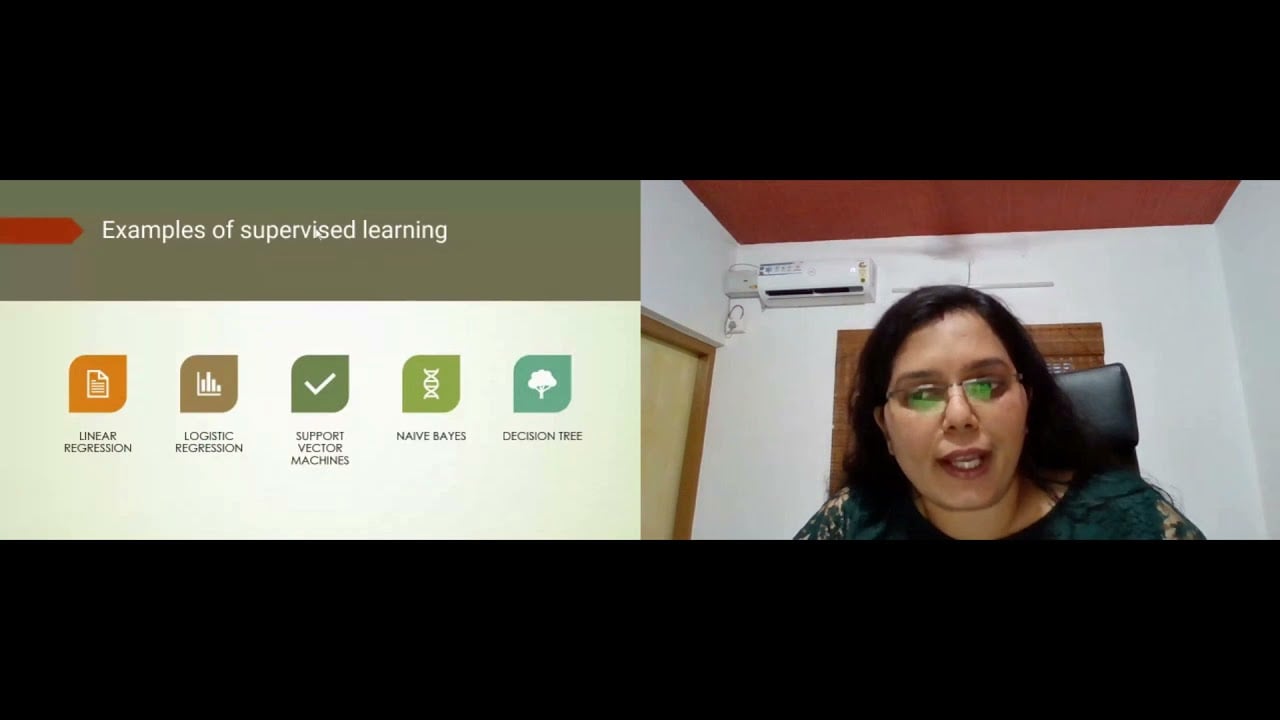
Speaker 6: It is somewhat like this. Speaker 6: We have input data and annotations that we feed to the machine. Speaker 6: So when we put an input to the machine, it will predict that what the input is. Speaker 6: Example of supervised learning is linear regression, logistic regression, support vector machine, NAV base and decision tree. Speaker 6: Unsupervised learning, it is like we don't have labeled data.
Speaker 6: And we make the machine to understand the design pattern. Speaker 6: The system can identify hidden features from input data provided. Speaker 6: Once the data is more readable, the pattern and similarity become more evident. Speaker 6: It will be like we will be putting lots of input without any annotations and the model will learn.
Speaker 6: And then it can divide and classify into the specific group. Speaker 6: Example of unsupervised learning is K-Mean clustering. Speaker 6: Hierarchical clustering and anomaly detection. Speaker 6: Reinforcement learning. Speaker 6: Here it is a combination of supervised and unsupervised learning. Speaker 6: Here minimum data, training data are available. Speaker 6: At that time we use reinforcement learning and also we don't have much idea of the environment.
Speaker 6: And it learned the environment by interacting with it. Speaker 6: Algorithm act on the environment. Speaker 6: For example, make a trade in financial portfolio. Speaker 6: Algorithm optimizes for best series of action by correcting itself over time. Speaker 6: And when we have to design a machine learning algorithm, we have to first collect the data, data processing, choose the model, train the model, test the model, Speaker 6: Feature scale and predictions.
Speaker 6: We will learn one by one. Speaker 6: First one is data collection. Speaker 6: There are five common methods by which we can collect data. Speaker 6: That is close survey and cues. Speaker 6: Other is open ended survey and questionaries, bar one to one interview, focus group or direct observation. Speaker 6: Once we have collected data, we have to check identifying and handling missing data.
Speaker 6: That is if any numerical value is missing, then we can go for mean of the all value and put it in the column. Speaker 6: Then inconsistence value. Speaker 6: For example, we are having someone is entering the data in computer that time. Speaker 6: They may have made a mistake like address and pin number are not matching.
Speaker 6: In such cases, it becomes inconsistent values. Speaker 6: So we have to treat that manually. Speaker 6: Then comes duplicate value. Speaker 6: There is a chance that two people under the same value. Speaker 6: If duplicate value is there, we have to delete one value that encoding categorical data. Speaker 6: For example, we are taking a population of three main three country.
Speaker 6: For example, India, US and UK. Speaker 6: In that case, we cannot feed the system categorical value. Speaker 6: We have to make better like we have to put India as 100, US as 010 and UK as 001. Speaker 6: Then next is choose the model for choosing the model. Speaker 6: We can we can have a first have a scatter plot of the independent variable each independent variable and dependent variable.
Speaker 6: When we have a scatter plot, we can see the relation between two. Speaker 6: If they are linear related or they are scattered and then we can go based on scatter plot. Speaker 6: We can decide which model we have to take that we have already learned supervised and unsupervised learning many like in a regression logistics.
Speaker 6: So we can choose from one of the model then resampling method. Speaker 7: It is an advanced like Monte Carlo stimulations can be used for this. Speaker 7: Then after that, we have to split the test. Speaker 7: We have having a test data. Say we are having 1000 test data in that we have to split into training set and a set training set.
Speaker 7: We have to divide into 80% test to 20% then training set. Speaker 7: We have to evaluate. Speaker 7: We have to train the system with training set and test set is used for evaluation. Speaker 7: And evaluation of model is done to check the performance of system. Speaker 8: Then come feature scaling for all the algorithm.
We don't go for feature scaling, feature scaling are used such so that all your features that is variable are scaled to make sure that all take same scale. Speaker 8: It is done to prevent that one feature does not dominate the other. Speaker 8: For example, if you are having multiple linear regression, it can be represented by this equation.
Speaker 8: So by using normalization or standardization, we can go for feature scaling. Speaker 8: Then prediction once our model is there, we have trained test and we have feature scale. Speaker 8: Then we can go for prediction, predicting the future value. Speaker 8: This can be done by putting system and live examples of machine learning is automatic tagging of friend in Facebook.
Speaker 8: When we put a photo, we automatically, we know that we get a tag. Speaker 9: This person is name is this. So like it is by using deep face algorithm, then Uber, Uber, calculate shortest distance and the demand. This are surprising everything is calculated, basing on machine learning application. Speaker 9: Then virtual personal assistants, such as Siri, Alexa, Google, Cortana, everything are using ML ML is used for speech recognition, speech to text conversion, match to language processing, text to speech conversion.
Speaker 9: Then Google Translate use neural machine translation and NLP for translation. Speaker 9: Then Netflix, we know that when you log into Netflix, it gives us the recommendation. It is done by collecting the data we do that is searching, browsing, start, stop, rewind, by collecting all of this data, they recommend the film for us. Speaker 9: Then next is fraud detection.
Speaker 9: When we use credit card or debit card, whenever a customer carries out a transaction. Speaker 9: ML model, thoroughly scan x-ray their profile searching for suspicious activity. Speaker 9: Then keynote sports. Here we don't have joystick, but by seeing our actions and movement, ML play with us. Speaker 9: Then it is virtual reality set. As we move, the picture also move.
Speaker 9: Then robot dog. Speaker 9: It is used for making kids learn walking and also it is appears in fiction. Then other example are audible recommendation, Amazon recommendation, Facebook ad recommendation. We use ML for mass exploration program. Then in drugs, we use behavior modeling. Speaker 9: Then in leap learning. Speaker 9: The major difference between ML and a deal is that ML uses our mimic our neural network.
But whereas ML works only on structured data. This is the example of neural network and provides a ability to mimic human brain. Speaker 9: It is like input layer. Speaker 9: We feed and the hidden layer identifies the pattern and get the output. It is a retina by scanning retina. They identify ML. Sorry. DL identifies if the patient is diabetic or not.
Speaker 9: Then it is calculated by when we provide an input. It provide a weightage for each one. Then it goes to an activation function. Activation function identifies the input and provide a bias. It determines whether it the input should be filtered or not. Once I put it according to the activation, the value enters. And once it entered, output layer predict the value.
These are the other applications DLR used. Thank you. You can write down my email ID. If there is any doubt or anything which I can have, please let me know. I will try to contact soon. Speaker 9: Thank you. Speaker 9: Thank you everyone.
Transcribed automatically; names checked against the speaker record. Select a time to jump there.
Article based on this talk
Como dados brutos se tornam uma previsão de IA?
Sandhya Krishnan mapeia, em linguagem simples, o caminho dos dados ruidosos até a análise, a inteligência artificial, o machine learning e o deep learning.
Em resumo
Dados brutos são ruidosos e incompletos, mas, depois de limpos e analisados, tornam-se insight, depois conhecimento e, por fim, o combustível da inteligência artificial. Sandhya Krishnan, entusiasta de dados com dez anos em TI, apresenta os quatro tipos de análise, as formas de classificar a IA, as três famílias de machine learning e as etapas concretas para construir um modelo. Sua mensagem para quem se preocupa com a IA é tranquilizadora: os empregos não vão desaparecer, mas os papéis vão mudar.
Principais aprendizados
Diferentes tipos de IA e usos de ML em tempo real.
Dos dados brutos às decisões
Krishnan começa com a premissa que orienta toda a palestra.
"Como todos vocês sabem, os dados são o novo petróleo da economia digital." (0:00)
Ela diferencia dados abertos, como resultados de pesquisas publicados e dados de pesquisa acessíveis a qualquer pessoa, de dados fechados, que exigem permissão por conterem registros sensíveis. Um gráfico em seus slides mostra o volume de dados crescendo exponencialmente a partir de 2015, coletados de plataformas como Twitter e Facebook e de tudo o que as pessoas pesquisam no celular. Em suas palavras, todos que vivem na era digital deixam uma pegada digital.
Esses dados brutos, explica ela, são inconsistentes, incompletos e cheios de ruído. Refinados e processados com ferramentas estatísticas, geram insights que se tornam informação e depois conhecimento. Duas disciplinas fazem esse trabalho. Business intelligence entrega informação confiável às pessoas certas no momento certo e abrange principalmente a análise descritiva (o que aconteceu) e a análise diagnóstica (por que aconteceu). Business analytics acrescenta a análise preditiva (o que vai acontecer) e a análise prescritiva (o que devo fazer).
"Então os dois primeiros são um método reativo: algo aconteceu e então trabalhamos nisso. Já os dois últimos são uma abordagem proativa." (3:07)
Seus exemplos tornam a distinção prática: relatórios de vendas para o trabalho descritivo, análise de desempenho de RH para o diagnóstico, clima e churn de clientes para a previsão, e capacidade de leitos hospitalares ou precificação no varejo para a otimização prescritiva.
O que é IA, e o que ela não é
Krishnan define inteligência artificial como qualquer técnica que permita aos computadores imitar a inteligência humana, como tomada de decisão, processamento de texto e percepção visual. A IA é um guarda-chuva amplo que abrange machine learning, robótica e visão computacional, e, quando a ciência de dados é usada para tomar decisões inteligentes, as duas se sobrepõem. Ela aborda diretamente o medo mais comum.
"O emprego humano não vai desaparecer. Mas os papéis vão mudar." (5:03)
Em seguida, ela apresenta duas formas de classificar a IA. Por capacidade, há a inteligência estreita, específica de uma área (Siri, IBM Watson, filtros de spam, sistemas de recomendação); a inteligência geral, ainda em desenvolvimento, para a qual ela cita o K computer da Fujitsu como uma tentativa que levou cerca de 40 minutos para simular um único segundo de atividade neural; e a superinteligência, que continua hipotética. Por funcionalidade, há máquinas reativas sem memória, como o IBM Deep Blue, que derrotou Garry Kasparov; sistemas de memória limitada, como carros autônomos; teoria da mente, ilustrada por Kismet e pela robô Sophia; e autoconsciência, também hipotética. Ela encerra a seção com citações que atribui a Elon Musk, Mark Cuban e Geoffrey Hinton sobre os riscos da IA e a necessidade de aprendê-la.
Como as máquinas aprendem
Na visão de Krishnan, o machine learning é uma forma de alcançar a IA, e o deep learning é uma forma de alcançar o machine learning.
"O machine learning dá à IA a capacidade de aprender sem programação explícita." (10:41)
Ela descreve três tipos. O aprendizado supervisionado trabalha com dados rotulados, com exemplos como regressão linear, regressão logística, máquinas de vetores de suporte, Naive Bayes e árvores de decisão.
"O aprendizado supervisionado é como ensinar uma criança." (12:02)
Assim como uma criança aprende a identificar um gato vendo fotos, um modelo supervisionado aprende com entradas associadas a saídas conhecidas. O aprendizado não supervisionado não tem rótulos: o modelo encontra padrões ocultos e agrupa os dados, por meio de métodos como clustering K-means, clustering hierárquico e detecção de anomalias. O aprendizado por reforço se aplica quando os dados de treino são escassos e o ambiente é desconhecido; o algoritmo age, por exemplo fazendo uma operação em uma carteira de investimentos, e se corrige ao longo do tempo.
Construindo um modelo, passo a passo
Krishnan apresenta um fluxo de trabalho prático. A coleta de dados pode usar questionários fechados ou abertos, entrevistas individuais, grupos focais ou observação direta. Depois vem a limpeza: preencher valores numéricos ausentes com a média da coluna, corrigir entradas inconsistentes, como um endereço que não corresponde ao seu código postal, excluir duplicatas e codificar dados categóricos, por exemplo transformando Índia, EUA e Reino Unido em colunas binárias separadas.
Para escolher um modelo, ela recomenda plotar cada variável independente em relação à dependente.
"Quando temos um gráfico de dispersão, conseguimos ver a relação entre as duas." (15:37)
Em seguida, os dados são divididos, normalmente 80% para treino e 20% para teste, e o modelo é avaliado no conjunto reservado. O escalonamento de features, por normalização ou padronização, evita que uma variável domine as demais antes de o modelo passar à previsão.
Machine learning no dia a dia, e deep learning
A última seção ancora os conceitos em produtos conhecidos: a marcação automática de amigos no Facebook com DeepFace, os cálculos de rota e demanda da Uber, assistentes virtuais como Siri, Alexa e Cortana, a tradução automática neural do Google Translate, as recomendações da Netflix construídas a partir do comportamento de busca, navegação e retrocesso, e a detecção de fraudes que analisa cada transação de cartão em busca de atividade suspeita.
O deep learning, explica ela, imita a rede neural do cérebro humano. As entradas recebem pesos, passam por camadas ocultas e por uma função de ativação, e a camada de saída prevê um valor. Seu exemplo é um sistema de deep learning que analisa a retina para identificar se um paciente é diabético.
Assista à palestra
"Data Science, Artificial Intelligence and Machine Learning", de Sandhya Krishnan, 21 minutos: https://www.womentech.net/video/data-science-artificial-intelligence-and-machine-learning
Sobre a palestrante
Sandhya Krishnan é entusiasta de dados e uma profissional de software altamente organizada e atenta aos detalhes, com domínio de Java, UNIX, Selenium, VB script e Python, e 10 anos de experiência em TI abrangendo desenvolvimento, testes e suporte à produção. Ela é uma das colaboradoras dos e-books Testing_Stories e #21stskills4testers.
Perguntas que esta palestra responde
Qual é a diferença entre business intelligence e business analytics?
A IA vai tirar o emprego das pessoas?
Como os sistemas de IA são classificados?
Quais são os principais tipos de machine learning?
Quais etapas envolvem a construção de um modelo de machine learning?
Rascunho gerado com IA a partir da transcrição da palestra. Revisão editorial pendente.
Frameworks and ideas mentioned
Descriptive, diagnostic, predictive and prescriptive analytics
Narrow, general and super intelligence
Reactive machines, limited memory, theory of mind and self-awareness
Supervised, unsupervised and reinforcement learning