Критиката, скрита между комплименти, може да остане незабелязана
На нейните обучения 12 или 13 души от 20 признават, че им е трудно да дават обратна връзка за подобрение, а навиците влошават нещата: обвинения, неясни оценки или критика, скрита между комплименти, където може да остане незабелязана. Navneetha Lokanathan, обучител по лидерство и комуникация, работила осем години като софтуерен разработчик и ръководител на екип, разглежда случай с колега, който постоянно не спазва ангажиментите си. Какво се променя, когато обратната връзка започва от вашите чувства и нужди?
Научете четирите стъпки на NVC, с които да формулирате трудна обратна връзка, която колегите приемат без защитна реакция
Navneetha Lokanathan, обучител по лидерство и комуникация, учи как да давате трудна обратна връзка чрез ненасилствена комуникация (NVC). Тя разглежда честите грешки при обратната връзка, след това четирите стъпки на NVC (наблюдение, чувства, нужди и молби) и кара участниците да преформулират обратна връзка към член на екипа, който не спазва поетите ангажименти.
“Значи всичко, което кара другия човек да изпитва страх, срам или вина, се смята за насилствено, нали?”
“Значи нуждите са основните фактори зад чувствата.”
What you will learn
Разпознавайте честите грешки при обратната връзка, като обвинения, неясни оценки и „сандвича“, който скрива посланието.
Разграничавайте фактическите наблюдения от оценките, когато описвате проблем.
Изразявайте чувствата си с изречения от първо лице и ги свързвайте с неудовлетворените нужди зад тях.
Формулирайте молбите като едно ясно, позитивно и конкретно действие, което другият може да предприеме.
Преформулирайте реална трудна обратна връзка с помощта на четиристъпковия модел на NVC.
Details
Level
Intermediate
Format
Talk
Technical depth
Non-technical
For
Early career, Mid-career, People manager
Length
18:40
Published
June 2023
Questions this talk answers
Кои са най-честите грешки при даване на обратна връзка?
Обвинения, прекалено много думи, неподходящ вид обратна връзка спрямо опита на човека, липса на конкретни действия, формулиране като присъда, прекалена общост и насочване към човека вместо към поведението. Тя посочва и „проблема с възглавницата“: критика, омекотена между положителни коментари, може да остане незабелязана.
Какво се смята за насилствена комуникация според NVC?
Всичко, което кара другия да изпитва страх, срам или вина. NVC вместо това говори от собствените ви чувства и нужди, така че другият е по-малко склонен да заеме защитна позиция.
Кои са четирите стъпки на ненасилствената комуникация?
Наблюдавайте фактите, определете чувствата си, определете свързаните неудовлетворени нужди и отправете молба за конкретно действие.
Как да наблюдавате, без да оценявате?
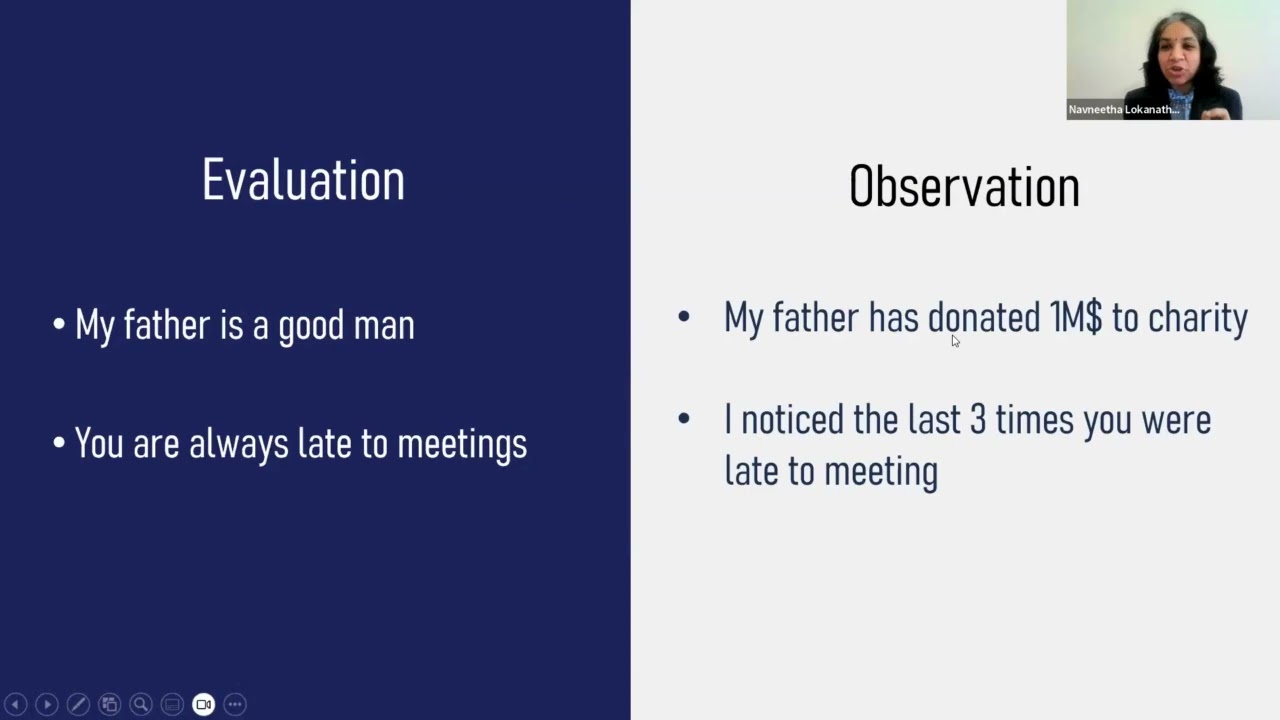
Казвайте какво всъщност се е случило, а не мнението си. Вместо да кажете, че някой винаги закъснява за срещи, кажете, че е закъснял за последните три срещи.
Защо молбите трябва да са конкретни и позитивни?
Поредица от „недей“ оставя хората в несигурност какво да правят, а неясните молби имат обратен ефект. В нейния пример съпруга помолила мъжа си да прекарва по-малко време в работа и той се записал на голф, а тя искала време с него.
Защо „сандвичът“ с обратна връзка не работи (53 s)
Наблюдение срещу оценка (53 s)
Историята с голфа: неясните молби имат обратен ефект (55 s)
So yes, I welcome you all to this session, becoming an expert in giving feedback. Good morning. Good afternoon. Good evening from wherever you are connecting. So tell me how many of you find it difficult to give feedback, especially when it comes to giving feedback that needs some improvement in others performance or some change in their behavior. How many of you find it difficult to give such sort of feedback? Can you see it in the chat? Yeah.
In the trainings that I conduct, you know what, when I ask this question, people say out of like 20 people, almost 12 to 13 people say that I find it difficult to give feedback. And that is almost more than 50 percentage, right? So let's get practical now. And let me give you a situation. And can you write a feedback? Let's see how it turns out. Are you in for that?
Yeah, Elaine, I hear you. Okay, so let me give you a situation. So the situation is, let's assume you are the team lead. You are the team lead and one of your team members doesn't, you know, doesn't hold on to the commitments he had made. Okay. And this is affecting you and the team. Let's see how will you give feedback for this particular person for this particular scenario.
All right. So let's take a couple of minutes to write the feedback. Once you're done, you can put your feedback in the chat box. Let's see. Giving feedback can be worse. Sarah, yes. But with right techniques, it can, it need not be worse. Okay, your time starts now to write the feedback. So if you want to know the situation again, for people who have joined just now, you are the team lead, and one of your team members doesn't stick to the commitments he has made when it comes to group work.
And it is affecting you and it is affecting you and the team. And how will you give the feedback in this scenario? Write down your feedback and paste it in the chat. Uh-huh. I got it, Selena. Come on, keep it going. Could you prioritized? Try to prioritize. Okay. Anybody else? Like, what feedback have you returned? Please put it in the chat box so that all of us can learn together.
Yeah. I hope we have. Yes. Yes, yes, yes. Keep it coming in. And you're all right, you know, when we say it is difficult to give feedback. Why? Because feedback can make or break a relationship with a team member or a colleague, right? When managed effectively, feedback can bring that high talent, bring that high potential into the workplace.
It can lead to high collaboration. So what are some of the mistakes we make when giving feedback? Let me share my screen with you now. What do you think are some of the mistakes we make in giving feedback? Can I see some of your answers in the chat box? Blaming people exactly what? What else? What are the common mistakes we make in giving feedback?
Yes, absolutely, Sarah. And telling people they are responsible for our feelings, right? Not giving enough praise. Yes. If you have any questions, you can put it in the Q&A box available and we will take it up at the end of this session. So I see some hands raised. you can put it in the Q&A box. Being either too bland or too soft.
Yes, yes, yes. You're all there. So these are some of the common mistakes we make. There are plenty, plentiful mistakes. But to cut short, like, you know, if we have to rate the mistakes that we make in feedback, these are some of the things that stand out. Blaming, right? You did this. Because of you, it got worse, right?
And saying too much. Wrong type of feedback. Sometimes, you know, the fresher, for the fresher, you have just joined in. If you gave him continuously improvements, he would go frustrated, right? So you would have to give some praise over there for a fresher. But for an experienced person, they might be looking for points to improve. So if we are giving a wrong type of feedback, then it is not going to serve the purpose of giving feedback.
And failure to give actionable feedback. What does the other person has to do? Right? And pausing it as judgments, lack of specificity, being too generalized. Feedback on someone instead of their behavior, right? And the pillow issue. What is this pillow issue? Sometimes, we know, right? Like, when we give feedback, we give a positive and negative and a positive, Like a sandwich.
And they say it is a pillow issue because it is like cushioned. The negative, whatever area of improvement is cushioned between the positives. And the thing here is sometimes that may, that may not get noticed by the recipient, right? So these are some of the common mistakes in giving feedback. Okay. I have come across many different ways of giving feedback and most of them are like transactional, There is no human involved in it.
So when it is transactional, what happens is we don't consider how the other person feels when we give this feedback, right? And we don't even consider our own feelings, how we feel when something happens, But to eliminate all these mistakes where in giving feedback, there comes this nonviolent communication, which is what we are going to see in this session.
So anything that makes the other person feel fearful, shameful, or guilt is considered as violent, right? It is considered as violent communication. This nonviolent communication was introduced by Dr. Marshall and he says like, we should not make the other person fearful, shameful, or guiltful when we communicate, right? So nonviolent communication is like, do you know, it is inclusive with empathy, inclusive of our feelings as well our needs, along with considering the other person's needs and wants.
Okay. And NVC is about you and not the other person because we have some unmet needs and that, that is what we expect from the other person. So in NVC method of giving feedback, we are not going to say to the other person that you have done this. Yeah. You have made me feel, you have made me feel bad and you have to change your behavior.
We are not going to blame the other person, but rather we are going to come from our side. So it is not at all about the other person. It is about us, our feelings and our emotions. And when we express in that way, what happens is we, the other person will not become defensive, rather he will listen to what we are saying.
All right. So NVC has four particular steps. Observe, identify your feelings, identify associated needs and request. Okay. Observe is, you will state that factual observations that is affecting you. What is the actual factual situation that is happening? That is what is observed. And what are the feelings associated with yourself? What are the needs, unmet needs? And what is the request?
What do you want the other person to do? All right. So four components in NVC, which are observe and feelings, identifying your feelings, identifying the needs and request. So when it comes to observe, often we confuse it with our evaluation and judgment. Okay. So observe without evaluation, right? How can we do that? How can we observe without evaluating?
Say, for example, saying that my father is a good man is evaluating, right? It is your opinion that he is a good man. But what is the actual thing that has happened? My father has donated $1 million to charity. That is the actual thing that has happened. So this is what observation is. Instead of saying you are always late to meeting, that is your opinion.
But that is not the fact, right? The fact is last three times, the person has come late to the meeting. All right. So when you are giving feedback in any situation, observe and factual statements. Okay. And withdrawing from your evaluations and from giving your own opinions. All right. And the next is feelings. Feelings give us a lot of information about ourselves, right?
Why we feel a certain way. And it is very important to have an emotional audit. What we feel at any particular time, correct? Because feeling tells us like what we like, what we don't like, what we like to have, all that we come to know about feelings. And once you have an emotional audit of what you're feeling, what is that that is affecting you?
Yeah. And what feel it is, what, what is that it is making you feel when you say that? Express it. Correct? It is, feeling is one of the most important components of nonviolent communication. Let us see. See, you irritate me when you leave company documents on the conference room floor. Here, it is wrong because you irritate me.
I'm blaming the other person. Correct? But when you say I am irritated when you leave company documents on the conference room floor, the other person don't have anything to take it down in a defensive way. Rather, they will listen to you. Correct? So one tip when you are expressing your feelings is using the I statements. You see, I am irritated instead of telling you irritate me.
And needs. How are these feelings and needs are connected? Because feelings are the mirror, that says that are there any unmet needs? Okay? If your needs are, all of your needs are met, you will be happy. Correct? If your, some of your needs are not met, you will be, you will be angry, frustrated. Correct? So the needs are the underlying factors of feelings.
So identify what are your underlying needs and express it. Because when you express your needs, most often we have a better chance of getting them met. Okay? See, in this example of leaving company documents on the conference room floor, when we add our needs to it, the other person understands why we say so. Right? because I want our documents to be safely stored and accessible.
Okay? So we saw observe without evaluation, feeling and needs. Be clear about your needs. And finally, request. Identify one actionable item that the other person wants to do, that you want the other person to do. Okay? And request it in clear, positive, concrete action language. When you say, don't do this, people will not, that is not a positive language.
Don't spread company documents on the conference room floor. Like, they don't know why this lady is always like, don't, Yeah? But when you say, could you place the company documents in the locker room? It is very specific. Tell them specifically what action item you want the other person to do. Right? So, nonviolent communication is observe, state the factual observations that is affecting you.
Do not evaluate. Again, I'm using here, but that is a wrong. You have to give it a positive statement as we saw in the request space. And identify your feelings. What are the, what are your feelings associated with it? And identifying what are the needs underlying with it? And what is the request? What is that you want the other person to do?
So with this template, now I invite you to go back and change your feedback for the situation we saw early, earlier. How would you change it? Can I see it in the chat box? If you have to say your observation, your feelings, associated needs and requests. When you say it in this template, what happens is the other person is not blamed.
The other person is not judged. Rather, it invites for understanding, which is what we need in today's working environment. Right? So if you have to change it, how would you change your feedback? Exactly, Sarah, needs are often related to your core values. Thank you. So I'm looking for the changed feedback. Meanwhile, we have four more minutes for this session to get over.
If you have any questions, you can type it in the Q&A box. The floor is open for questions. Thank you, Hamida. So when we are making requests, we need to be clear. What is it we really want? Yeah, there was an, you know, there was a story, a husband and wife were there and that his husband was spending too much of time at his workplace.
So the wife went and told him like, don't spend too much work, too much time at your workplace. Yeah. So what happened? This husband, after two, three weeks, he come and told me, see, I have signed up for the golf course, but actually the wife wanted him to spend the time with her. Right? Since she did not mention what is that she wants specifically, this is what will happen.
Yes. I noticed that we are in getting everything done on time as the team. Could you make sure? Your part in the project is done by end of the week. we are getting there. Yes. Well, I feel stressed when the team deadlines are not met. Please share your timelines with your team so that we could address the workload.
Do you have any questions or any thoughts to say about what we have just discussed? You can type it in the chat box as well. So here, the challenges could be two things. Right? When we have our feelings, we may forget to be in touch with our feelings anytime. So that is one challenge. And another challenge is we may not know, clearly know what we need.
So if we can work on this, it would be much, much better when we give our feedback to our colleagues rather than blaming them. Yes. So thank you everyone for the wonderful participation in, through the chat box. And how do you feel where for your first feedback and this feedback when you have changed it? Yeah. Love it.
We all would want to receive such a feedback where nobody blames us, right? But just points what has to be correct. Isn't it? So thank you. Thank you for your participation. And yes, love it. I don't feel defensive at all. That is the beauty of NVC. And thanks a lot for your participation in this session. Thank you.
Maya, wish you good luck in delivering that difficult feedback. The session will be ending now. Thanks a lot for your participation.
Transcribed automatically; names checked against the speaker record. Select a time to jump there.
Article based on this talk
Как да давате трудна обратна връзка, без хората да заемат защитна позиция?
Navneetha Lokanathan показва как ненасилствената комуникация превръща обвинението в ясна, фактическа молба, която колегите наистина могат да чуят.
Накратко
Трудната обратна връзка се проваля, когато обвинява, осъжда или скрива истинското послание, твърди обучителят по лидерство и комуникация Navneetha Lokanathan. Нейният отговор е ненасилствената комуникация (NVC): изложете фактическо наблюдение, назовете собственото си чувство, свържете го с неудовлетворена нужда и отправете една ясна, позитивна молба. Формулирана така, обратната връзка приканва към разбиране, а не към защитна реакция.
Основни изводи
Чести грешки при даване на обратна връзка, когато сме емоционални
Разбиране на принципите на NVC
Практични и ефективни начини за формулиране на обратна връзка
Защо обратната връзка толкова често не постига целта си
Lokanathan започва с прост въпрос: на кого му е трудно да дава обратна връзка, която изисква по-добро представяне или промяна в поведението? На собствените ѝ обучения, казва тя, приблизително 12 или 13 души от 20 признават, че им е трудно. След това тя дава практическо упражнение. Участниците си представят, че са ръководители на екип, чийто член не спазва ангажиментите, които поема при групова работа, и записват обратната връзка, която биха му дали.
Залогът, обяснява тя, е голям: „Защото обратната връзка може да изгради или да разруши отношенията с член на екипа или с колега, нали?“ (3:15). Добре поднесена, обратната връзка може да разгърне голям потенциал и да доведе до силно сътрудничество.
Заедно с публиката тя съставя списък с чести грешки: обвинения („заради теб стана по-лошо“), прекалено много думи, неподходящ вид обратна връзка (новодошлият има нужда от малко похвала, докато опитният човек може да иска насоки за подобрение), липса на конкретни действия, формулиране като присъда, прекалена общост и коментиране на човека вместо на поведението. Тя назовава и „проблема с възглавницата“, по-известен като „сандвич“ с обратна връзка, при който областта за подобрение е омекотена между два положителни коментара и получателят може изобщо да не я забележи. В основата на много от тези грешки, казва тя, стои чисто транзакционна обратна връзка, без внимание към това как се чувства всеки от двамата.
Какво прави комуникацията „насилствена“
За да премахне тези грешки, Lokanathan се обръща към ненасилствената комуникация, която тя приписва, по думите на лектора, на Dr. Marshall. Определението ѝ е директно: „Значи всичко, което кара другия човек да изпитва страх, срам или вина, се смята за насилствено, нали?“ (7:15).
NVC, обяснява тя, включва емпатия, собствените ни чувства и нужди, както и нуждите и желанията на другия. Ключовото е, че тя започва от страната на говорещия. Вместо да кажете на някого какво е направил грешно и как ви е накарал да се чувствате, вие описвате собственото си преживяване. Когато обратната връзка е изразена по този начин, казва тя, другият не заема защитна позиция и е по-склонен да слуша.
Наблюдавайте фактите, после поемете отговорност за чувствата си
Четирите стъпки са: наблюдение, определяне на чувствата, определяне на свързаните нужди и молба. Първата стъпка е по-трудна, отколкото изглежда, защото хората бъркат наблюдението с оценката. „Баща ми е добър човек“ е мнение; „той дари пари за благотворителност“ е наблюдение. Версията за работното място: „Но това не е фактът, нали? Фактът е, че последните три пъти човекът е закъснял за срещата.“ (10:19).
След това идват чувствата. Lokanathan препоръчва „емоционален одит“, за да забележите какво чувствате и какво го предизвиква, защото чувствата разкриват какво харесваме и какво не. Тя противопоставя „ти ме дразниш, когато оставяш фирмени документи на пода в заседателната зала“ на „аз съм раздразнена, когато оставяш фирмени документи на пода в заседателната зала“. Нейният съвет: „Един съвет, когато изразявате чувствата си, е да използвате изречения от първо лице. Виждате ли, „аз съм раздразнена“ вместо „ти ме дразниш“.“ (11:38).
Назовете нуждата, после отправете ясна молба
Чувствата, казва тя, са огледало на нуждите. Когато нуждите са удовлетворени, сме доволни; когато не са, се чувстваме ядосани или разочаровани. „Значи нуждите са основните фактори зад чувствата.“ (12:03). Изразяването на нуждата помага на другия да разбере защо повдигате въпроса, например защото искате фирмените документи да се съхраняват безопасно и да са достъпни.
Последната стъпка е молба за едно конкретно действие, с ясен, позитивен и конкретен език. Поток от „не прави това“ оставя хората объркани какво всъщност се иска. „Би ли могъл да оставяш фирмените документи в шкафчето?“ работи по-добре, защото е конкретно. По нейните думи: „Кажете им конкретно какво действие искате другият човек да предприеме.“ (13:28). Тя илюстрира цената на неясните молби с историята на съпруга, която помолила мъжа си да не прекарва толкова много време в работа; седмици по-късно той обявил, че се е записал на голф, а тя всъщност искала време с него.
Преформулиране на обратната връзка с модела
След това Lokanathan кара участниците да преформулират първоначалната си обратна връзка с четирите стъпки. Една от версиите, които тя прочита от чата, изразява стрес, когато сроковете на екипа не се спазват, и гласи: „Моля, споделяй сроковете си с екипа, за да можем да се справим с натоварването.“ (16:13). Смисълът на модела, казва тя, е, че „Другият човек не е осъден. Напротив, това приканва към разбиране, а точно от това имаме нужда в днешната работна среда.“ (14:51).
Тя завършва с две предизвикателства, за които да внимаваме: да изгубим връзка със собствените си чувства в момента и да не знаем ясно от какво имаме нужда. Работата върху двете, твърди тя, прави обратната връзка много по-ефективна от обвинението. Реакцията на един участник към преработената обратна връзка обобщава резултата: изобщо не се почувствал в защитна позиция.
Гледайте лекцията
„Become an expert in giving difficult feedback“ от Navneetha Lokanathan, около 19 минути: https://www.womentech.net/video/become-expert-in-giving-difficult-feedback
За лектора
Navneetha Lokanathan е обучител по лидерство и комуникация и коуч по асертивност от Лондон, сертифициран лайф коуч и NLP практик, която е обучила над 800 души за четири години. Преди да се насочи към обученията и коучинга, тя работи осем години в IT като софтуерен разработчик и ръководител на екип в международни компании в Индия, САЩ и Дубай.
Въпроси, на които отговаря лекцията
Кои са най-честите грешки при даване на обратна връзка?
Какво се смята за насилствена комуникация според NVC?
Кои са четирите стъпки на ненасилствената комуникация?
Как да наблюдавате, без да оценявате?
Защо молбите трябва да са конкретни и позитивни?
Изготвено с AI въз основа на транскрипта на лекцията. Предстои редакторски преглед.
Frameworks and ideas mentioned
Nonviolent Communication (NVC)
Feedback sandwich
I statements
Cite this talk
Navneetha Lokanathan. "Become an expert in giving difficult feedback." WomenTech Network, 2023. https://www.womentech.net/video/become-expert-in-giving-difficult-feedback