Amortiguar la crítica entre elogios puede hacer que pase desapercibida
En sus formaciones, 12 o 13 de cada 20 personas admiten que les cuesta dar feedback de mejora, y ciertos hábitos lo empeoran: culpar, emitir juicios vagos o esconder la crítica entre elogios, donde puede pasar desapercibida. Navneetha Lokanathan, formadora en liderazgo y comunicación que trabajó ocho años como desarrolladora de software y líder de equipo, aborda el caso de un compañero que incumple sus compromisos una y otra vez. ¿Qué cambia cuando el feedback parte de tus sentimientos y necesidades?
Aprende los cuatro pasos de la CNV para plantear feedback difícil que tus colegas puedan escuchar sin ponerse a la defensiva
Navneetha Lokanathan, formadora en liderazgo y comunicación, enseña a dar feedback difícil con la Comunicación No Violenta (CNV). Repasa los errores habituales al dar feedback y luego los cuatro pasos de la CNV (observación, sentimientos, necesidades y peticiones), y pide a los participantes reescribir el feedback para un miembro del equipo que no cumple sus compromisos.
“Así que todo lo que haga que la otra persona sienta miedo, vergüenza o culpa se considera violento, ¿verdad?”
“Así que las necesidades son los factores subyacentes de los sentimientos.”
What you will learn
Detectar errores habituales al dar feedback, como culpar, los juicios vagos y el sándwich de feedback que oculta el mensaje.
Separar las observaciones objetivas de las evaluaciones al describir un problema.
Expresar sentimientos con frases en primera persona y relacionarlos con las necesidades no satisfechas que hay detrás.
Formular peticiones como una única acción clara, positiva y concreta que la otra persona pueda realizar.
Reescribir un feedback difícil real con la plantilla de cuatro pasos de la CNV.
Details
Level
Intermediate
Format
Talk
Technical depth
Non-technical
For
Early career, Mid-career, People manager
Length
18:40
Published
June 2023
Questions this talk answers
¿Cuáles son los errores más comunes al dar feedback?
Culpar, decir demasiado, dar un tipo de feedback inadecuado para la experiencia de la persona, no hacerlo accionable, formularlo como un juicio, ser demasiado general y centrarse en la persona en lugar del comportamiento. También señala el "problema de la almohada", en el que la crítica amortiguada entre aspectos positivos puede pasar desapercibida.
¿Qué se considera comunicación violenta en la CNV?
Todo lo que haga que la otra persona sienta miedo, vergüenza o culpa. La CNV, en cambio, habla desde tus propios sentimientos y necesidades, de modo que es menos probable que la otra persona se ponga a la defensiva.
¿Cuáles son los cuatro pasos de la Comunicación No Violenta?
Observar los hechos, identificar tus sentimientos, identificar las necesidades no satisfechas asociadas y hacer una petición de una acción específica.
¿Cómo se observa sin evaluar?
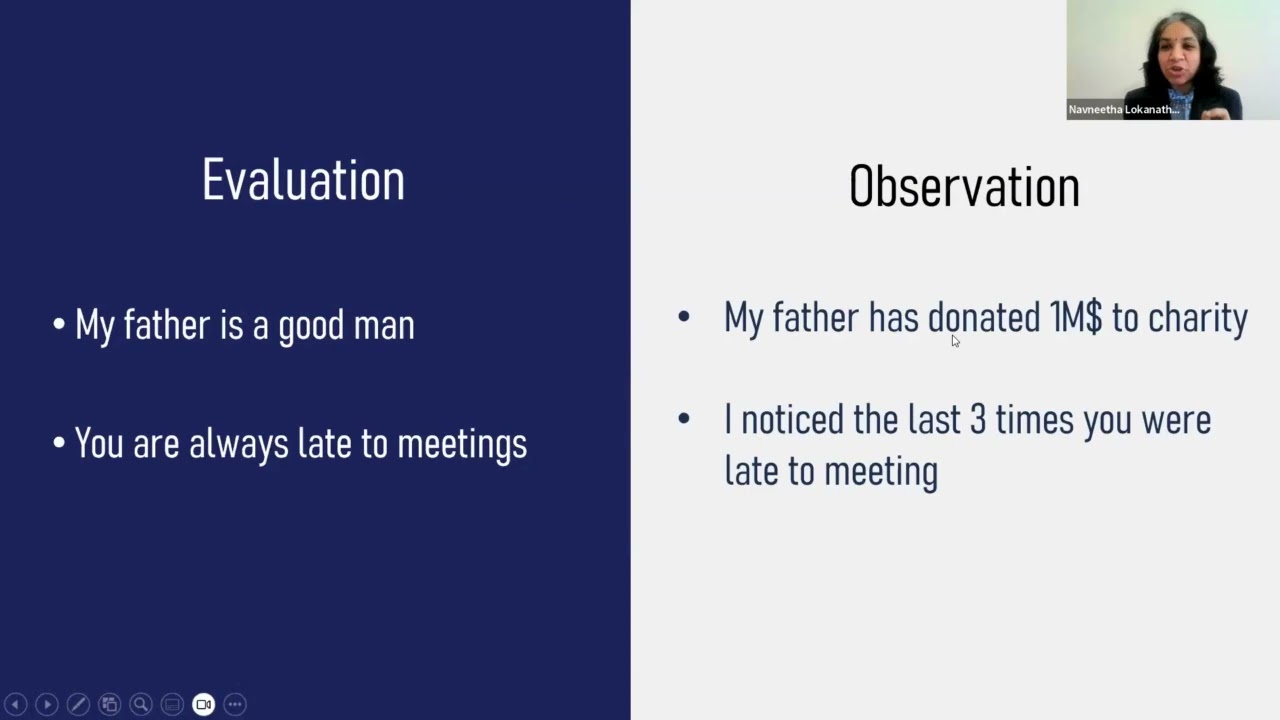
Expón lo que realmente ocurrió en lugar de tu opinión. En vez de decir que alguien siempre llega tarde a las reuniones, di que ha llegado tarde a las tres últimas reuniones.
¿Por qué las peticiones deben ser específicas y positivas?
Una serie de "no hagas" deja a la gente sin saber qué hacer, y las peticiones vagas resultan contraproducentes. En su ejemplo, una esposa pidió a su marido que pasara menos tiempo en el trabajo y él se apuntó a golf, cuando ella quería pasar tiempo con él.
La historia del golf: las peticiones vagas fallan (55 s)
So yes, I welcome you all to this session, becoming an expert in giving feedback. Good morning. Good afternoon. Good evening from wherever you are connecting. So tell me how many of you find it difficult to give feedback, especially when it comes to giving feedback that needs some improvement in others performance or some change in their behavior. How many of you find it difficult to give such sort of feedback? Can you see it in the chat? Yeah.
In the trainings that I conduct, you know what, when I ask this question, people say out of like 20 people, almost 12 to 13 people say that I find it difficult to give feedback. And that is almost more than 50 percentage, right? So let's get practical now. And let me give you a situation. And can you write a feedback? Let's see how it turns out. Are you in for that?
Yeah, Elaine, I hear you. Okay, so let me give you a situation. So the situation is, let's assume you are the team lead. You are the team lead and one of your team members doesn't, you know, doesn't hold on to the commitments he had made. Okay. And this is affecting you and the team. Let's see how will you give feedback for this particular person for this particular scenario.
All right. So let's take a couple of minutes to write the feedback. Once you're done, you can put your feedback in the chat box. Let's see. Giving feedback can be worse. Sarah, yes. But with right techniques, it can, it need not be worse. Okay, your time starts now to write the feedback. So if you want to know the situation again, for people who have joined just now, you are the team lead, and one of your team members doesn't stick to the commitments he has made when it comes to group work.
And it is affecting you and it is affecting you and the team. And how will you give the feedback in this scenario? Write down your feedback and paste it in the chat. Uh-huh. I got it, Selena. Come on, keep it going. Could you prioritized? Try to prioritize. Okay. Anybody else? Like, what feedback have you returned? Please put it in the chat box so that all of us can learn together.
Yeah. I hope we have. Yes. Yes, yes, yes. Keep it coming in. And you're all right, you know, when we say it is difficult to give feedback. Why? Because feedback can make or break a relationship with a team member or a colleague, right? When managed effectively, feedback can bring that high talent, bring that high potential into the workplace.
It can lead to high collaboration. So what are some of the mistakes we make when giving feedback? Let me share my screen with you now. What do you think are some of the mistakes we make in giving feedback? Can I see some of your answers in the chat box? Blaming people exactly what? What else? What are the common mistakes we make in giving feedback?
Yes, absolutely, Sarah. And telling people they are responsible for our feelings, right? Not giving enough praise. Yes. If you have any questions, you can put it in the Q&A box available and we will take it up at the end of this session. So I see some hands raised. you can put it in the Q&A box. Being either too bland or too soft.
Yes, yes, yes. You're all there. So these are some of the common mistakes we make. There are plenty, plentiful mistakes. But to cut short, like, you know, if we have to rate the mistakes that we make in feedback, these are some of the things that stand out. Blaming, right? You did this. Because of you, it got worse, right?
And saying too much. Wrong type of feedback. Sometimes, you know, the fresher, for the fresher, you have just joined in. If you gave him continuously improvements, he would go frustrated, right? So you would have to give some praise over there for a fresher. But for an experienced person, they might be looking for points to improve. So if we are giving a wrong type of feedback, then it is not going to serve the purpose of giving feedback.
And failure to give actionable feedback. What does the other person has to do? Right? And pausing it as judgments, lack of specificity, being too generalized. Feedback on someone instead of their behavior, right? And the pillow issue. What is this pillow issue? Sometimes, we know, right? Like, when we give feedback, we give a positive and negative and a positive, Like a sandwich.
And they say it is a pillow issue because it is like cushioned. The negative, whatever area of improvement is cushioned between the positives. And the thing here is sometimes that may, that may not get noticed by the recipient, right? So these are some of the common mistakes in giving feedback. Okay. I have come across many different ways of giving feedback and most of them are like transactional, There is no human involved in it.
So when it is transactional, what happens is we don't consider how the other person feels when we give this feedback, right? And we don't even consider our own feelings, how we feel when something happens, But to eliminate all these mistakes where in giving feedback, there comes this nonviolent communication, which is what we are going to see in this session.
So anything that makes the other person feel fearful, shameful, or guilt is considered as violent, right? It is considered as violent communication. This nonviolent communication was introduced by Dr. Marshall and he says like, we should not make the other person fearful, shameful, or guiltful when we communicate, right? So nonviolent communication is like, do you know, it is inclusive with empathy, inclusive of our feelings as well our needs, along with considering the other person's needs and wants.
Okay. And NVC is about you and not the other person because we have some unmet needs and that, that is what we expect from the other person. So in NVC method of giving feedback, we are not going to say to the other person that you have done this. Yeah. You have made me feel, you have made me feel bad and you have to change your behavior.
We are not going to blame the other person, but rather we are going to come from our side. So it is not at all about the other person. It is about us, our feelings and our emotions. And when we express in that way, what happens is we, the other person will not become defensive, rather he will listen to what we are saying.
All right. So NVC has four particular steps. Observe, identify your feelings, identify associated needs and request. Okay. Observe is, you will state that factual observations that is affecting you. What is the actual factual situation that is happening? That is what is observed. And what are the feelings associated with yourself? What are the needs, unmet needs? And what is the request?
What do you want the other person to do? All right. So four components in NVC, which are observe and feelings, identifying your feelings, identifying the needs and request. So when it comes to observe, often we confuse it with our evaluation and judgment. Okay. So observe without evaluation, right? How can we do that? How can we observe without evaluating?
Say, for example, saying that my father is a good man is evaluating, right? It is your opinion that he is a good man. But what is the actual thing that has happened? My father has donated $1 million to charity. That is the actual thing that has happened. So this is what observation is. Instead of saying you are always late to meeting, that is your opinion.
But that is not the fact, right? The fact is last three times, the person has come late to the meeting. All right. So when you are giving feedback in any situation, observe and factual statements. Okay. And withdrawing from your evaluations and from giving your own opinions. All right. And the next is feelings. Feelings give us a lot of information about ourselves, right?
Why we feel a certain way. And it is very important to have an emotional audit. What we feel at any particular time, correct? Because feeling tells us like what we like, what we don't like, what we like to have, all that we come to know about feelings. And once you have an emotional audit of what you're feeling, what is that that is affecting you?
Yeah. And what feel it is, what, what is that it is making you feel when you say that? Express it. Correct? It is, feeling is one of the most important components of nonviolent communication. Let us see. See, you irritate me when you leave company documents on the conference room floor. Here, it is wrong because you irritate me.
I'm blaming the other person. Correct? But when you say I am irritated when you leave company documents on the conference room floor, the other person don't have anything to take it down in a defensive way. Rather, they will listen to you. Correct? So one tip when you are expressing your feelings is using the I statements. You see, I am irritated instead of telling you irritate me.
And needs. How are these feelings and needs are connected? Because feelings are the mirror, that says that are there any unmet needs? Okay? If your needs are, all of your needs are met, you will be happy. Correct? If your, some of your needs are not met, you will be, you will be angry, frustrated. Correct? So the needs are the underlying factors of feelings.
So identify what are your underlying needs and express it. Because when you express your needs, most often we have a better chance of getting them met. Okay? See, in this example of leaving company documents on the conference room floor, when we add our needs to it, the other person understands why we say so. Right? because I want our documents to be safely stored and accessible.
Okay? So we saw observe without evaluation, feeling and needs. Be clear about your needs. And finally, request. Identify one actionable item that the other person wants to do, that you want the other person to do. Okay? And request it in clear, positive, concrete action language. When you say, don't do this, people will not, that is not a positive language.
Don't spread company documents on the conference room floor. Like, they don't know why this lady is always like, don't, Yeah? But when you say, could you place the company documents in the locker room? It is very specific. Tell them specifically what action item you want the other person to do. Right? So, nonviolent communication is observe, state the factual observations that is affecting you.
Do not evaluate. Again, I'm using here, but that is a wrong. You have to give it a positive statement as we saw in the request space. And identify your feelings. What are the, what are your feelings associated with it? And identifying what are the needs underlying with it? And what is the request? What is that you want the other person to do?
So with this template, now I invite you to go back and change your feedback for the situation we saw early, earlier. How would you change it? Can I see it in the chat box? If you have to say your observation, your feelings, associated needs and requests. When you say it in this template, what happens is the other person is not blamed.
The other person is not judged. Rather, it invites for understanding, which is what we need in today's working environment. Right? So if you have to change it, how would you change your feedback? Exactly, Sarah, needs are often related to your core values. Thank you. So I'm looking for the changed feedback. Meanwhile, we have four more minutes for this session to get over.
If you have any questions, you can type it in the Q&A box. The floor is open for questions. Thank you, Hamida. So when we are making requests, we need to be clear. What is it we really want? Yeah, there was an, you know, there was a story, a husband and wife were there and that his husband was spending too much of time at his workplace.
So the wife went and told him like, don't spend too much work, too much time at your workplace. Yeah. So what happened? This husband, after two, three weeks, he come and told me, see, I have signed up for the golf course, but actually the wife wanted him to spend the time with her. Right? Since she did not mention what is that she wants specifically, this is what will happen.
Yes. I noticed that we are in getting everything done on time as the team. Could you make sure? Your part in the project is done by end of the week. we are getting there. Yes. Well, I feel stressed when the team deadlines are not met. Please share your timelines with your team so that we could address the workload.
Do you have any questions or any thoughts to say about what we have just discussed? You can type it in the chat box as well. So here, the challenges could be two things. Right? When we have our feelings, we may forget to be in touch with our feelings anytime. So that is one challenge. And another challenge is we may not know, clearly know what we need.
So if we can work on this, it would be much, much better when we give our feedback to our colleagues rather than blaming them. Yes. So thank you everyone for the wonderful participation in, through the chat box. And how do you feel where for your first feedback and this feedback when you have changed it? Yeah. Love it.
We all would want to receive such a feedback where nobody blames us, right? But just points what has to be correct. Isn't it? So thank you. Thank you for your participation. And yes, love it. I don't feel defensive at all. That is the beauty of NVC. And thanks a lot for your participation in this session. Thank you.
Maya, wish you good luck in delivering that difficult feedback. The session will be ending now. Thanks a lot for your participation.
Transcribed automatically; names checked against the speaker record. Select a time to jump there.
Article based on this talk
¿Cómo dar feedback difícil sin que la gente se ponga a la defensiva?
Navneetha Lokanathan muestra cómo la Comunicación No Violenta convierte la culpa en una petición clara y objetiva que los colegas pueden escuchar de verdad.
En resumen
El feedback difícil sale mal cuando culpa, juzga u oculta el mensaje real, sostiene la formadora en liderazgo y comunicación Navneetha Lokanathan. Su respuesta es la Comunicación No Violenta (CNV): exponer una observación objetiva, nombrar tu propio sentimiento, relacionarlo con una necesidad no satisfecha y hacer una petición clara y positiva. Planteado así, el feedback invita a la comprensión en lugar de a la defensiva.
Ideas clave
Errores comunes al dar feedback cuando estamos alterados emocionalmente
Comprender los principios de la CNV
Formas prácticas y eficaces de plantear el feedback
Por qué el feedback falla tan a menudo
Lokanathan empieza con una pregunta sencilla: ¿a quién le cuesta dar feedback que pide un mejor rendimiento o un cambio de comportamiento? En sus propias formaciones, dice, aproximadamente 12 o 13 de cada 20 personas lo admiten. Después plantea un ejercicio práctico. Los participantes imaginan que son líderes de un equipo en el que un miembro no cumple los compromisos que asume en el trabajo en grupo, y escriben el feedback que le darían.
Lo que está en juego, explica, es mucho: "Porque el feedback puede construir o romper una relación con un miembro del equipo o un colega, ¿verdad?" (3:15). Bien gestionado, el feedback puede sacar a la luz un gran potencial y dar lugar a una colaboración sólida.
Junto con el público, elabora una lista de errores comunes: culpar ("por tu culpa, fue a peor"), decir demasiado, dar un tipo de feedback inadecuado (una persona recién llegada necesita algún elogio, mientras que alguien con experiencia puede querer puntos de mejora), no hacer el feedback accionable, formularlo como un juicio, ser demasiado general y comentar sobre la persona en lugar del comportamiento. También menciona el "problema de la almohada", más conocido como el sándwich de feedback, en el que un aspecto de mejora se amortigua entre dos aspectos positivos y puede que quien lo recibe nunca lo note. Detrás de muchos de estos errores, afirma, hay un feedback puramente transaccional, que no presta atención a cómo se siente ninguna de las dos personas.
Qué hace que la comunicación sea "violenta"
Para eliminar esos errores, Lokanathan recurre a la Comunicación No Violenta, que atribuye, según citó la ponente, a Dr. Marshall. Su definición es directa: "Así que todo lo que haga que la otra persona sienta miedo, vergüenza o culpa se considera violento, ¿verdad?" (7:15).
La CNV, explica, incluye la empatía, nuestros propios sentimientos y necesidades, y las necesidades y deseos de la otra persona. Y, sobre todo, parte de quien habla. En lugar de decirle a alguien lo que hizo mal y cómo te hizo sentir, describes tu propia experiencia. Cuando el feedback se expresa así, dice, la otra persona no se pone a la defensiva y es más probable que escuche.
Observa los hechos y asume tus sentimientos
Los cuatro pasos son observar, identificar tus sentimientos, identificar las necesidades asociadas y pedir. El primer paso es más difícil de lo que parece porque se confunde la observación con la evaluación. Decir "mi padre es un buen hombre" es una opinión; decir que donó dinero a una organización benéfica es una observación. La versión laboral: "Pero ese no es el hecho, ¿verdad? El hecho es que las tres últimas veces, la persona ha llegado tarde a la reunión." (10:19).
Después vienen los sentimientos. Lokanathan recomienda una "auditoría emocional" para darte cuenta de qué sientes y qué lo provoca, porque los sentimientos revelan lo que nos gusta y lo que no. Contrasta "me irritas cuando dejas documentos de la empresa en el suelo de la sala de reuniones" con "me siento irritada cuando dejas documentos de la empresa en el suelo de la sala de reuniones". Su consejo: "Así que un consejo al expresar tus sentimientos es usar frases en primera persona. Ya ves, estoy irritada en lugar de decir me irritas." (11:38).
Nombra la necesidad y haz una petición clara
Los sentimientos, dice, son un espejo de las necesidades. Cuando las necesidades se cubren, nos sentimos satisfechos; cuando no, nos sentimos enfadados o frustrados. "Así que las necesidades son los factores subyacentes de los sentimientos." (12:03). Expresar la necesidad ayuda a la otra persona a entender por qué planteas el tema, como querer que los documentos de la empresa estén guardados de forma segura y accesibles.
El último paso es una petición de una única acción concreta, en un lenguaje claro, positivo y específico. Una retahíla de "no hagas esto" deja a la gente confundida sobre lo que se espera. "¿Podrías guardar los documentos de la empresa en el cuarto de taquillas?" funciona mejor porque es específico. Como ella dice: "Diles específicamente qué acción quieres que haga la otra persona." (13:28). Ilustra el coste de las peticiones vagas con la historia de una esposa que pidió a su marido que no pasara tanto tiempo en el trabajo; semanas después, él anunció que se había apuntado a golf, cuando lo que ella quería era pasar tiempo con él.
Reescribir el feedback con la plantilla
A continuación, Lokanathan pide a los participantes que reescriban su feedback original con los cuatro pasos. Una de las versiones que lee del chat expresa estrés cuando no se cumplen los plazos del equipo y pide: "Por favor, comparte tus plazos con tu equipo para que podamos gestionar la carga de trabajo." (16:13). La clave de la plantilla, dice, es que "No se juzga a la otra persona. Más bien, invita a la comprensión, que es lo que necesitamos en el entorno laboral actual." (14:51).
Cierra con dos retos a tener en cuenta: perder el contacto con tus propios sentimientos en el momento y no saber con claridad qué necesitas. Trabajar ambos, sostiene, hace que el feedback sea mucho más eficaz que la culpa. La reacción de una persona participante al feedback reformulado resume el resultado: no se sintió a la defensiva en absoluto.
Mira la charla
"Become an expert in giving difficult feedback", de Navneetha Lokanathan, unos 19 minutos: https://www.womentech.net/video/become-expert-in-giving-difficult-feedback
Sobre la ponente
Navneetha Lokanathan es formadora en liderazgo y comunicación y coach de asertividad con sede en Londres, certificada como life coach y practicante de PNL, y ha formado a más de 800 personas en cuatro años. Antes de dedicarse a la formación y el coaching, trabajó ocho años en TI como desarrolladora de software y líder de equipo en empresas multinacionales de India, Estados Unidos y Dubái.
Preguntas que responde esta charla
¿Cuáles son los errores más comunes al dar feedback?
¿Qué se considera comunicación violenta en la CNV?
¿Cuáles son los cuatro pasos de la Comunicación No Violenta?
¿Cómo se observa sin evaluar?
¿Por qué las peticiones deben ser específicas y positivas?
Redactado con IA a partir de la transcripción de la charla. Pendiente de revisión editorial.
Frameworks and ideas mentioned
Nonviolent Communication (NVC)
Feedback sandwich
I statements
Cite this talk
Navneetha Lokanathan. "Become an expert in giving difficult feedback." WomenTech Network, 2023. https://www.womentech.net/video/become-expert-in-giving-difficult-feedback