Critica ascunsă între complimente poate trece neobservată
La trainingurile ei, 12 sau 13 persoane din 20 recunosc că le este greu să ofere feedback de îmbunătățire, iar obiceiurile agravează situația: învinovățirea, judecățile vagi sau critica strecurată între complimente, unde poate trece neobservată. Navneetha Lokanathan, trainer în leadership și comunicare, care a lucrat opt ani ca software developer și team lead, analizează cazul unui coleg care își încalcă mereu angajamentele. Ce se schimbă când feedbackul pornește de la sentimentele și nevoile tale?
Învață cei patru pași NVC pentru a formula un feedback dificil pe care colegii îl pot auzi fără să devină defensivi
Navneetha Lokanathan, trainer în leadership și comunicare, arată cum să oferi feedback dificil folosind Comunicarea Nonviolentă (NVC). Ea trece în revistă greșelile frecvente de feedback, apoi cei patru pași NVC: observații, sentimente, nevoi și cereri, iar participanții rescriu feedbackul pentru un membru al echipei care nu își respectă angajamentele.
“Deci orice o face pe cealaltă persoană să simtă frică, rușine sau vinovăție este considerat violent, nu-i așa?”
“Deci nevoile sunt factorii care stau la baza sentimentelor.”
What you will learn
Identifică greșelile frecvente de feedback, precum învinovățirea, judecățile vagi și „sandvișul de feedback” care ascunde mesajul.
Separă observațiile factuale de evaluări atunci când descrii o problemă.
Exprimă sentimentele prin afirmații la persoana I și leagă-le de nevoile nesatisfăcute din spatele lor.
Formulează cererile ca o singură acțiune clară, pozitivă și concretă pe care cealaltă persoană o poate face.
Rescrie un feedback dificil real folosind șablonul NVC în patru pași.
Details
Level
Intermediate
Format
Talk
Technical depth
Non-technical
For
Early career, Mid-career, People manager
Length
18:40
Published
June 2023
Questions this talk answers
Care sunt cele mai frecvente greșeli pe care le fac oamenii când oferă feedback?
Învinovățirea, a spune prea mult, a oferi tipul greșit de feedback pentru experiența persoanei, lipsa unor acțiuni concrete, formularea ca judecată, generalizarea excesivă și vizarea persoanei în loc de comportament. Ea semnalează și „problema pernei”, în care critica amortizată între aspecte pozitive poate trece neobservată.
Ce înseamnă comunicare violentă în NVC?
Orice o face pe cealaltă persoană să simtă frică, rușine sau vinovăție. NVC pornește în schimb de la propriile sentimente și nevoi, astfel încât cealaltă persoană este mai puțin probabil să devină defensivă.
Care sunt cei patru pași ai Comunicării Nonviolente?
Observă faptele, identifică-ți sentimentele, identifică nevoile nesatisfăcute asociate și formulează o cerere pentru o acțiune specifică.
Cum observi fără să evaluezi?
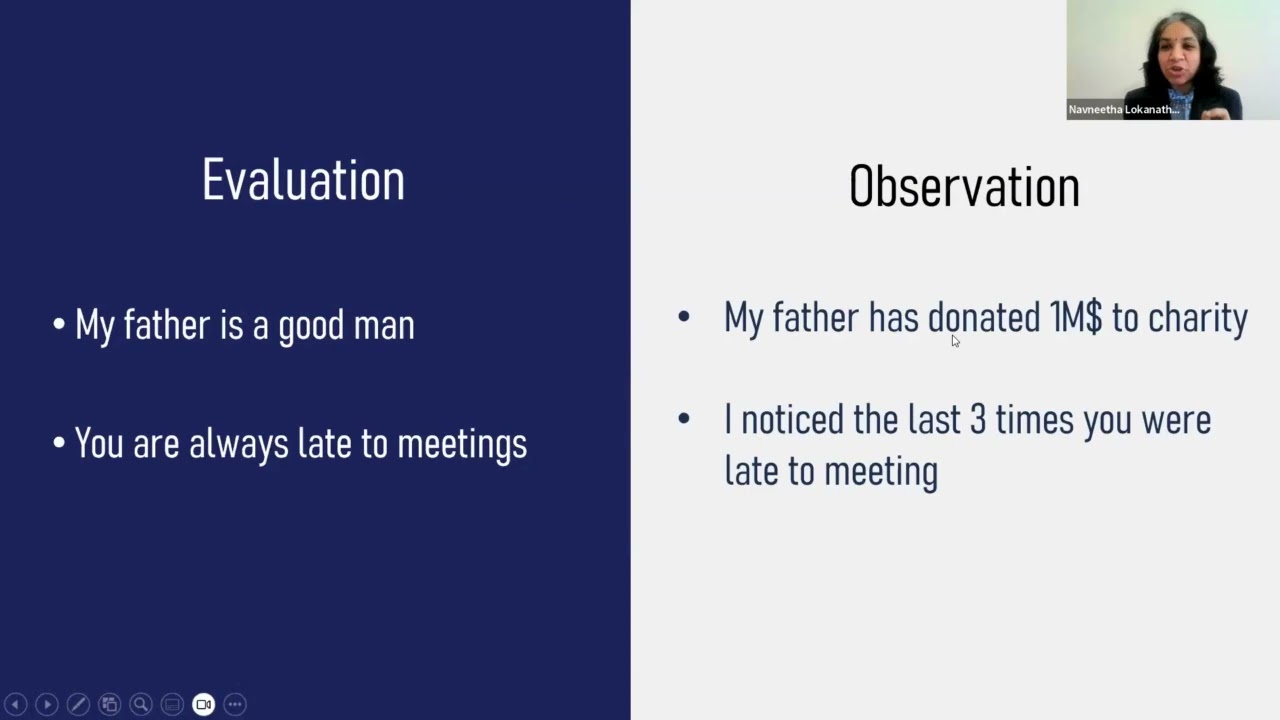
Spune ce s-a întâmplat de fapt, nu opinia ta. În loc să spui că cineva întârzie mereu la ședințe, spune că a întârziat la ultimele trei ședințe.
De ce trebuie cererile să fie specifice și pozitive?
Un șir de „nu face” îi lasă pe oameni nesiguri ce să facă, iar cererile vagi au efect opus. În exemplul ei, o soție i-a cerut soțului să petreacă mai puțin timp la muncă, iar el s-a înscris la golf, deși ea își dorea timp împreună cu el.
Povestea cu golful: cererile vagi au efect opus (55 s)
So yes, I welcome you all to this session, becoming an expert in giving feedback. Good morning. Good afternoon. Good evening from wherever you are connecting. So tell me how many of you find it difficult to give feedback, especially when it comes to giving feedback that needs some improvement in others performance or some change in their behavior. How many of you find it difficult to give such sort of feedback? Can you see it in the chat? Yeah.
In the trainings that I conduct, you know what, when I ask this question, people say out of like 20 people, almost 12 to 13 people say that I find it difficult to give feedback. And that is almost more than 50 percentage, right? So let's get practical now. And let me give you a situation. And can you write a feedback? Let's see how it turns out. Are you in for that?
Yeah, Elaine, I hear you. Okay, so let me give you a situation. So the situation is, let's assume you are the team lead. You are the team lead and one of your team members doesn't, you know, doesn't hold on to the commitments he had made. Okay. And this is affecting you and the team. Let's see how will you give feedback for this particular person for this particular scenario.
All right. So let's take a couple of minutes to write the feedback. Once you're done, you can put your feedback in the chat box. Let's see. Giving feedback can be worse. Sarah, yes. But with right techniques, it can, it need not be worse. Okay, your time starts now to write the feedback. So if you want to know the situation again, for people who have joined just now, you are the team lead, and one of your team members doesn't stick to the commitments he has made when it comes to group work.
And it is affecting you and it is affecting you and the team. And how will you give the feedback in this scenario? Write down your feedback and paste it in the chat. Uh-huh. I got it, Selena. Come on, keep it going. Could you prioritized? Try to prioritize. Okay. Anybody else? Like, what feedback have you returned? Please put it in the chat box so that all of us can learn together.
Yeah. I hope we have. Yes. Yes, yes, yes. Keep it coming in. And you're all right, you know, when we say it is difficult to give feedback. Why? Because feedback can make or break a relationship with a team member or a colleague, right? When managed effectively, feedback can bring that high talent, bring that high potential into the workplace.
It can lead to high collaboration. So what are some of the mistakes we make when giving feedback? Let me share my screen with you now. What do you think are some of the mistakes we make in giving feedback? Can I see some of your answers in the chat box? Blaming people exactly what? What else? What are the common mistakes we make in giving feedback?
Yes, absolutely, Sarah. And telling people they are responsible for our feelings, right? Not giving enough praise. Yes. If you have any questions, you can put it in the Q&A box available and we will take it up at the end of this session. So I see some hands raised. you can put it in the Q&A box. Being either too bland or too soft.
Yes, yes, yes. You're all there. So these are some of the common mistakes we make. There are plenty, plentiful mistakes. But to cut short, like, you know, if we have to rate the mistakes that we make in feedback, these are some of the things that stand out. Blaming, right? You did this. Because of you, it got worse, right?
And saying too much. Wrong type of feedback. Sometimes, you know, the fresher, for the fresher, you have just joined in. If you gave him continuously improvements, he would go frustrated, right? So you would have to give some praise over there for a fresher. But for an experienced person, they might be looking for points to improve. So if we are giving a wrong type of feedback, then it is not going to serve the purpose of giving feedback.
And failure to give actionable feedback. What does the other person has to do? Right? And pausing it as judgments, lack of specificity, being too generalized. Feedback on someone instead of their behavior, right? And the pillow issue. What is this pillow issue? Sometimes, we know, right? Like, when we give feedback, we give a positive and negative and a positive, Like a sandwich.
And they say it is a pillow issue because it is like cushioned. The negative, whatever area of improvement is cushioned between the positives. And the thing here is sometimes that may, that may not get noticed by the recipient, right? So these are some of the common mistakes in giving feedback. Okay. I have come across many different ways of giving feedback and most of them are like transactional, There is no human involved in it.
So when it is transactional, what happens is we don't consider how the other person feels when we give this feedback, right? And we don't even consider our own feelings, how we feel when something happens, But to eliminate all these mistakes where in giving feedback, there comes this nonviolent communication, which is what we are going to see in this session.
So anything that makes the other person feel fearful, shameful, or guilt is considered as violent, right? It is considered as violent communication. This nonviolent communication was introduced by Dr. Marshall and he says like, we should not make the other person fearful, shameful, or guiltful when we communicate, right? So nonviolent communication is like, do you know, it is inclusive with empathy, inclusive of our feelings as well our needs, along with considering the other person's needs and wants.
Okay. And NVC is about you and not the other person because we have some unmet needs and that, that is what we expect from the other person. So in NVC method of giving feedback, we are not going to say to the other person that you have done this. Yeah. You have made me feel, you have made me feel bad and you have to change your behavior.
We are not going to blame the other person, but rather we are going to come from our side. So it is not at all about the other person. It is about us, our feelings and our emotions. And when we express in that way, what happens is we, the other person will not become defensive, rather he will listen to what we are saying.
All right. So NVC has four particular steps. Observe, identify your feelings, identify associated needs and request. Okay. Observe is, you will state that factual observations that is affecting you. What is the actual factual situation that is happening? That is what is observed. And what are the feelings associated with yourself? What are the needs, unmet needs? And what is the request?
What do you want the other person to do? All right. So four components in NVC, which are observe and feelings, identifying your feelings, identifying the needs and request. So when it comes to observe, often we confuse it with our evaluation and judgment. Okay. So observe without evaluation, right? How can we do that? How can we observe without evaluating?
Say, for example, saying that my father is a good man is evaluating, right? It is your opinion that he is a good man. But what is the actual thing that has happened? My father has donated $1 million to charity. That is the actual thing that has happened. So this is what observation is. Instead of saying you are always late to meeting, that is your opinion.
But that is not the fact, right? The fact is last three times, the person has come late to the meeting. All right. So when you are giving feedback in any situation, observe and factual statements. Okay. And withdrawing from your evaluations and from giving your own opinions. All right. And the next is feelings. Feelings give us a lot of information about ourselves, right?
Why we feel a certain way. And it is very important to have an emotional audit. What we feel at any particular time, correct? Because feeling tells us like what we like, what we don't like, what we like to have, all that we come to know about feelings. And once you have an emotional audit of what you're feeling, what is that that is affecting you?
Yeah. And what feel it is, what, what is that it is making you feel when you say that? Express it. Correct? It is, feeling is one of the most important components of nonviolent communication. Let us see. See, you irritate me when you leave company documents on the conference room floor. Here, it is wrong because you irritate me.
I'm blaming the other person. Correct? But when you say I am irritated when you leave company documents on the conference room floor, the other person don't have anything to take it down in a defensive way. Rather, they will listen to you. Correct? So one tip when you are expressing your feelings is using the I statements. You see, I am irritated instead of telling you irritate me.
And needs. How are these feelings and needs are connected? Because feelings are the mirror, that says that are there any unmet needs? Okay? If your needs are, all of your needs are met, you will be happy. Correct? If your, some of your needs are not met, you will be, you will be angry, frustrated. Correct? So the needs are the underlying factors of feelings.
So identify what are your underlying needs and express it. Because when you express your needs, most often we have a better chance of getting them met. Okay? See, in this example of leaving company documents on the conference room floor, when we add our needs to it, the other person understands why we say so. Right? because I want our documents to be safely stored and accessible.
Okay? So we saw observe without evaluation, feeling and needs. Be clear about your needs. And finally, request. Identify one actionable item that the other person wants to do, that you want the other person to do. Okay? And request it in clear, positive, concrete action language. When you say, don't do this, people will not, that is not a positive language.
Don't spread company documents on the conference room floor. Like, they don't know why this lady is always like, don't, Yeah? But when you say, could you place the company documents in the locker room? It is very specific. Tell them specifically what action item you want the other person to do. Right? So, nonviolent communication is observe, state the factual observations that is affecting you.
Do not evaluate. Again, I'm using here, but that is a wrong. You have to give it a positive statement as we saw in the request space. And identify your feelings. What are the, what are your feelings associated with it? And identifying what are the needs underlying with it? And what is the request? What is that you want the other person to do?
So with this template, now I invite you to go back and change your feedback for the situation we saw early, earlier. How would you change it? Can I see it in the chat box? If you have to say your observation, your feelings, associated needs and requests. When you say it in this template, what happens is the other person is not blamed.
The other person is not judged. Rather, it invites for understanding, which is what we need in today's working environment. Right? So if you have to change it, how would you change your feedback? Exactly, Sarah, needs are often related to your core values. Thank you. So I'm looking for the changed feedback. Meanwhile, we have four more minutes for this session to get over.
If you have any questions, you can type it in the Q&A box. The floor is open for questions. Thank you, Hamida. So when we are making requests, we need to be clear. What is it we really want? Yeah, there was an, you know, there was a story, a husband and wife were there and that his husband was spending too much of time at his workplace.
So the wife went and told him like, don't spend too much work, too much time at your workplace. Yeah. So what happened? This husband, after two, three weeks, he come and told me, see, I have signed up for the golf course, but actually the wife wanted him to spend the time with her. Right? Since she did not mention what is that she wants specifically, this is what will happen.
Yes. I noticed that we are in getting everything done on time as the team. Could you make sure? Your part in the project is done by end of the week. we are getting there. Yes. Well, I feel stressed when the team deadlines are not met. Please share your timelines with your team so that we could address the workload.
Do you have any questions or any thoughts to say about what we have just discussed? You can type it in the chat box as well. So here, the challenges could be two things. Right? When we have our feelings, we may forget to be in touch with our feelings anytime. So that is one challenge. And another challenge is we may not know, clearly know what we need.
So if we can work on this, it would be much, much better when we give our feedback to our colleagues rather than blaming them. Yes. So thank you everyone for the wonderful participation in, through the chat box. And how do you feel where for your first feedback and this feedback when you have changed it? Yeah. Love it.
We all would want to receive such a feedback where nobody blames us, right? But just points what has to be correct. Isn't it? So thank you. Thank you for your participation. And yes, love it. I don't feel defensive at all. That is the beauty of NVC. And thanks a lot for your participation in this session. Thank you.
Maya, wish you good luck in delivering that difficult feedback. The session will be ending now. Thanks a lot for your participation.
Transcribed automatically; names checked against the speaker record. Select a time to jump there.
Article based on this talk
Cum oferi feedback dificil fără să-i faci pe oameni defensivi?
Navneetha Lokanathan arată cum Comunicarea Nonviolentă transformă învinovățirea într-o cerere clară și factuală pe care colegii o pot auzi cu adevărat.
Pe scurt
Feedbackul dificil eșuează atunci când învinovățește, judecă sau ascunde mesajul real, susține Navneetha Lokanathan, trainer în leadership și comunicare. Răspunsul ei este Comunicarea Nonviolentă (NVC): formulează o observație factuală, numește-ți propriul sentiment, leagă-l de o nevoie nesatisfăcută și fă o singură cerere clară și pozitivă. Formulat astfel, feedbackul invită la înțelegere, nu la defensivă.
Idei principale
Greșeli frecvente în oferirea feedbackului atunci când suntem emoționați
Înțelegerea principiilor NVC
Modalități practice și eficiente de a formula feedbackul
De ce feedbackul dă atât de des greș
Lokanathan începe cu o întrebare simplă: cui îi este greu să ofere feedback care cere o performanță mai bună sau o schimbare de comportament? La propriile ei traininguri, spune ea, aproximativ 12 sau 13 persoane din 20 recunosc acest lucru. Apoi propune un exercițiu practic. Participanții își imaginează că sunt team lead, iar un membru al echipei nu își respectă angajamentele asumate în munca de grup, și scriu feedbackul pe care l-ar oferi.
Miza, explică ea, este mare: „Pentru că feedbackul poate construi sau distruge relația cu un membru al echipei sau cu un coleg, nu-i așa?” (3:15). Gestionat bine, feedbackul poate scoate la iveală un potențial ridicat și poate duce la o colaborare solidă.
Împreună cu publicul, ea alcătuiește o listă de greșeli frecvente: învinovățirea („din cauza ta s-a înrăutățit”), a spune prea mult, a oferi tipul greșit de feedback (un nou venit are nevoie de câteva laude, în timp ce o persoană cu experiență poate dori puncte de îmbunătățire), lipsa unor acțiuni concrete, formularea ca judecată, generalizarea excesivă și comentariile despre persoană în loc de comportament. Ea numește și „problema pernei”, mai cunoscută ca sandvișul de feedback, în care un aspect de îmbunătățit este amortizat între două aspecte pozitive și poate să nu fie observat niciodată de destinatar. La baza multora dintre aceste erori, spune ea, se află un feedback pur tranzacțional, fără atenție la ce simte fiecare persoană.
Ce face comunicarea „violentă”
Pentru a elimina aceste greșeli, Lokanathan apelează la Comunicarea Nonviolentă, pe care o atribuie, așa cum a citat vorbitoarea, lui Dr. Marshall. Definiția ei este directă: „Deci orice o face pe cealaltă persoană să simtă frică, rușine sau vinovăție este considerat violent, nu-i așa?” (7:15).
NVC, explică ea, include empatia, propriile noastre sentimente și nevoi, precum și nevoile și dorințele celeilalte persoane. Esențial, pornește de la cel care vorbește. În loc să-i spui cuiva ce a greșit și cum te-a făcut să te simți, îți descrii propria experiență. Când feedbackul este exprimat astfel, spune ea, cealaltă persoană nu devine defensivă și este mai dispusă să asculte.
Observă faptele, apoi asumă-ți sentimentele
Cei patru pași sunt: observă, identifică-ți sentimentele, identifică nevoile asociate și formulează cererea. Primul pas este mai greu decât pare, pentru că oamenii confundă observația cu evaluarea. A spune „tatăl meu este un om bun” este o opinie; a spune că a donat bani unei organizații caritabile este o observație. Versiunea de la locul de muncă: „Dar acesta nu este faptul, nu-i așa? Faptul este că, în ultimele trei rânduri, persoana a întârziat la ședință.” (10:19).
Urmează sentimentele. Lokanathan recomandă un „audit emoțional” pentru a observa ce simți și ce provoacă acest sentiment, deoarece sentimentele dezvăluie ce ne place și ce nu. Ea pune în contrast „mă iriți când lași documentele companiei pe podeaua sălii de conferințe” cu „sunt iritat când lași documentele companiei pe podeaua sălii de conferințe”. Sfatul ei: „Deci un sfat când îți exprimi sentimentele este să folosești afirmații la persoana I. Vedeți, «sunt iritat» în loc de «mă iriți».” (11:38).
Numește nevoia, apoi fă o cerere clară
Sentimentele, spune ea, sunt o oglindă a nevoilor. Când nevoile sunt satisfăcute, ne simțim mulțumiți; când nu sunt, ne simțim furioși sau frustrați. „Deci nevoile sunt factorii care stau la baza sentimentelor.” (12:03). Exprimarea nevoii o ajută pe cealaltă persoană să înțeleagă de ce aduci problema în discuție, de exemplu dorința ca documentele companiei să fie depozitate în siguranță și să fie accesibile.
Ultimul pas este o cerere pentru o singură acțiune concretă, într-un limbaj clar, pozitiv și concret. Un șir de „nu face asta” îi lasă pe oameni confuzi cu privire la ce se dorește. „Ai putea pune documentele companiei în vestiar?” funcționează mai bine pentru că este specific. După cum spune ea: „Spune-le exact ce acțiune vrei să facă cealaltă persoană.” (13:28). Ea ilustrează costul cererilor vagi cu povestea unei soții care i-a cerut soțului să nu mai petreacă atât de mult timp la muncă; câteva săptămâni mai târziu, el a anunțat că s-a înscris la golf, deși ea își dorea de fapt timp împreună cu el.
Rescrierea feedbackului cu ajutorul șablonului
Apoi, Lokanathan le cere participanților să își rescrie feedbackul inițial folosind cei patru pași. O variantă rescrisă pe care o citește din chat exprimă stresul resimțit când termenele echipei nu sunt respectate și cere: „Te rog să îți comunici termenele echipei, astfel încât să putem gestiona volumul de muncă.” (16:13). Rostul șablonului, spune ea, este că „Cealaltă persoană nu este judecată. Mai degrabă, este invitată la înțelegere, de care avem nevoie în mediul de lucru de astăzi.” (14:51).
Ea încheie cu două provocări de care trebuie să ținem cont: pierderea contactului cu propriile sentimente în momentul respectiv și lipsa unei imagini clare asupra a ceea ce îți trebuie. Lucrul la ambele, susține ea, face feedbackul mult mai eficient decât învinovățirea. Reacția unui participant la feedbackul reformulat rezumă rezultatul: nu s-a simțit deloc defensiv.
Urmărește prezentarea
„Become an expert in giving difficult feedback” de Navneetha Lokanathan, aproximativ 19 minute: https://www.womentech.net/video/become-expert-in-giving-difficult-feedback
Despre vorbitoare
Navneetha Lokanathan este Leadership & Communication Trainer și Assertiveness Coach cu sediul la Londra, certificată ca life coach și practician NLP, și a instruit peste 800 de persoane în patru ani. Înainte de a trece la training și coaching, a lucrat opt ani în IT ca software developer și team lead în companii multinaționale din India, SUA și Dubai.
Întrebări la care răspunde această prezentare
Care sunt cele mai frecvente greșeli pe care le fac oamenii când oferă feedback?
Ce înseamnă comunicare violentă în NVC?
Care sunt cei patru pași ai Comunicării Nonviolente?
Cum observi fără să evaluezi?
De ce trebuie cererile să fie specifice și pozitive?
Redactat cu AI pe baza transcrierii prezentării. Revizuirea editorială este în așteptare.
Frameworks and ideas mentioned
Nonviolent Communication (NVC)
Feedback sandwich
I statements
Cite this talk
Navneetha Lokanathan. "Become an expert in giving difficult feedback." WomenTech Network, 2023. https://www.womentech.net/video/become-expert-in-giving-difficult-feedback